Clinical Science of Ayurveda: Kapikacchu Parkinson’s Trials, Kutki Liver Studies, and Jatamansi Sleep Efficacy
Clinical Science of Ayurveda: Kapikacchu Parkinson’s Trials, Kutki Liver Studies, and Jatamansi Sleep Efficacy
As modern medicine seeks new solutions for chronic and neurodegenerative disorders, the traditional Indian system of Ayurveda is undergoing an unprecedented wave of clinical validation. This week, we examine major clinical research milestones that bridge ancient herbal wisdom with state-of-the-art medical science. From multicenter clinical trials evaluating Kapikacchu for Parkinson's disease to Phase III trials of Kutki-derived phytopharmaceuticals for fatty liver disease and randomized controlled trials on Jatamansi’s sleep efficacy, peer-reviewed science is confirming the therapeutic power of AYUSH therapies.
🌿 Kapikacchu and Neuroprotection: Parkinson’s Disease Clinical Trials
Kapikacchu (Mucuna pruriens), also known as velvet bean, has been utilized in Ayurveda for millennia under the classification of a Balya (strength-imparting) and Vatahara (Vata-pacifying) agent. Traditionally, it is the primary therapeutic countermeasure for Kampa Vata, a condition characterized by tremors, bradykinesia, and rigidity that corresponds closely with the clinical presentation of Parkinson’s disease (PD). In Ayurvedic pharmacology, Kapikacchu possesses Guru (heavy) and Snigdha (unctuous) attributes, a Madhura (sweet) and Tikta (bitter) taste profile, a warming thermal energy (Ushna Veerya), and a sweet post-digestive outcome (Madhura Vipaka). These characteristics allow the herb to nourish the nervous system deeply and pacify the hyperactive Vata dosha responsible for motor dysfunction.
Modern neuropharmacology has long recognized that Kapikacchu is a rich, natural source of L-dopa (levodopa), the metabolic precursor to dopamine. Unlike synthetic levodopa, which is frequently associated with long-term side effects like motor fluctuations and dyskinesia, the natural L-dopa in Kapikacchu co-occurs with an array of secondary metabolites—including alkaloids, phenolics, and antioxidants—that appear to improve its bioavailability and shield neurons from oxidative stress. This natural molecular synergy provides a smoother therapeutic response and reduces the risk of drug-induced side effects, making it a subject of significant interest for integrative neurology.
A landmark 12-month, randomized, controlled multicenter clinical trial published in the Journal of Parkinson’s Disease in February 2026 has advanced this botanical into mainstream clinical discussion. The study tracked patients with untreated Parkinson’s disease in sub-Saharan Africa, demonstrating that standardized Kapikacchu extracts delivered significant, long-term symptomatic relief and motor improvement. The researchers reported excellent patient tolerability and highlighted the treatment's potential as a highly accessible, cost-effective therapeutic alternative in resource-limited regions. By subjecting this ancient remedy to rigorous clinical methodologies, the trial establishes Kapikacchu as a validated botanical option for progressive neurodegenerative care.
🧪 Kutki Phytopharmaceuticals: Phase III Clinical Trials in Hepatoprotection
Kutki (Picrorhiza kurroa) is one of Ayurveda’s most revered bitter herbs, traditionally indicated for Yakrit Roga (liver disorders), Kamala (jaundice), and chronic fever (Jwara). Classified as a potent Deepana (digestive stimulant), Pachana (digestant), and Bhedana (purgative that clears accumulation), Kutki acts to purge systemic metabolic waste (Ama) from the liver and gallbladder. From a pharmacodynamic standpoint, the herb carries a dominant Tikta (bitter) taste, Laghu (light) and Rooksha (dry) qualities, a cooling energy (Sheeta Veerya), and a pungent post-digestive effect (Katu Vipaka). This combination allows it to pacify both Pitta and Kapha doshas, resolving heat, congestion, and toxic accumulation in the hepatic pathways.
Modern gastroenterology is validating these traditional actions through high-level clinical trials. In 2026, a standardized phytopharmaceutical fraction of Picrorhiza kurroa known as Picroliv, developed by the Council of Scientific & Industrial Research (CSIR), entered Phase III clinical evaluation for the treatment of Non-Alcoholic Fatty Liver Disease (NAFLD), also known as Metabolic Dysfunction-Associated Steatotic Liver Disease (MASLD). Supported by the Indian Council of Medical Research (ICMR), these trials are being conducted across premier medical centers, including AIIMS Delhi, ILBS Delhi, PGIMER Chandigarh, and KEM Hospital Mumbai, representing a significant milestone in bringing traditional pharmacology to mainstream drug approval.
The clinical objective of the Phase III trials is to evaluate Picroliv's ability to reduce hepatic fat infiltration, suppress chronic liver inflammation, and normalize elevated liver enzymes (AST and ALT). The primary active compounds in the formulation, picroside I and II, have been shown to operate via a "reverse pharmacology" mechanism, modulating key lipid metabolism pathways and downregulating pro-inflammatory cytokines. Because NAFLD/MASLD currently lacks widely approved, highly effective conventional drug treatments, this clinical evaluation represents a vital bridge. It transforms Kutki from a traditional remedy into a first-in-class, scientifically standardized phytopharmaceutical that could soon offer global patients a safe, validated solution for metabolic liver disease.
💤 Jatamansi for Sleep: GABAergic Modulation and Clinical Efficacy
Jatamansi (Nardostachys jatamansi), historically referred to as Indian Spikenard, holds a prominent place in Ayurvedic psychiatry and neurology as a Medhya Rasayana (cognitive rejuvenator) and Manasa Prashamana (mind-calming) herb. In classical texts, Jatamansi is indicated for the treatment of Anidra (insomnia), Bhrama (vertigo), and Unmada (emotional distress or cognitive instability). It is unique because it balances all three doshas (Tridosha Shamaka), with a specific affinity for soothing Prana Vata (the sub-dosha of Vata regulating the nervous system and mental functions) and Sadhaka Pitta (the sub-dosha of Pitta regulating emotions and heart functions). Its pharmacology features a mix of bitter, astringent, and sweet tastes (Tikta, Kashaya, Madhura), Laghu (light) and Snigdha (unctuous) attributes, a cooling energy (Sheeta Veerya), and a sweet post-digestive effect (Madhura Vipaka).
Modern scientific investigations in late 2025 and 2026 have focused heavily on clarifying Jatamansi's sleep-promoting and anti-anxiety mechanisms. A randomized controlled clinical trial published in December 2025 compared the sleep-regulatory effects of Jatamansi moola churna combined with Ashwagandha against a placebo in patients suffering from chronic insomnia. The results, assessed using the Pittsburgh Sleep Quality Index (PSQI), demonstrated highly significant improvements in sleep duration, sleep efficiency, and sleep onset latency. The herbal combination was well tolerated and did not produce the morning grogginess or dependence frequently associated with synthetic sedative-hypnotics.
Furthermore, a study published in 2025 evaluated specific synergistic formulations combining Nardostachys jatamansi and Withania somnifera (Ashwagandha). The research revealed that the active compounds—such as jatamansone and valerenic acid—exhibit over 50% sleep-promoting efficacy and reduce cortisol and anxiety levels by more than 30%. Pharmacological assays confirm that these bioactives act by modulating GABAergic and serotonergic pathways in the brain, increasing the availability of calming neurotransmitters to stabilize mood. Additionally, clinical research in early 2026 has investigated Dhupan (Ayurvedic olfactory/fumigation therapy) utilizing Jatamansi for Generalized Anxiety Disorder (GAD). Patients demonstrated a marked decrease in Hamilton Anxiety Rating Scale (HAM-A) scores, proving that Jatamansi’s volatile therapeutic compounds can effectively calm the nervous system through sensory pathways.
📌 The Bottom Line
- mucuna-parkinsons-trials: A 12-month multicenter clinical trial published in early 2026 confirms that Kapikacchu (Mucuna pruriens) provides a safe, highly tolerable, and effective natural L-dopa source for Parkinson's disease management.
- kutki-liver-phytopharmaceutical: The CSIR-developed Kutki extract Picroliv has entered Phase III clinical trials under the ICMR for NAFLD/MASLD, representing a major step toward creating a standardized, regulatory-approved botanical drug for liver disease.
- jatamansi-sleep-anxiety: Clinical trials from late 2025 and 2026 validate Jatamansi (Nardostachys jatamansi) as a potent natural remedy for insomnia and anxiety, showing over 50% sleep efficacy and 30% cortisol reduction via GABAergic modulation.
Disclaimer: The information provided in this post is for educational and informational purposes only. It is not intended to be a substitute for professional medical advice, diagnosis, or treatment. Always seek the advice of your physician or other qualified health provider with any questions you may have regarding a medical condition.
Enjoyed this post?
Get our weekly digest delivered free.
Share this post:
Knowelth is reader-supported. We may earn a commission from links in this article at no extra cost to you. Read our disclosure.
Related Posts
Systems Biology, Circadian Dinacharya, and Gut-Agni Chrono-Nutrition: The Science Validating Ayurvedic Medicine
Systems Biology, Circadian Dinacharya, and Gut-Agni Chrono-Nutrition: The Science Validating Ayurvedic Medicine Modern healthcare is undergoing a paradigm shift from reductionist single-molecule thera…
Clinical Validation in Ayurveda: Cardiometabolic Formulations, Chrononutrition Agni Science, and Ayurgenomics in Ovarian Reserve
Clinical Validation in Ayurveda: Cardiometabolic Formulations, Chrononutrition Agni Science, and Ayurgenomics in Ovarian Reserve Traditional Indian medicine is undergoing a profound scientific renaiss…
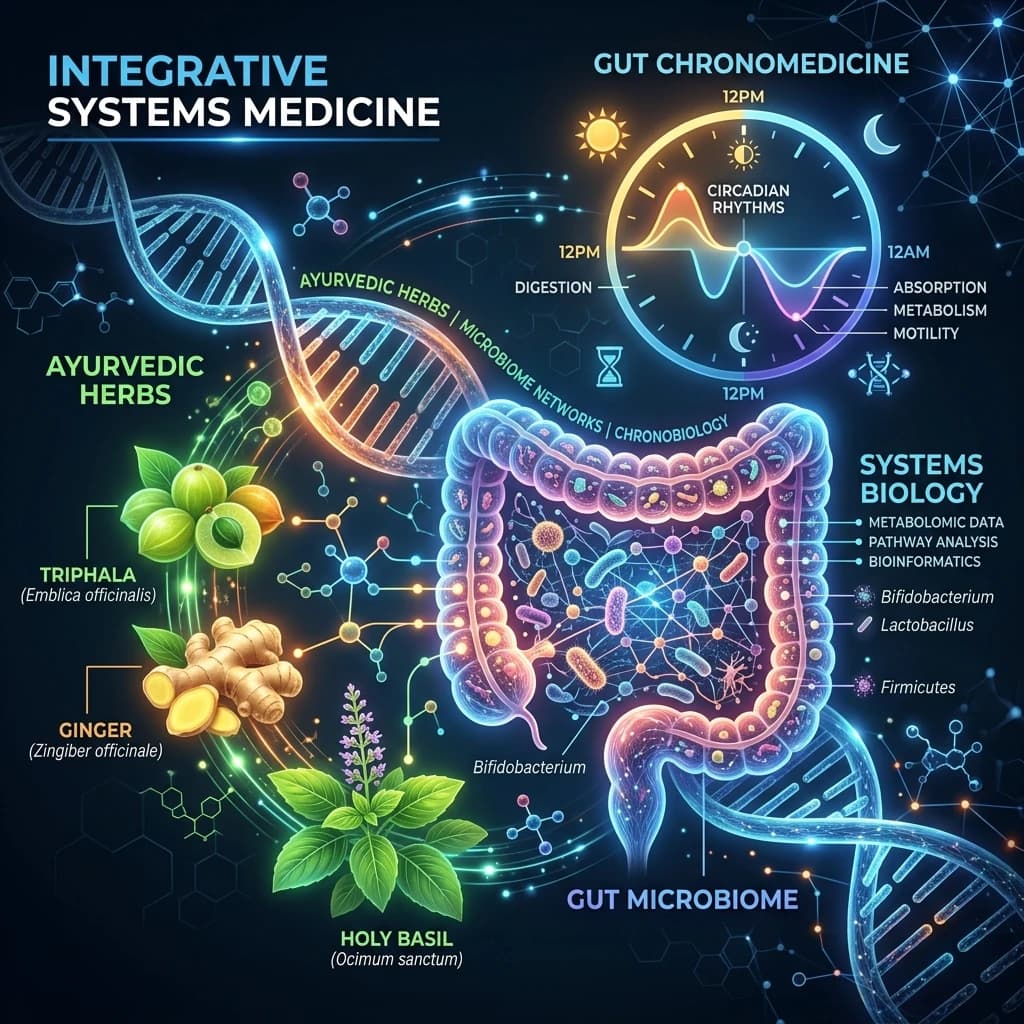
Ayurveda Meets Systems Biology: Agni, Chronomedicine, and Botanical Synergy in Modern Clinical Science
Ayurveda Meets Systems Biology: Agni, Chronomedicine, and Botanical Synergy in Modern Clinical Science The 2025–2026 wave of systems biology research has made an unambiguous statement: the three pilla…