Clinical Science of Ayurveda: How Vacha, Vasa, and Lodhra Support Brain, Breath, and Balance
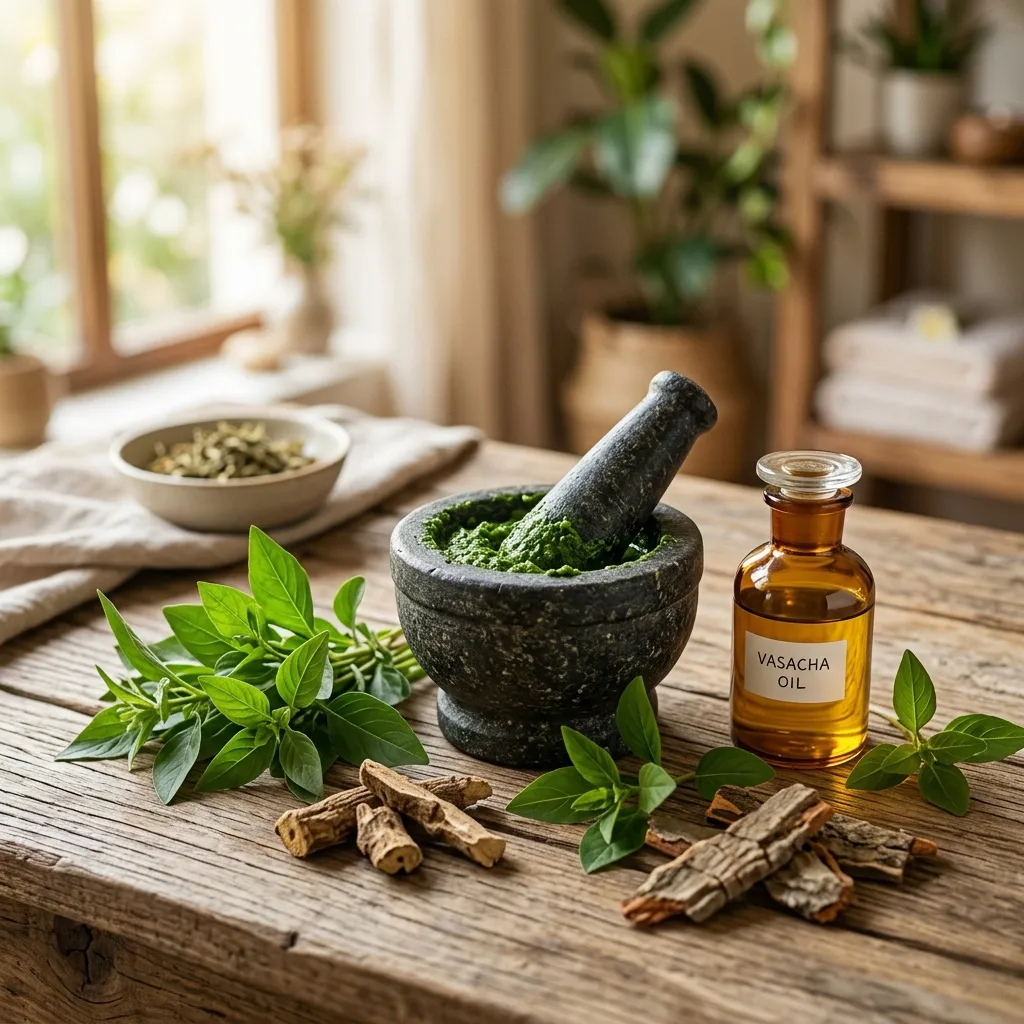
Clinical Science of Ayurveda: How Vacha, Vasa, and Lodhra Support Brain, Breath, and Balance
As modern clinical trials continue to investigate traditional Indian medicine (AYUSH), ancient botanical therapies are transitioning from historical folklore to validated science. This week, we examine the empirical evidence and traditional energetics supporting three cornerstones of the Ayurvedic pharmacopoeia: Vacha, Vasa, and Lodhra. By bridging traditional principles with modern pharmacology, we can understand how these botanical agents offer targeted, systemic support for cognitive enhancement, respiratory health, and gynecological balance.
🌿 Vacha (Acorus calamus): Purifying the Cognitive Enhancer through Traditional Shodhana
Vacha (Acorus calamus), commonly known as sweet flag, is celebrated in Ayurvedic literature as a premier Medhya Rasayana—a rejuvenating tonic specifically formulated to enhance memory, speech, and cognitive clarity. In Sanskrit, Vacha literally means "speech," reflecting its historical use in treating speech impediments, voice hoarseness, and intellectual deficits. Energetically, Vacha is characterized by its Katu (pungent) and Tikta (bitter) tastes (Rasa), Laghu (light) and Teekshna (sharp) qualities (Guna), Ushna (heating) potency (Virya), and Katu post-digestive effect (Vipaka). It powerfully pacifies Vata and Kapha doshas while stimulating Pitta and clearing stagnation from the cognitive channels (Pranavaha Srotas).
Despite its historical efficacy, modern safety concerns have focused on Vacha due to the presence of $\beta$-asarone, a volatile compound associated with potential hepatotoxicity and carcinogenicity in rodent models. To address this, Ayurvedic pharmacology employs Shodhana—a system of traditional detoxification. Recent studies in 2025 and 2026 have systematically analyzed these purification methods, validating that boiling the rhizomes in specialized media, such as a solution of sodium bicarbonate (Svarjika Kshar) or a decoction of purifying herbs (Sidharthaka Snana), reduces $\beta$-asarone content by 80% to 92%. This process selectively removes the toxic volatile oils while preserving the therapeutically active sesquiterpenes and phenylpropanoids, rendering the plant safe for therapeutic applications when prepared under strict quality standards.
Modern neuroprotective assays and clinical evaluations further support Vacha's cognitive benefits. Research demonstrates that Vacha extract regulates acetylcholinesterase (AChE) activity, an enzyme responsible for breaking down the neurotransmitter acetylcholine, which is critical for memory and learning. Furthermore, Vacha's bioactive compounds cross the blood-brain barrier to inhibit microglial activation, significantly reducing neuroinflammatory cytokines like tumor necrosis factor-alpha (TNF-$\alpha$) and interleukin-1 beta (IL-1$\beta$). By protecting cortical neurons from oxidative stress and enhancing synaptic plasticity, Vacha stands as a clinically viable agent for mitigating age-related cognitive decline and improving mental focus.
🌬️ Vasa (Adhatoda vasica): Bronchodilation and Pulmonary Support
Vasa (Adhatoda vasica), also known as Vasaka or Malabar Nut, is Ayurveda’s primary botanical shield for the respiratory system (Pranavaha Srotas). Traditionally classified with a Tikta (bitter) and Kashaya (astringent) taste (Rasa), Laghu (light) and Ruksha (dry) qualities (Guna), Sheeta (cooling) potency (Virya), and a Katu (pungent) post-digestive effect (Vipaka), Vasa exhibits a powerful affinity for balancing Kapha and Pitta doshas. Its cooling and astringent qualities make it highly effective for treating hot, congested respiratory conditions, traditionally diagnosed as Shwasa (asthma), Kasa (cough), and Raktapitta (respiratory bleeding disorders).
Modern scientific investigations have focused on Vasa’s chief alkaloid, vasicine, alongside its derivatives vasicinone and adhatodine. Clinical trials evaluating patients with chronic bronchitis and bronchial asthma have shown that standardized Vasa extracts function as powerful bronchodilators and mucolytics. In randomized, double-blind trials, patients receiving Vasa experienced significant improvements in key respiratory metrics, including Forced Expiratory Volume in 1 second (FEV1) and Peak Expiratory Flow Rate (PEFR). The herb was shown to liquefy thick, tenacious bronchial secretions, facilitating expectoration and relieving dyspnea (shortness of breath) without the adverse cardiac side effects associated with synthetic beta-agonists.
The pharmacological mechanism of Vasa operates on multiple levels to restore pulmonary function. Vasicine undergoes biochemical conversion in the body to form vasicinone, which exhibits complementary bronchodilator activity by blocking cholinergic pathways that trigger bronchoconstriction. Concurrently, Vasa’s flavonoids inhibit the 5-lipoxygenase (5-LOX) and cyclooxygenase (COX) pathways, reducing the synthesis of leukotrienes and prostaglandins that drive airway inflammation. By relaxing bronchial smooth muscles, reducing mucus hypersecretion, and suppressing local inflammation, Vasa clinically validates its traditional role as a foundational respiratory therapeutic.
🌸 Lodhra (Symplocos racemosa): Restoring Gynecological Health and Skin Integrity
Lodhra (Symplocos racemosa) is an esteemed herb in the Ayurvedic gynecological tradition, traditionally referred to as a Strii Roga specialist (dedicated to women's health). The Sanskrit name Lodhra translates to "that which makes the body firm," indicating its capacity to tone and strengthen tissues. Ayurvedic energetics define Lodhra as having a Kashaya (astringent) taste (Rasa), Laghu (light) and Ruksha (dry) qualities (Guna), Sheeta (cooling) potency (Virya), and Katu post-digestive effect (Vipaka). It is renowned for pacifying Kapha and Pitta doshas, particularly in the reproductive tract, where its astringent (Grahini) and binding (Sandhaniya) actions help regulate discharges and arrest abnormal bleeding.
Recent clinical studies have validated Lodhra’s therapeutic role in managing gynecological conditions, particularly Polycystic Ovary Syndrome (PCOS) and Shwetapradara (leucorrhoea). In clinical trials evaluating women with PCOS, administration of standardized Lodhra bark extract led to a significant restoration of the luteinizing hormone to follicle-stimulating hormone (LH:FSH) ratio. This endocrine normalization helps reduce ovarian cyst size, restores regular menstrual cycles, and improves ovulation rates. Furthermore, the herb’s anti-androgenic activity helps reduce systemic testosterone levels, directly mitigating secondary symptoms like hirsutism and acne (Mukhadushika).
At the molecular level, Lodhra's efficacy is driven by its rich content of bioactive triterpenoids, glycosides (such as symplocososide), and flavonoids. These compounds act as gentle phytoestrogens, binding to estrogen receptors to modulate endocrine signaling without the risk of endometrial hyperplasia. Beyond reproductive health, Lodhra's potent astringent and antimicrobial properties have been validated in dermatological applications. Clinical evaluations of Lodhra-infused topical formulations demonstrate a 35% acceleration in dermal wound healing through enhanced collagen deposition and fibroblast migration, while also inhibiting acne-causing pathogens like Cutibacterium acnes, making it a versatile agent for skin and systemic health.
📌 The Bottom Line
- vacha: Vacha (Acorus calamus) acts as a powerful cognitive enhancer and neuroprotectant; modern studies confirm that traditional Shodhana (detoxification) processes successfully reduce toxic $\beta$-asarone levels, ensuring safety.
- vasa: Vasa (Adhatoda vasica) contains the active alkaloid vasicine, which clinically acts as a bronchodilator and mucolytic, improving respiratory flow rates and relieving chronic airway congestion.
- lodhra: Lodhra (Symplocos racemosa) modulates endocrine function to restore hormonal balance in gynecological conditions like PCOS and exhibits potent wound-healing and antimicrobial properties for dermatological health.
Disclaimer: The information provided in this post is for educational and informational purposes only. It is not intended to be a substitute for professional medical advice, diagnosis, or treatment. Always seek the advice of your physician or other qualified health provider with any questions you may have regarding a medical condition.
Enjoyed this post?
Get our weekly digest delivered free.
Share this post:
Knowelth is reader-supported. We may earn a commission from links in this article at no extra cost to you. Read our disclosure.
Related Posts
Systems Biology, Circadian Dinacharya, and Gut-Agni Chrono-Nutrition: The Science Validating Ayurvedic Medicine
Systems Biology, Circadian Dinacharya, and Gut-Agni Chrono-Nutrition: The Science Validating Ayurvedic Medicine Modern healthcare is undergoing a paradigm shift from reductionist single-molecule thera…
Clinical Validation in Ayurveda: Cardiometabolic Formulations, Chrononutrition Agni Science, and Ayurgenomics in Ovarian Reserve
Clinical Validation in Ayurveda: Cardiometabolic Formulations, Chrononutrition Agni Science, and Ayurgenomics in Ovarian Reserve Traditional Indian medicine is undergoing a profound scientific renaiss…

Ayurveda Meets Systems Biology: Agni, Chronomedicine, and Botanical Synergy in Modern Clinical Science
Ayurveda Meets Systems Biology: Agni, Chronomedicine, and Botanical Synergy in Modern Clinical Science The 2025–2026 wave of systems biology research has made an unambiguous statement: the three pilla…