Intricate Stone Masterpieces: Someshvara of Kiradu, Madhukeshwara of Banavasi, and the Kalinga Spires of Mukhalingam
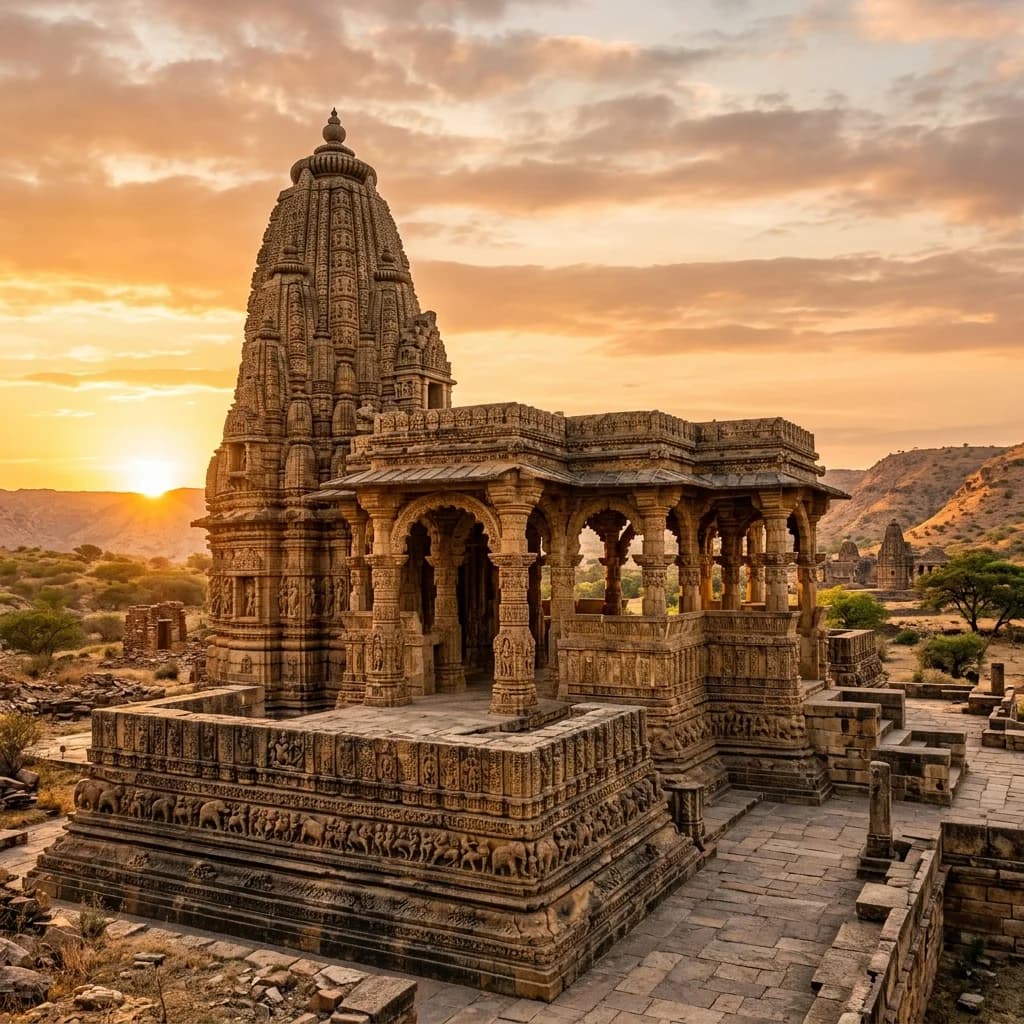
Intricate Stone Masterpieces: Someshvara of Kiradu, Madhukeshwara of Banavasi, and the Kalinga Spires of Mukhalingam
Three temples from geographically distant corners of medieval India — the Someshvara Temple at Kiradu, Rajasthan (Paramara/Chauhan vassals of the Solanki dynasty, c. 11th–12th century CE); the Madhukeshwara Temple at Banavasi, Karnataka (original Kadamba foundation, 4th century CE, expanded by Chalukyas, Hoysalas, and Sonda rulers through the 17th century); and the Mukhalingam complex on the Vamsadhara River, Andhra Pradesh (Eastern Ganga dynasty, 8th–11th century CE) — span 1,300 years of sacred architecture. The Kiradu Someshvara is the finest surviving Maru-Gurjara Shiva temple in the Thar Desert region, its interlocking dry-stone octagonal mandapa and dense sculptural programme (gajathara, asvathara, surasundaris) abandoned mid-construction after the Ghurid invasions of the 1190s. Banavasi's Madhukeshwara is one of South India's oldest continuously worshipped temples — a honey-colored svayambhu Shiva Linga around which architectural layers accreted across 13 centuries, culminating in the 1628 CE stone cot (Kallina Mancha) assembled from 10 interlocking granite panels by the Sonda king Raghu Nayaka. And Mukhalingam's three-temple trikona complex in Rekha Deula style documents the Eastern Ganga dynasty's Pashupata Shaivism — Lakulisa carvings on every major doorframe, three deula types (Rekha, Pidha, Khakhara) within a single campus.
🏛️ Someshvara Temple, Kiradu — The Abandoned Desert Jewel
The Paramara-Solanki Political Context
Kiradu's political history: Kiradu (ancient name: Kiratkoop) served as a major regional centre in the Barmer district of Rajasthan under local Paramara and Chauhan chiefs who held it as vassals of the Solanki (Chaulukya) dynasty of Gujarat. The Solanki dynasty — the same that built Rani ki Vav (1063 CE) and the Modhera Sun Temple (c. 1026 CE) — was the era's preeminent patron of the Maru-Gurjara architectural style.
| Period | Ruling power | Architectural significance |
|---|---|---|
| 10th century CE | Early Paramara chiefs | Initial temple establishment at Kiradu |
| 11th–early 12th century CE | Paramara/Chauhan vassals of Solanki | Major construction: Someshvara Temple (current form) |
| c. 1197–1206 CE | Ghurid invasions (Muhammad of Ghor) | Kiradu abandoned; temples left unfinished |
| 13th century CE onwards | Abandoned | Site uninhabited; desert reclamation begins |
The Ghurid invasion's timing explains why the Someshvara Temple's shikhara is partially ruined — construction stopped mid-process. This makes Kiradu uniquely valuable to architectural historians: it preserves the building process itself (incomplete elements reveal the construction sequence).
Maru-Gurjara Style — Technical Analysis
The Maru-Gurjara synthesis: The Maru-Gurjara style arose in western India (Rajasthan + Gujarat) between the 8th and 13th centuries CE as a synthesis of two distinct regional idioms:
- Maha-Maru (Rajasthan): angular, bold, high-relief sculpture; deep shadow-cutting
- Maha-Gurjara (Gujarat): refined, delicate, more linear sculptural treatment
The resulting Maru-Gurjara style is characterised by:
| Feature | Description |
|---|---|
| Mandapa plan | Octagonal or complex multi-lobed plan (not standard square) |
| Pillars | Ghatapallava (vase-and-foliage) motif; highly stylised brackets |
| Bracket figures | Surasundaris (celestial beauties) in dynamic poses at pillar tops |
| Base mouldings | Multiple horizontal friezes: elephants (gajathara) → horses (asvathara) → humans → deities |
| Shikhara | Dense angashikharas (subsidiary spires) — similar to Kandariya Mahadeva |
| Surface density | Highest in Indian temple architecture — almost no plain stone surface visible |
The octagonal mandapa at Kiradu: The Someshvara's open mandapa (pillared hall) follows an octagonal plan — unusual among Maru-Gurjara temples (most use circular or square). The octagonal geometry:
- Creates 8 equal opening bays, allowing maximum light and ventilation in the desert climate
- Requires each pillar to bear loads from two different angles simultaneously — more complex structural calculation than standard square mandapa
- Produces a 45° diagonal view from any entrance — the deity in the sanctum is visible from multiple approach angles simultaneously
The sculptural programme — density and subject matter:
| Zone | Height from base | Subject | Approx. figure density |
|---|---|---|---|
| Base frieze (lowest) | 0–0.5m | Charging war elephants (gajathara) | 1 figure per 25cm |
| Second frieze | 0.5–1m | Galloping horses (asvathara) | 1 figure per 20cm |
| Third frieze | 1–1.5m | Ramayana + Mahabharata + Krishna-lila narrative | 1 panel per 30cm |
| Wall niche panels | 1.5–2.5m | Major deities (Shiva, Vishnu, Devi aspects) | 3 niches per face |
| Pillar brackets | 2.5–3m | Surasundaris (celestial beauties) | 1 per bracket (48 total) |
| Shikhara base | 3m+ | Angashikharas + Shiva mythology | Continuous programme |
🗿 Madhukeshwara Temple, Banavasi — 1,700 Years of Accreted Architecture
The Kadamba Dynasty — South India's First Sanskrit Kings
Why Banavasi matters historically: Banavasi was the first capital of the Kadamba dynasty — founded by Mayura Sharma (c. 345–365 CE), who is historically significant as the first Brahmin to establish an independent kingdom through military force in South India. The Kadambas were the first to use Sanskrit as a royal administrative language in the Deccan — a precedent followed by every subsequent South Indian dynasty.
The Madhukeshwara Temple's 1,700-year architectural history:
| Period | Dynasty | Contribution |
|---|---|---|
| 4th century CE | Kadamba (foundational) | Original simple shrine; svayambhu Shiva Linga established |
| 6th–8th century CE | Western Chalukya | Stone expansion; Kadamba-Nagara shikhara formalized |
| 12th century CE | Hoysala | Soapstone mandapa additions; sculptural programme |
| 17th century CE (1628 CE) | Sonda kingdom (Raghu Nayaka) | Kallina Mancha (stone cot) donated |
| Ongoing | State + private patronage | Active worship; continual minor additions |
The Svayambhu Honey Linga and the Nandi Alignment
The honey-colored Shiva Linga (Madhukeshwara): The central Shiva Linga at Madhukeshwara is described as madhu (honey) colored — a warm, amber-golden translucency visible under ghee lamp light. In Shaiva tradition, svayambhu lingas (self-manifest, not carved) are considered the most sacred — they are natural stone formations identified as inherently divine. The Banavasi Linga's honey color comes from its specific quartz-feldspar mineral composition, which absorbs and refracts warm light uniquely.
The monolithic Nandi and its geometrically precise alignment:
| Element | Detail |
|---|---|
| Material | Dark grey basalt (high polish) |
| Height | ~2.1m (7 feet) seated |
| Location | Nritya Mandapa (dance hall), facing sanctum |
| Left eye alignment | Gazes directly at the central Shiva Linga |
| Right eye alignment | Points toward the adjacent shrine of Goddess Parvati |
This dual-axis eye alignment — left toward Shiva, right toward Parvati — is an exceptionally precise sculptural achievement. The Nandi's head was carved at a specific compound angle (slightly tilted and rotated simultaneously) to achieve both alignments from the single sculpture's fixed position. This required the sculptor to pre-calculate both sight-line angles before cutting stone.
The Kallina Mancha (stone cot) — 1628 CE engineering:
| Feature | Detail |
|---|---|
| Donor | Sonda King Raghu Nayaka (1628 CE) |
| Appearance | Single block of stone (visual illusion) |
| Actual construction | ~10 interlocking granite panels |
| Dimensions | Full bed scale (~2m × 1m) |
| Decoration | Carved screens (jali-work), deity figures, ornate canopy |
| Symbolic meaning | Shiva at rest; royal devotion to the resting deity |
| Engineering achievement | Interlocking joints so precisely fitted that the seams are invisible at normal viewing distance |
🔱 Mukhalingam Complex — Three Deula Types in a Sacred Trikona
The Three Kalinga Deula Types
The Kalinga architectural tradition (Odisha + coastal Andhra) is unique in formally classifying temples into three distinct structural types — all three appear within the Mukhalingam complex:
| Deula Type | Tower Profile | Shrine Association | Examples |
|---|---|---|---|
| Rekha Deula | Curvilinear (rekha = line); continuously tapering shikhara | Primary Shiva/Vishnu shrines | Lingaraja (Bhubaneswar), Mukhalingam Madhukeshwara |
| Pidha Deula | Stepped pyramidal (horizontal pidha layers); flat top | Assembly halls (jagamohana) + subsidiary shrines | All Odisha jagamohanas |
| Khakhara Deula | Barrel-vaulted roof; oblong plan (like an inverted boat keel) | Shakta (Goddess) shrines only | Vaital Deula (Bhubaneswar), Mukhalingam Khakhara examples |
The presence of all three types within a single complex at Mukhalingam is exceptional — it indicates the complex served multiple sectarian communities simultaneously (Shaiva in Rekha Deulas, Shakta in Khakhara Deula).
Mukhalingam complex specifications:
| Temple | Deity | Deula type | Patron | Date |
|---|---|---|---|---|
| Madhukeshwara | Shiva (primary; Mukhalingam) | Rekha Deula | Kamarnava II Eastern Ganga | Late 8th c. CE |
| Someswara | Shiva (lunar aspect) | Rekha Deula | Immadi Vajrahasta Eastern Ganga | 9th c. CE |
| Bhimeswara | Shiva (fierce aspect) | Rekha + Pidha | Later Eastern Ganga kings | 10th–11th c. CE |
| Khakhara shrines | Goddess (Shakta) | Khakhara Deula | Various | 9th–10th c. CE |
Pashupata Shaivism — the theological programme: Lakulisa (lagu = staff; isa = lord) is the historical founder of the Pashupata Shaiva sect (c. 2nd century CE) — one of the oldest organised Shaiva movements. His iconography: a dwarf-like figure holding a staff, often with an erect phallus (indicating ascetic liberation from conventional norms). At Mukhalingam:
- Lakulisa carvings appear on every major temple doorframe — indicating the complex was managed by Pashupata Shaiva priests
- This is direct archaeological evidence of Pashupata institutional presence in coastal Andhra in the 8th–11th centuries
- The Pashupata sect was later largely absorbed into the Veerashaiva/Lingayat movement (12th century) — Mukhalingam's carvings are among the last major southern Pashupata architectural statements
📌 The Bottom Line
- kiradu-someshvara-maru-gurjara-paramara: Paramara/Chauhan vassals of Solanki, c. 11th-12th c.; abandoned incomplete mid-construction (Ghurid invasions c. 1197-1206) → preserves building process (unique historical value); Maru-Gurjara synthesis: Maha-Maru (bold/angular) + Maha-Gurjara (refined/linear); octagonal mandapa: 8 equal bays + multi-angle deity visibility + compound structural load calculation; sculptural density: highest in Indian temple architecture — gajathara (1 figure/25cm) → asvathara → epic narratives → deity niches → 48 surasundari bracket figures.
- banavasi-madhukeshwara-kadamba: Kadamba dynasty (c. 345 CE) = South India's first Sanskrit royal language users; 1,700-year accreted architecture: Kadamba foundation → Chalukya expansion → Hoysala soapstone mandapa → 1628 CE Kallina Mancha; honey-colored svayambhu quartz-feldspar Linga; 2.1m dark basalt Nandi: compound-angle head sculpture (left eye=Linga, right eye=Parvati shrine simultaneously); Kallina Mancha: ~10 interlocking granite panels with invisible joints = appears as single stone block.
- mukhalingam-eastern-ganga-kalinga: Three Kalinga deula types in one campus: Rekha Deula (curvilinear, Shiva/Vishnu primary) + Pidha Deula (stepped pyramid, assembly halls) + Khakhara Deula (barrel-vault, Shakta shrines only) = Shaiva + Shakta communities simultaneously; Kamarnava II Eastern Ganga (late 8th c.) + Immadi Vajrahasta continuations; Lakulisa (Pashupata sect founder) carvings on every doorframe = institutional Pashupata Shaiva management; one of last major southern Pashupata architectural statements before Lingayat absorption (12th c.).
📬 Stay Updated
Explore India's extraordinary architectural heritage with weekly deep dives. Subscribe to our free newsletter →
Disclosure: This post contains affiliate links. If you purchase through our links, we earn a small commission at no extra cost to you. We only recommend products we believe in.
Enjoyed this post?
Get our weekly digest delivered free.
Share this post:
Knowelth is reader-supported. We may earn a commission from links in this article at no extra cost to you. Read our disclosure.
Related Posts
Stone Chronicles of Sovereignty and Democracy: The Epigraphic Legacy of Aihole's Meguti Temple, Uttiramerur's Assembly Inscriptions, and the Royal Reliefs of Hampi's Hazara Rama
Stone Chronicles of Sovereignty and Democracy: The Epigraphic Legacy of Aihole's Meguti Temple, Uttiramerur's Assembly Inscriptions, and the Royal Reliefs of Hampi's Hazara Rama Across the diverse lan…
Monolithic Cliffs, Alpine Spires, and Chariots of Stone: The Architectural Feats of Dhamnar, Baijnath, and Melkadambur
Monolithic Cliffs, Alpine Spires, and Chariots of Stone: The Architectural Feats of Dhamnar, Baijnath, and Melkadambur Across the vast geographical expanse of the Indian subcontinent, ancient and medi…
Sacred Corridors, Interlocking Stone Chains, and Thousand-Pillar Sanctuaries: The Architectural Marvels of Rameswaram, Kanchipuram, and Moodabidri
Sacred Corridors, Interlocking Stone Chains, and Thousand-Pillar Sanctuaries: The Architectural Marvels of Rameswaram, Kanchipuram, and Moodabidri Across the Indian subcontinent, sacred architecture r…