Sensex Rallies 553 Points, RBI Proposes Bank Board Overhaul, Rupee Hovers Near 96.20
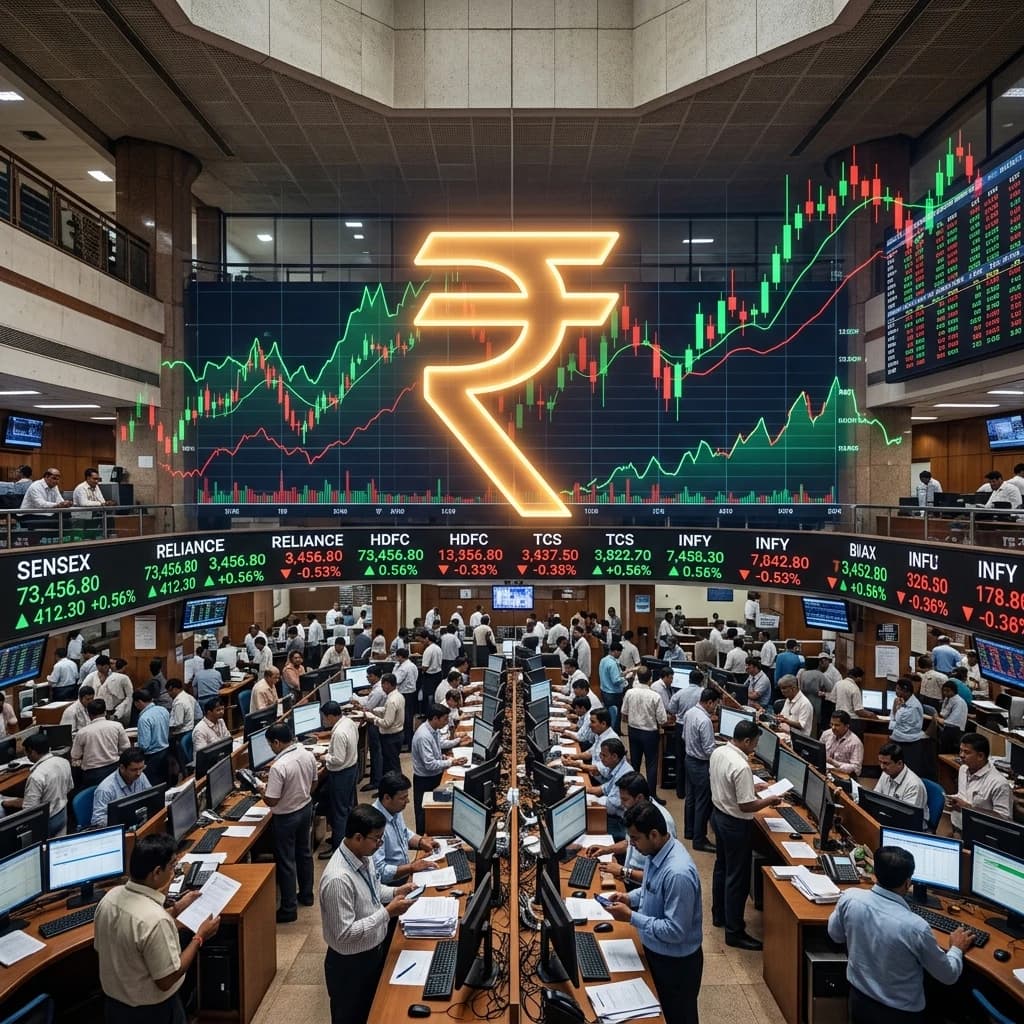
Sensex Rallies 553 Points, RBI Proposes Bank Board Overhaul, Rupee Hovers Near 96.20
Indian financial markets staged a strong recovery on Wednesday, July 15, 2026, as cooling inflation figures in the United States revived global risk appetite. The benchmark BSE Sensex surged over 550 points in early trade, tracking global peers, while the Reserve Bank of India (RBI) captured attention with significant regulatory proposals targeting bank board governance and foreign currency inflows. Despite the risk-on mood, the Indian Rupee remained volatile, hovering close to the 96.20 mark against the US Dollar.
📊 Equities Rebound as Softer US Inflation Sparks Global Rally
Indian equity benchmarks recovered sharply from the previous session's sell-off, tracking a strong overnight rally on Wall Street. The BSE Sensex jumped 553 points, or 0.72%, to touch an intraday peak of 77,603.57 in early trading, while the broader NSE Nifty 50 climbed 148.15 points, or 0.61%, to trade at 24,198.40. The market sentiment was bolstered by US retail inflation cooling to 3.5% in June — below the consensus estimate of 3.8% — raising expectations that the Federal Reserve might adopt a less aggressive interest rate path.
The rally was led by banking and financial service heavyweights, which saw strong institutional buying following the prior day's corrections. HDFC Bank, ICICI Bank, and Axis Bank recovered 1.2%–1.8% each, while PSU bank names including SBI and Bank of Baroda gained between 1.5% and 2.2%. However, the gains were capped by persistent weakness in the technology sector; the Nifty IT index declined by nearly 2% following a disappointing earnings forecast from global tech giant IBM, dragging down major domestic IT companies like Infosys and Wipro.
Market breadth improved decisively from Tuesday's broad-based selling. On the NSE, 1,680 stocks advanced against 780 declining — an advance-decline ratio of over 2:1, confirming genuine broad-market participation in the recovery. India VIX pulled back 3.8% to 15.52, signalling a reduction in near-term hedging demand as the geopolitical anxiety premium partially unwound after the US inflation surprise.
🔬 Technical Picture: Nifty Reclaims Key Short-Term Moving Average
Wednesday's recovery pushed the Nifty 50 back above the 24,150–24,200 zone, reclaiming the 20-day EMA that it had violated the previous session. This is a technically important achievement — the reclamation of the 20-day EMA on a single-day bounce signals that Tuesday's sell-off was a sharp but temporary reaction rather than the beginning of a structural breakdown.
The RSI-14 recovered from its oversold approach at 38.5 the prior day to 44.2 by mid-session Wednesday, entering a neutral zone that suggests the worst of the selling pressure has likely abated in the short term. MACD histogram bars are still in negative territory but are narrowing, which is an early sign of momentum stabilisation.
Key levels to watch:
- Immediate resistance: 24,350–24,400 (50-day EMA and previous consolidation zone)
- Key support: 24,000 (major psychological and options market anchor)
- Bullish confirmation trigger: A daily close above 24,500 on strong volume would confirm resumption of the broader uptrend
🏦 RBI Proposes Banking Governance Overhaul and DII Investment Ease
In a move aimed at enhancing the operational efficiency of the banking sector, the Reserve Bank of India (RBI) proposed draft guidelines to overhaul bank board governance. The central bank's proposals aim to shift the focus of commercial bank boards away from routine administrative and compliance tasks toward long-term strategy, risk management, and corporate culture. The RBI suggested that bank boards should set up specialized committees to oversee operational resilience, cybersecurity, and technological risks, particularly with the rapid adoption of artificial intelligence in financial services.
Simultaneously, the central bank proposed easing investment norms for Domestic Institutional Investors (DIIs) looking to acquire equity stakes in private sector banks. Under the proposed rules, the ceiling for DII shareholdings without requiring prior RBI approval could be raised, which is expected to facilitate capital raising for mid-sized private lenders. However, to prevent concentration risk and ensure compliance, the RBI plans to tighten disclosure requirements, requiring banks to submit detailed quarterly reports on beneficial ownership and voting rights.
Banking analysts view the governance overhaul proposals as a long-term structural positive for Indian banks. Historically, when bank boards have been overly preoccupied with day-to-day compliance, strategic misalignments have resulted — a pattern that contributed to elevated NPA cycles in the 2015–2020 period. By redirecting board attention to strategy, cybersecurity (an increasing threat as digital transactions surge), and AI risk management, the RBI is effectively future-proofing the governance architecture of India's banking system.
The proposed DII investment norm relaxation is particularly significant for mid-tier private banks like Federal Bank, Karur Vysya Bank, and RBL Bank, which have struggled to attract large institutional anchor investors due to existing cap restrictions. Easing these limits would make it easier for these banks to raise growth capital through domestic institutions, reducing dependency on foreign capital for balance sheet expansion.
💵 Rupee Under Pressure Near 96.20; RBI Mulls FCNR(B) Hedging Support
Despite the positive momentum in the equity markets, the Indian Rupee (INR) continued to experience pressure, trading in a volatile range between 96.18 and 96.30 against the US Dollar (USD). The domestic currency opened slightly stronger following the US inflation data but quickly surrendered gains due to robust dollar demand from oil marketing companies and persistent hedging costs. The local unit closed the morning session at 96.23 against the greenback, remaining close to its recent multi-month lows.
To counter the currency's depreciation and boost foreign exchange reserves, the RBI held high-level discussions with commercial bank chiefs regarding Foreign Currency Non-Resident FCNR(B) deposit schemes. Sources close to the development revealed that the central bank is considering offering to absorb or subsidize a portion of the hedging costs for these deposits. By reducing the hedging premium for banks, the RBI hopes to make FCNR(B) deposits highly attractive to Non-Resident Indians (NRIs), potentially drawing in billions of dollars in foreign currency inflows.
This is not a new playbook — the RBI deployed a similar FCNR(B) scheme in 2013 during the "taper tantrum" episode, when the rupee depreciated sharply following the US Federal Reserve's signals of quantitative easing tapering. That 2013 scheme successfully mobilized over $34 billion in NRI deposits within three months, providing critical support to the rupee and shoring up India's forex reserves. A 2026 repeat of this intervention — if executed — would likely attract $15–25 billion in NRI deposits and provide meaningful support to the rupee over the following 6–12 months.
💡 Investor Takeaway: A Temporary Bounce or Trend Reversal?
Wednesday's 553-point Sensex rally needs to be contextualised carefully. The trigger — soft US inflation data — is a global factor that lifts all equity markets equally and does not specifically improve India's domestic earnings outlook. The underlying headwinds — elevated crude oil, above-target domestic inflation, and persistent FII outflows — remain firmly in place.
For Indian equity investors, the key question is whether the bounce can sustain above 24,200 on the Nifty 50 without a fresh catalyst. Historically, post-geopolitical-shock bounces in Indian markets tend to fade within 2–5 trading sessions if the original trigger (Middle East tensions) hasn't resolved. The US-Iran situation remains fluid, and any fresh escalation could re-ignite crude prices and FII outflows.
Investment strategy for the near term:
- Reduce risk in high-beta names (small/mid-cap, metals, PSU banks) on bounces
- Accumulate quality defensives (FMCG, Pharma, IT majors) on further dips
- Monitor the 10-year IGB yield — if it rises above 7.0%, it would signal bond market distress and could trigger a broader equity risk-off
📌 The Bottom Line
- equities-rebound-us-inflation: The Sensex surged 553 points to 77,603.57 and Nifty climbed 148.15 points to 24,198.40 as US June CPI cooled to 3.5%, below the 3.8% consensus. Nifty IT dragged -2% on IBM's earnings disappointment.
- rbi-bank-board-overhaul: The RBI proposed governance reforms to refocus bank boards on strategy and cybersecurity risk, while also easing DII stake acquisition ceilings for private banks — a structural positive for mid-tier lenders.
- rupee-volatility: The Indian Rupee remained at 96.23 per USD despite the equity rally. The RBI is exploring FCNR(B) deposit incentives, a proven playbook used in 2013 to attract $34 billion in NRI inflows and defend the rupee.
📬 Stay Updated
Get India market analysis delivered to your inbox every trading day. Subscribe to our free newsletter →
Disclosure: This post contains affiliate links. If you purchase through our links, we earn a small commission at no extra cost to you. We only recommend products we believe in.
Enjoyed this post?
Get our weekly digest delivered free.
Share this post:
Knowelth is reader-supported. We may earn a commission from links in this article at no extra cost to you. Read our disclosure.
Related Posts
India Markets Daily: Sensex Rebounds to 78,080 as Nifty Drags, RBI Proposes Loan Reset Rules, FIIs Sell ₹1,006 Cr
India Markets Daily: Sensex Rebounds to 78,080 as Nifty Drags, RBI Proposes Loan Reset Rules, FIIs Sell ₹1,006 Cr Indian financial markets navigated a divergent trading session on August 13, 2026, as …
India Markets Update: Nifty Drops Below 24,450 Amid Oil Spike, RBI Holds Repo Rate at 5.25%, and FII Inflows Resume
India Markets Update: Nifty Drops Below 24,450 Amid Oil Spike, RBI Holds Repo Rate at 5.25%, and FII Inflows Resume Indian benchmark indices drifted lower for a second consecutive session as global en…
Nifty Snaps 4-Day Rally as Pre-RBI Policy Jitters & Crude Surge Trigger Profit Booking; Bharti Airtel Q1 Profit Soars 37%
Nifty Snaps 4-Day Rally as Pre-RBI Policy Jitters & Crude Surge Trigger Profit Booking; Bharti Airtel Q1 Profit Soars 37% Indian benchmark equity indices snapped their four-session winning streak on A…