Senate Vote on Iran War Powers, Supreme Court Prisoner Rights Ruling, and Treasury AI Finance Framework
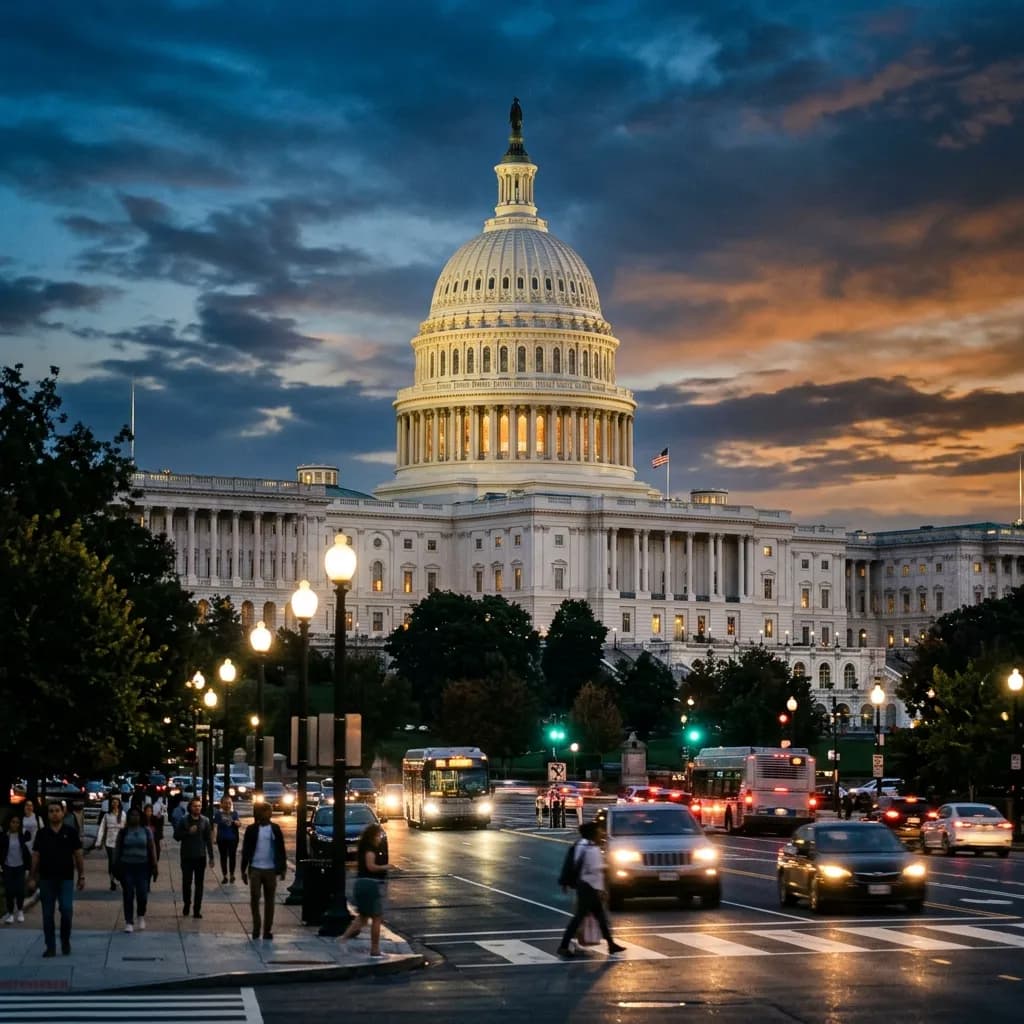
Senate Vote on Iran War Powers, Supreme Court Prisoner Rights Ruling, and Treasury AI Finance Framework
In a series of major developments across Washington, D.C., federal institutions have taken critical steps regarding international conflict, civil liberties, and technological governance. Congress has asserted its constitutional role in war powers, the Supreme Court has set limits on individual liability in civil rights cases, and the Treasury has completed its blueprint for regulating artificial intelligence in financial markets. These actions outline the shifting landscape of U.S. domestic policy and foreign affairs as the nation enters the summer.
🇺🇸 Senate Rebukes President with Bipartisan Iran War Powers Resolution
The United States Senate has passed a concurrent war powers resolution in a narrow 50–48 vote, directing President Donald Trump to remove American military forces from hostilities against Iran. The resolution states that U.S. forces must be withdrawn unless Congress formally declares war or provides explicit statutory authorization.
The vote represents a notable bipartisan rebuke of the executive branch's military strategy. Four Republican senators—Susan Collins of Maine, Bill Cassidy of Louisiana, Lisa Murkowski of Alaska, and Rand Paul of Kentucky—joined nearly all Democrats in supporting the measure. Pennsylvania Democrat John Fetterman broke ranks to vote against it. The resolution's passage was aided by the absence of Republican Senators Mitch McConnell and Dave McCormick, which narrowed the margin required for a majority.
Although the House of Representatives has already passed a matching resolution, this concurrent measure is widely considered symbolic. Because it does not require the President's signature, it lacks the force of binding law. However, lawmakers used the floor debate to express deep concerns over the escalating costs of the conflict and the terms of the tentative Memorandum of Understanding (MoU) regarding United States-Iran nuclear inspections. President Trump reacted swiftly on Truth Social, criticizing the supporting senators and pledging to maintain his foreign policy course.
⚖️ Supreme Court Rules on Prisoner Religious Rights and Monetary Damages
In a 6–3 decision, the U.S. Supreme Court ruled in Landor v. Louisiana Department of Corrections and Public Safety that former inmates cannot sue individual prison officials for monetary damages under the Religious Land Use and Institutionalized Persons Act (RLUIPA).
The case originated from a 2020 incident involving Damon Landor, a devout Rastafarian. Landor, who has adhered to a Nazarite vow requiring him to leave his hair uncut for two decades, was transferred to the Raymond Laborde Correctional Center. Despite providing documentation of his beliefs and citing prior legal precedents, prison guards restrained Landor and forcibly shaved off his dreadlocks. Upon his release, Landor filed suit seeking damages from the guards in their individual capacities.
Writing for the majority, Justice Neil Gorsuch explained that because RLUIPA was enacted under the Spending Clause of the Constitution, it functions as a contract between the federal government and recipient states. Since individual officers are not parties to this contract, they cannot be held personally liable for monetary damages under the statute. In her dissent, Justice Ketanji Brown Jackson, joined by Justices Sonia Sotomayor and Elena Kagan, argued that the ruling leaves victims of clear religious freedom violations "remediless" and reduces the incentive for prison guards to respect federal civil rights laws.
🤖 Treasury Department Establishes Final AI Framework for Financial Services
The U.S. Department of the Treasury, in cooperation with the Financial Stability Oversight Council (FSOC), has officially concluded its "Artificial Intelligence (AI) Innovation Series." Launched to study the integration of machine learning in the financial services sector, the series finished its final round of public-private consultations on June 24, 2026.
The series comprised four roundtables held throughout the spring, addressing key topics:
- Strategy & Governance Principles: Establishing standards for responsible machine learning deployment.
- Value Generation & Efficiency: Exploring business applications and automated workflows in banking.
- Cybersecurity & Risk Management: Hardening defenses against adversarial attacks and data leaks.
- Financial Stability: Evaluating the systemic risks posed by algorithmic trading and centralized AI models.
The completion of the innovation series coincides with the administration's broader push for technological oversight. Earlier this month, President Trump issued Executive Order 14409, which directs federal departments to review "covered frontier" AI models and upgrade cybersecurity standards. Simultaneously, the Internal Revenue Service (IRS) Office of Professional Responsibility issued introductory guidelines outlining the ethical responsibilities of tax practitioners using generative AI. The Treasury plans to use the roundtables' findings to formulate concrete regulatory policies in the coming months.
📌 The Bottom Line
- iran-war-powers: The Senate passed a symbolic bipartisan resolution to halt military action in Iran, signaling deep congressional division over the President's unilateral foreign policy decisions.
- scotus-prisoner-rights: The Supreme Court ruled that federal law does not permit prisoners to recover money damages from individual guards for religious freedom violations, limiting civil rights recourse under RLUIPA.
- treasury-ai-finance: The Treasury Department concluded its AI Innovation Series, establishing a foundation for upcoming regulatory policies to govern artificial intelligence in financial systems.
Enjoyed this post?
Get our weekly digest delivered free.
Share this post:
📌 Disclosure: This post may contain affiliate links. If you make a purchase through our links, we may earn a commission at no extra cost to you. We only recommend products we believe in. See our Affiliate Disclosure.
Related Posts
Fed Hawkish Shift Sparks Affordability Concerns, US Restricts Frontier AI, and Trump Seeks Syria Terror Delisting
Fed Hawkish Shift Sparks Affordability Concerns, US Restricts Frontier AI, and Trump Seeks Syria Terror Delisting The United States is navigating critical transitions across economic, technological, a…

US Strikes Iran After Ceasefire Collapses, Apple-Broadcom Unveil $30B Silicon Deal, and Deere Settles Right-to-Repair
US Strikes Iran After Ceasefire Collapses, Apple-Broadcom Unveil $30B Silicon Deal, and Deere Settles Right-to-Repair The United States faces a pivotal day marked by severe geopolitical escalation in …

US World Cup Defeat, Raman Sworn In at NIST, and Congressional Visit to Taiwan
US World Cup Defeat, Raman Sworn In at NIST, and Congressional Visit to Taiwan The United States has experienced a whirlwind 24 hours across sports, national technology policy, and international di…