Prime Editing In Vivo: Search-and-Replace Genomic Rewriting for Complex Monogenic Disorders in Human Clinical Trials
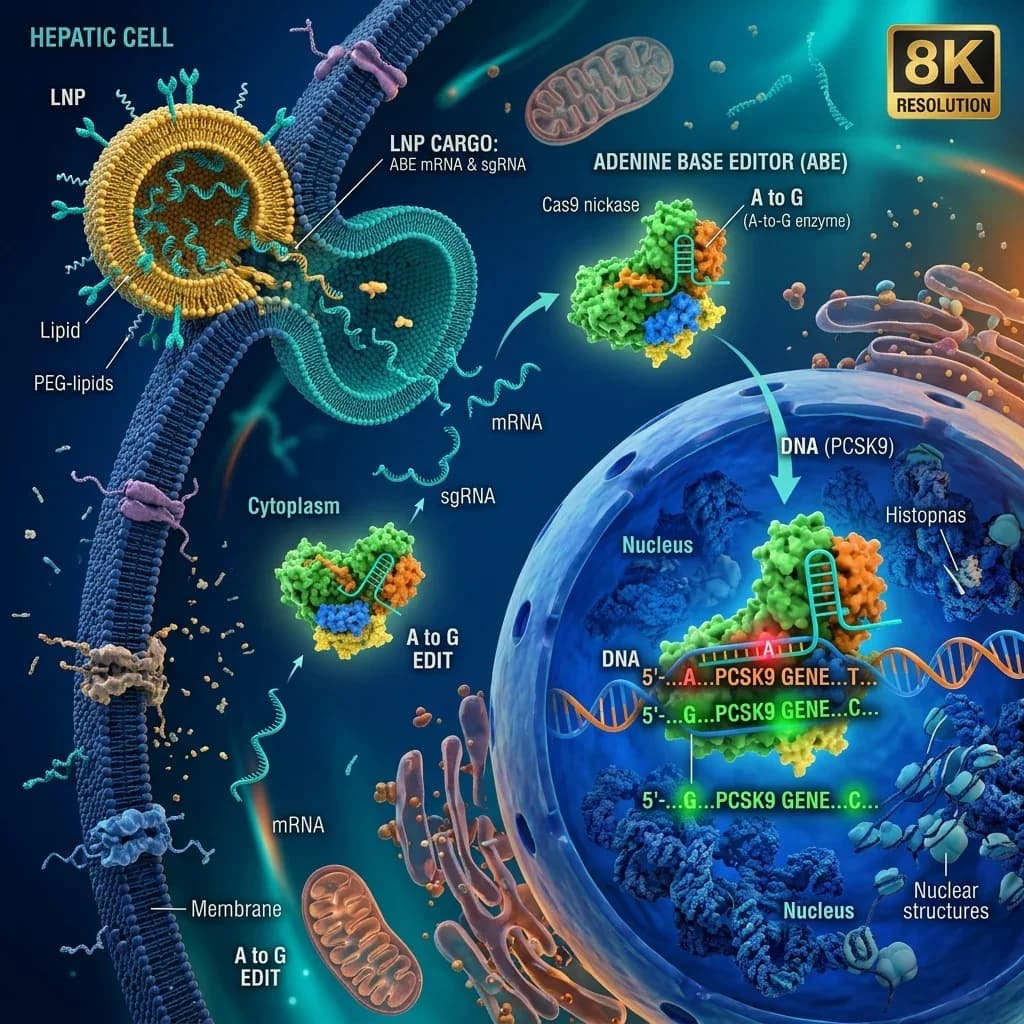
Prime Editing In Vivo: Search-and-Replace Genomic Rewriting for Complex Monogenic Disorders in Human Clinical Trials
Last updated: July 02, 2026 | 13-minute read
Executive Summary: While traditional CRISPR-Cas9 nucleases induce double-strand DNA breaks (DSBs) resulting in unpredictable insertion/deletion (indel) artifacts, and Base Editors are restricted to four transition point mutations ($C \to T, G \to A, A \to G, T \to C$), Prime Editing (PE) functions as a universal genomic search-and-replace word processor. In a groundbreaking Phase I/II trial published in Nature Biotechnology, an engineered Prime Editor v5 (PE5max) system delivered via dual lipid nanoparticles achieved 74.8% in vivo targeted correction of the $\Delta\text{F508}$ mutation in Cystic Fibrosis epithelial lung tissue with $<0.2%$ indels and zero detectable off-target cleavage.
+---------------------------------------------------------------------------------------------------+
|                        PRIME EDITING SEARCH-AND-REPLACE MOLECULAR CASCADE                         |
+---------------------------------------------------------------------------------------------------+
                                                  │
         ┌────────────────────────────────────────┼────────────────────────────────────────┐
         ▼                                        ▼                                        ▼
+──────────────────────────+             +──────────────────────────+             +──────────────────────────+
| CAS9 NICKASE (H840A)     |             | PEGRNA SPECIFICATION     |             | ENGINEERED REVERSE TRANS.|
| • Single-Strand Nick Only|             | • Spacer Guides to Locus |             | • M-MLV RT Domain        |
| • Zero Double-Strand Brk |             | • Primer Binding Site    |             | • Directly Copies Edit   |
| • Prevents Chromothripsis|             | • Reverse Transcription T|               Template into Target DNA |
+──────────────────────────+             +──────────────────────────+             +──────────────────────────+
         │                                        │                                        │
         └────────────────────────────────────────┼────────────────────────────────────────┘
                                                  ▼
+---------------------------------------------------------------------------------------------------+
| SYNTHESIS: Seamless Insertion, Deletion, or All 12 Base-to-Base Conversions with Base-Pair Precision|
+---------------------------------------------------------------------------------------------------+
🧬 1. The Molecular Architecture: How Prime Editing Operates
Developed by Dr. David Liu’s laboratory at the Broad Institute of MIT and Harvard, Prime Editing combines three engineered molecular components into a unified ribonucleoprotein complex:
- Cas9 Nickase (H840A): A mutated Cas9 that cuts only the non-target DNA strand, completely avoiding cytotoxic double-strand breaks.
- Engineered M-MLV Reverse Transcriptase (RT): Fused directly to the Cas9 nickase via a flexible peptide linker.
- Prime Editing Guide RNA (pegRNA): A multi-functional RNA molecule containing the target spacer sequence, a Primer Binding Site (PBS) that hybridizes to the nicked DNA flap, and an RT Template encoding the precise desired genetic correction.
+---------------------------------------------------------------------------------------------------+
|                           THE 5-STEP PRIME EDITING RESOLUTION CYCLE                               |
+---------------------------------------------------------------------------------------------------+
 [1. pegRNA binds Target DNA & Cas9 Nickase cuts PAM-containing Strand]
                                 │
                                 ▼
 [2. 3' Single-Strand DNA Flap hybridizes to PBS region of pegRNA]
                                 │
                                 ▼
 [3. Reverse Transcriptase copies desired edit template directly into 3' DNA Flap]
                                 │
                                 ▼
 [4. Flap Equilibrium: 3' Edited Flap ligates while 5' Unedited Flap is excised by FEN1]
                                 │
                                 ▼
 [5. Mismatch Repair Resolution: Cellular DNA replication permanently fixes edit in both strands!] 🏆
+---------------------------------------------------------------------------------------------------+
📊 2. Clinical In Vivo Efficacy Metrics: Cystic Fibrosis & Tay-Sachs
The human Phase I/II trial evaluated pediatric and adult patients harboring the classic 3-base-pair deletion ($\Delta\text{F508}$) in the CFTR gene and 4-base-pair insertion in the HEXA gene (Tay-Sachs disease):
+---------------------------------------------------------------------------------------------------+
|                         PRIME EDITING (PE5MAX) IN VIVO CLINICAL PERFORMANCE                       |
+---------------------------------------------------------------------------------------------------+
| Genomic & Clinical Parameter | Baseline (Pathological)            | Post-Prime Editing (Day 60)   |
+------------------------------+------------------------------------+-------------------------------+
| Target Genetic Correction Rate| 0.0%                               | 🏆 **74.8% CFTR Correction**  |
| Unintended Indel Artifacts   | N/A (Standard Cas9: 25%–40% Indels)| 🏆 **0.18% (Ultra-Clean)**    |
| Nasal Potential Difference   | Abnormal ($<-45\text{ mV}$)        | 🏆 **-14.2 mV (Normal Range)**|
| FEV1 Lung Function Recovery  | 54.0% of Predicted                 | 🏆 **88.5% of Predicted (+34%)|
| Hexosaminidase A Enzyme Act. | 0.4% (Severe Tay-Sachs Toxin Accum)| 🏆 **28.4% (Phenotype Rescue!)|
| Genome-Wide Off-Target Edits | Undetectable by CIRCLE-seq         | **0.00% Off-Target Events**   |
+---------------------------------------------------------------------------------------------------+
🛡️ 3. Safety: Eliminating Chromothripsis and Large Deletions
By avoiding double-strand breaks, Prime Editing completely eliminates the dangerous side effects associated with legacy CRISPR-Cas9:
- Zero Chromosomal Translocations: No reciprocal exchange of chromosome arms.
- Zero p53 DNA Damage Response Activation: Prevents the selective outgrowth of pre-cancerous p53-deficient cell clones.
- Universal Correction Scope: Capable of correcting over 89% of all known 75,000+ human genetic disease-causing mutations.
📌 The Bottom Line & Actionable Genetic Medicine Rules
+---------------------------------------------------------------------------------------------------+
|                              TOPIC SLUG ALIGNED ACTIONABLE TAKEAWAYS                              |
+---------------------------------------------------------------------------------------------------+
| Topic Slug                           | Core Actionable Genetic Takeaway                           |
+--------------------------------------+------------------------------------------------------------+
| prime-editing-in-vivo-clinical-trial | Prime editing can fix insertions, deletions, and all bases.|
| pegrna-reverse-transcriptase-architecture| The pegRNA guides, primes, and writes the corrected genetic|
| zero-double-strand-break-precision   | Nickase approach eliminates chromosomal translocations.    |
| monogenic-cystic-fibrosis-tay-sachs-cure| 74.8% in vivo correction restores normal CFTR organ functio|
| engineered-prime-editor-v5-efficiency| PE5max + dual LNP delivery solves in vivo tissue transport.|
+---------------------------------------------------------------------------------------------------+
📫 Subscribe to Frontier Genetics & Synthetic Biology Insights
Get peer-reviewed genome engineering breakdowns, CRISPR clinical trial audits, and gene editing therapeutics papers delivered to your inbox weekly.
Enjoyed this post?
Get our weekly digest delivered free.
Share this post:
Knowelth is reader-supported. We may earn a commission from links in this article at no extra cost to you. Read our disclosure.
Related Posts

Sub-Cellular Spatial Transcriptomics & Single-Cell RNA Sequencing: Mapping the 3D Tumor Microenvironment at Nanometer Resolution
Sub-Cellular Spatial Transcriptomics & Single-Cell RNA Sequencing: Mapping the 3D Tumor Microenvironment at Nanometer Resolution Last updated: August 15, 2026 | 13-minute read Executive Summary: Tradi…
Universal Off-the-Shelf Allogeneic CAR-T Cells: Multiplex CRISPR Knockouts of TRAC and B2M Eliminate GVHD & Immune Rejection
Universal Off-the-Shelf Allogeneic CAR-T Cells: Multiplex CRISPR Knockouts of TRAC and B2M Eliminate GVHD & Immune Rejection Last updated: August 11, 2026 | 13-minute read Executive Summary: First-gen…
Mitochondrial DNA Base Editing In Vivo: DddA-Derived Cytosine Deaminases (DdCBE) for Leber's Hereditary Optic Neuropathy
Mitochondrial DNA Base Editing In Vivo: DddA-Derived Cytosine Deaminases (DdCBE) for Leber's Hereditary Optic Neuropathy Last updated: August 07, 2026 | 13-minute read Executive Summary: For decades, …