Permafrost Carbon Sinks, Nanofaceted Superconductors, and Laser-Enhanced Cryo-EM
Permafrost Carbon Sinks, Nanofaceted Superconductors, and Laser-Enhanced Cryo-EM
Scientific discovery pushed new frontiers this week, challenging our assumptions about climate change and nanoscale engineering. From the high-altitude plains of the Tibetan Plateau to the precise confines of superconductivity and cryo-electron microscopy labs, researchers have unveiled mechanisms that could reshape our climate models, power grids, and biological imaging capabilities. Together, these breakthroughs demonstrate the power of looking at old problems through a new, structurally innovative lens.
🔬 Carbon Sequestration from the Cold: How Thawing Permafrost Accelerates Rock Weathering
As the Earth warms, the thawing of permafrost is widely regarded as a critical climate tipping point—a feedback loop where melting frozen soil releases immense volumes of greenhouse gases into the atmosphere. However, a groundbreaking study published in the journal Nature has revealed a surprising counterweight to this narrative. An international team of researchers has discovered that permafrost degradation on the Qinghai-Tibet Plateau accelerates chemical rock weathering, a geological process that actively absorbs atmospheric carbon dioxide (CO₂). This newfound mechanism acts as a local carbon sink, suggesting that the geological response of our planet's high-altitude regions to warming is far more complex than previously believed.
The study was spearheaded by scientists from Umeå University in Sweden and East China Normal University in China, alongside collaborators from Germany, Switzerland, the United Kingdom, and the United States. To uncover this phenomenon, the research team conducted a comprehensive field investigation across 50 river catchments on the Qinghai-Tibet Plateau, often called the Earth's "Third Pole." By analyzing the chemistry, isotopic signatures, and carbon dioxide concentrations of river waters, the team was able to contrast watersheds characterized by continuous, intact permafrost against those with highly degraded, discontinuous, or isolated permafrost.
At the heart of this process is the sudden exposure of fresh minerals. Think of permafrost as a giant geological freezer; as long as it remains frozen, the minerals inside are locked away from the elements. But as the freezer thaws, water from melting ice and summer rains trickles through the newly exposed soil and rock. Rainwater, which absorbs CO₂ from the air to form a weak carbonic acid, reacts with these freshly exposed silicate and carbonate minerals. This chemical reaction breaks down the rocks, transforming the atmospheric CO₂ into dissolved bicarbonate ions, which are then carried away by rivers. In essence, the thawing ground acts like a giant, natural carbon-scrubbing sponge.
The implications of this discovery are profound for global climate forecasting. The researchers found that in catchments where permafrost was actively fragmenting, the carbon sequestration driven by rock weathering was robust enough to significantly offset—and in some cases, entirely overwhelm—the CO₂ released by riverine organic decomposition. While this geological sink does not cancel out the massive global emissions from thawing tundra, it represents a crucial, previously overlooked negative feedback loop. Incorporating these mineral-weathering kinetics into earth system models will be essential for accurately projecting the future of the Third Pole and our planet's climate trajectory.
⚡ Overcoming the Critical Barriers: Nanofaceted Substrates Enhance Superconductivity
Superconductors hold the promise of a technological revolution, offering the ability to transmit electricity with absolutely zero energy loss. However, these materials are notoriously delicate: push their temperature too high or expose them to a strong magnetic field, and their superconducting state collapses. In a major milestone for materials science, physicists at the Chalmers University of Technology in Sweden have demonstrated a novel way to strengthen superconductors. By manipulating the nanoscale structure of the substrate upon which a superconductor is grown, the researchers dramatically enhanced its tolerance to both heat and magnetic fields, charting a new path for next-generation quantum and power electronics.
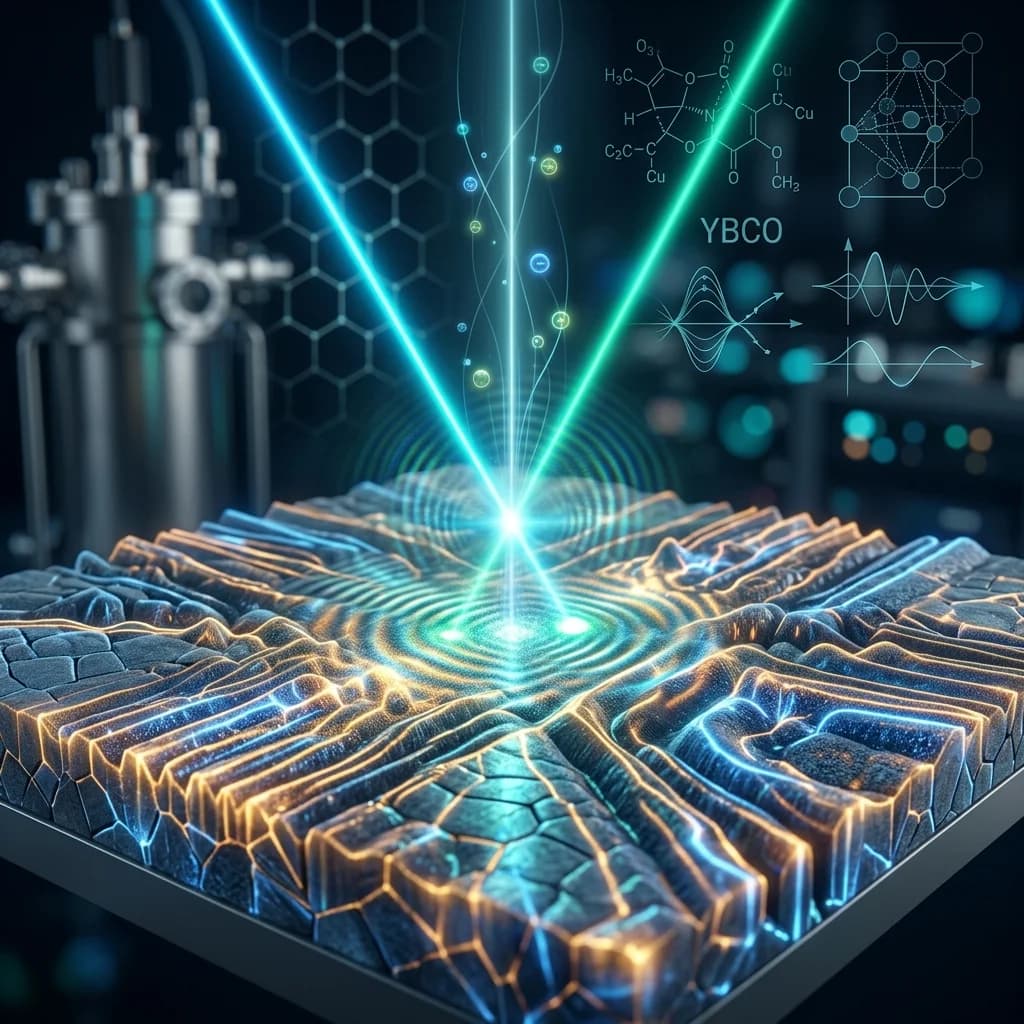
The study, published in Nature Communications and receiving widespread academic attention in mid-June 2026, focused on an ultrathin film of Yttrium Barium Copper Oxide (YBCO), a well-known high-temperature superconductor. Normally, when superconducting films are made thin enough to be integrated into microchips, their performance deteriorates rapidly. The Chalmers team bypassed this limitation by focusing not on the YBCO itself, but on the magnesium oxide (MgO) substrate supporting it. Using precise fabrication techniques, they etched the MgO surface to create nanofacets—a repeating pattern of microscopic "hills and valleys" measuring just 1 nanometer high and 20 to 50 nanometers wide.
To understand how this works, imagine trying to lay a flexible tile floor over an uneven concrete slab. The tiles will naturally bend and realign to conform to the contours of the floor beneath them. Similarly, as the YBCO atoms settled onto the nanofaceted MgO substrate, they arranged themselves in response to the nanoscale contours. This forced structural deformation altered the YBCO’s electronic landscape, encouraging the electrons to pair up and flow without resistance at much higher thresholds. The results were startling: the onset temperature of superconductivity jumped by over 15 Kelvin, and the upper critical magnetic field—the point at which the superconducting state is destroyed—increased by a massive 50 tesla compared to flat reference films.
This research represents a paradigm shift in how we engineer superconducting devices. Rather than searching for entirely new chemical compounds, scientists can now use nano-patterned substrates to squeeze superior performance out of existing materials. Boosting the critical magnetic field by 50 tesla opens up possibilities for compact, high-field magnets used in medical imaging (MRI) and fusion reactors, while raising the transition temperature simplifies the cooling systems required for superconducting quantum computers. It brings us one step closer to practical, energy-saving electronics operating under real-world conditions.
🔬 Illuminating the Unseen: Laser Phase Plates Reveal the Cell's Smallest Proteins
Cryo-electron microscopy (cryo-EM) has revolutionized structural biology by allowing scientists to view the atomic models of proteins and other biomolecules. Yet, despite its power, the technology has long suffered from a frustrating limitation: it is virtually blind to small proteins. Nearly 90% of the proteins that regulate human cells are simply too small to produce a clear signal under standard electron beams, leaving them lost in a sea of molecular noise. In a landmark study published in Science, researchers from the University of California, Berkeley, and the Chan Zuckerberg Biohub have broken through this barrier by introducing a "laser phase plate" that uses light to bring these elusive molecular machines into sharp focus.
The development, led by UC Berkeley physicist Holger Müller and collaborators at the Lawrence Berkeley National Laboratory, is the culmination of over fifteen years of intense engineering and theoretical design. The team succeeded in building a stable, high-power optical cavity directly inside the vacuum chamber of a transmission electron microscope. By bouncing a laser beam back and forth between mirrors, they generated a standing light wave millions of times brighter than the Sun. As the microscope's electron beam passes through this intense field, it interacts with the photons, shifting the phase of the electron waves and creating a high-contrast image.
The laser phase plate operates on the same principle as phase-contrast light microscopy, which won the Nobel Prize in Physics in 1953, but adapts it to the far more energetic realm of electron beams. When electrons pass through a thin biological specimen, they undergo phase shifts rather than being absorbed. Normally, these phase shifts are invisible, like a pane of clean glass submerged in water. The laser phase plate acts like a special optical filter, shifting the unscattered electrons relative to the scattered ones. This converts the invisible phase variations into stark differences in brightness, turning a blurry silhouette into a crisp, high-resolution portrait of a protein's structure.
By dramatically boosting contrast, the laser phase plate allows researchers to image proteins that are down to one-third the size of the previous limits of cryo-EM. This capability is poised to revolutionize cryo-electron tomography (cryo-ET)—a technique used to capture 3D "cell snapshots" of proteins in their native environments. Biologists will now be able to observe how small signaling proteins interact, track the structural changes of disease-causing molecules inside cells, and accelerate the development of drugs targeted at previously un-imageable receptors. It represents a massive leap forward in our quest to map the inner workings of life.
📌 The Bottom Line
- permafrost-weathering: Thawing permafrost on the Qinghai-Tibet Plateau exposes minerals to water, accelerating rock weathering that absorbs atmospheric carbon dioxide and acts as an unexpected regional carbon sink.
- nanofaceted-superconductors: Patterning MgO substrates with nanometer-scale facets raises the YBCO superconducting temperature by 15 Kelvin and boosts its critical magnetic field limit by 50 tesla, overcoming a major bottleneck in thin-film superconducting electronics.
- laser-cryo-em: Integrating a high-power laser phase plate in cryo-electron microscopes boosts imaging contrast, enabling researchers to visualize tiny proteins previously invisible to structural biology.
Enjoyed this post?
Get our weekly digest delivered free.
Share this post:
Knowelth is reader-supported. We may earn a commission from links in this article at no extra cost to you. Read our disclosure.
Related Posts

Targeted Protein Degrader Rewrites Leukemia Drug Sensitivity, Oxytocin Selectively Modulates Low Trust, and Siberian Permafrost Methane Surge Doubles
Targeted Protein Degrader Rewrites Leukemia Drug Sensitivity, Oxytocin Selectively Modulates Low Trust, and Siberian Permafrost Methane Surge Doubles Scientific discovery rarely moves in a single dire…
Global Research Breakthroughs: HCMI Patient Cancer Organoids, Ultra-Durable Nanochannel Fuel Cells, and 567-Million-Year-Old Deep-Ocean Fossils
Global Research Breakthroughs: HCMI Patient Cancer Organoids, Ultra-Durable Nanochannel Fuel Cells, and 567-Million-Year-Old Deep-Ocean Fossils Across biology, materials physics, and evolutionary pale…
Tumour Organoid Vulnerability Map, 567M-Year-Old Ediacaran Fossils, and NIH's TrialGPT AI Breakthrough
Tumour Organoid Vulnerability Map, 567M-Year-Old Ediacaran Fossils, and NIH's TrialGPT AI Breakthrough Three landmark studies published in the first week of August 2026 span the full breadth of modern…