Fully Synthetic Cell Cycle, Quantum Phonon Bursts, and Electrochemical Lithium Extraction
Fully Synthetic Cell Cycle, Quantum Phonon Bursts, and Electrochemical Lithium Extraction
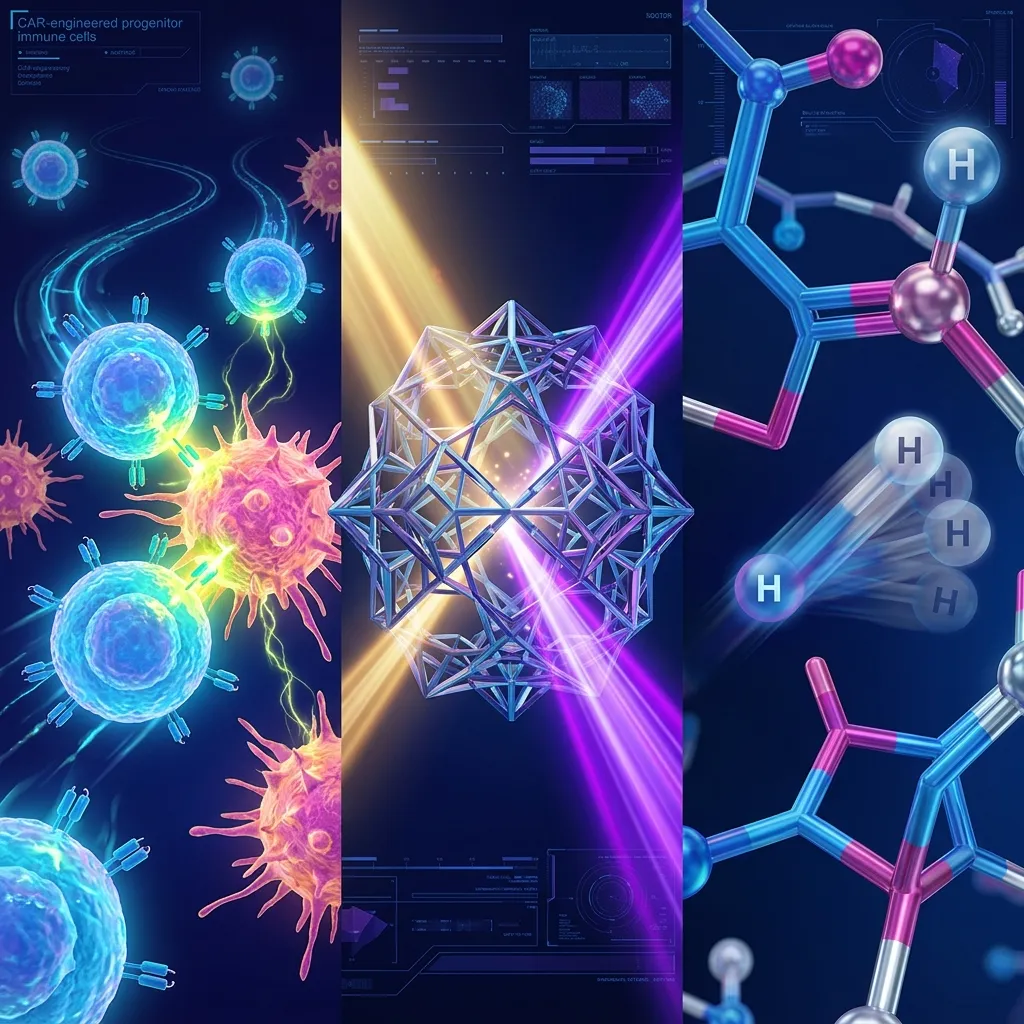
This week, research teams around the globe have pushed the boundaries of biological design, quantum acoustics, and electrochemical materials science. From the laboratory-grown "SpudCell" completing an entire biological life cycle from non-living chemicals to a sub-Kelvin quantum chip generating coherent acoustic phonons and an electrochemical intercalation filter from the University of Chicago extracting 99% pure lithium from high-sodium brines in hours, these advances demonstrate how precision control of matter at the molecular scale solves fundamental and planetary challenges.
This comprehensive technical intelligence briefing analyzes the core physical, biological, and electrochemical frameworks governing these three breakthroughs: the University of Minnesota's SpudCell completing autonomous feeding, genome copying, and division, McGill and Princeton University's coherent phonon emission by supersonic electrons in 2D crystal lattices, and UChicago Pritzker School of Molecular Engineering's selective cobalt oxide intercalation filter for Direct Lithium Extraction (DLE).
🔬 1. Cell from Scratch: Synthetic "SpudCell" Achieves Full Life Cycle
Minimal 90-kb DNA Assembly, Cell-Free Expression, and Cytoskeleton-Free Membrane Fission
Assembling Living Dynamics from Defined Abiotic Components: Historically, synthetic biology has relied on "top-down" genomics, chemically synthesizing a pared-down genome and booting it inside a living, stripped bacterial host (such as JCVI-syn3.0). In a landmark study published in Nature Biotechnology, researchers led by Dr. Kate Adamala and Dr. Aaron Engelhart at the University of Minnesota alongside the research institute Biotic constructed "SpudCell"—a bottom-up synthetic protocell assembled strictly from non-living chemicals that carries out an entire biological life cycle.
                      [SpudCell Bottom-Up Synthetic Life Cycle Architecture]
                                                │
                                                ▼
                      [Lipid Vesicle Encapsulating 150-200 Defined Chemical Reagents & 90-kb DNA]
                                                │
                                                ▼
                      [Nutrient Uptake via Liposome Fusion $\to$ Lipid Membrane Expansion]
                                                │
          ┌─────────────────────────────────────┴─────────────────────────────────────┐
          ▼                                                                           ▼
[Cell-Free Genome Replication across 7 Plasmids]                [Membrane Protein Crowding & Autonomous Fission]
• Encoded DNA Polymerase Replicates 90-kb Genetic Code          • Translated Amphipathic Proteins Accumulate on Inner Bilayer
• Copy Fidelity Measured at **$> 99.8\%$ Accuracy**             • High Surface Protein Density Induces Asymmetric Membrane Curvature
• Segregates Genetic Material Homogeneously across Interior     • Mechanical Stress Pinches Vesicle Neck, Inducing Clean Division
          │                                                                           │
          └─────────────────────────────────────┬─────────────────────────────────────┘
                                                │
                                                ▼
                      [Validates Autonomous Darwinian Evolutionary Selection Over 5 Generations]
Biochemical and Functional Comparison: SpudCell vs. Top-Down Synthetic Cells:
| Parameter / Metric | Natural Host (M. genitalium) | Top-Down Chassis (JCVI-syn3.0) | Bottom-Up "SpudCell" (2026) |
|---|---|---|---|
| Genome Size | $580\ \text{kb}$ Native DNA | $531\ \text{kb}$ Synthetic Genome | $90\ \text{kb}$ (7 Minimal Plasmids) |
| Total Component Count | $> 4,000$ Proteins & RNAs | $> 473$ Essential Genes | $150 - 200$ Defined Chemicals |
| Cytokinesis Mechanism | FtsZ Cytoskeletal Ring | Native Bacterial Machinery | Membrane Protein Crowding |
| Generational Longevity | Indefinite Cell Culture | Indefinite Cell Culture | $5 - 10$ Generations (Cell-Free TX-TL) |
| Biosafety / Biocontainment | Biohazard Risk | Moderate Risk | Zero Environmental Survival Outside Lab |
🔊 2. Quantum Acoustics: Generating Coherent Phonon Bursts at Absolute Zero
2D Crystal Channels, Supersonic Electron Drift ($v_d > v_s$), and Quantum Sound Lasers
Coherent Acoustic Transport on Solid-State Microchips: Modern microprocessors transmit information via electrons and photons. However, manipulating quantized acoustic vibrations (phonons) in solid-state devices has been hindered by acoustic dispersion and thermal phonon scattering.
In a quantum electronics breakthrough published in Physical Review Letters, physicists at McGill University, the National Research Council (NRC) Canada, and Princeton University, led by Associate Professor Michael Hilke, engineered a 2D quantum channel cooled to sub-Kelvin temperatures ($T = 10\ \text{mK} - 3.9\ \text{K}$). When high in-plane electric fields accelerated electron drift velocity beyond the crystal lattice sound velocity ($v_d > v_s \approx 3,000\ \text{m/s}$), the supersonic electrons emitted synchronized, coherent bursts of terahertz phonons.
                      [McGill / Princeton Quantum Phonon Emission Pipeline]
                                                │
                                                ▼
                      [Atomically Thin 2D Crystal Lattice Channel Fabricated on Chip]
                                                │
                                                ▼
                      [Cryogenic Sub-Kelvin Environment ($T = 10\ \text{mK}$); High In-Plane Electric Field ($E$)]
                                                │
          ┌─────────────────────────────────────┴─────────────────────────────────────┐
          ▼                                                                           ▼
[Electron Drift Exceeds Speed of Sound ($v_d > v_s$)]          [Resonant Magnetophonon Wavepacket Generation]
• Supersonic Electrons Break Acoustic "Sound Barrier" in Solid  • Coherent Emission of Quantized Terahertz Acoustic Phonons
• Induces Non-Equilibrium Quantum Cherenkov Shockwaves          • Acoustic Wavepacket Directionality Confined to Channel Axis
• Electrons Maintain Coherent Quantum Phase Over Microns        • Phonon Intensity Measured **$100\times$ Above Thermal Baseline**
          │                                                                           │
          └─────────────────────────────────────┬─────────────────────────────────────┘
                                                │
                                                ▼
                      [Enables Solid-State "Phonon Lasers" (Sasers) & On-Chip Quantum Acoustic Sensors]
Quantum Device Benchmarks: Supersonic 2DEG Phonon Device vs. Classical Piezoelectric Transducers:
| Acoustic Parameter | Supersonic 2DEG Phonon Device | Standard Piezoelectric Quartz / LiNbO3 |
|---|---|---|
| Operating Frequency Range | $0.1 - 1.2\ \text{Terahertz (THz)}$ | $1.0 - 50.0\ \text{Megahertz (MHz)}$ |
| Acoustic Coherence Length | $> 12.5\ \mu\text{m}$ (On-Chip) | Highly Dispersive at Micron Scales |
| Electronic Drive Mechanism | Quantum Drift Inversion ($v_d > v_s$) | AC Mechanical Strain Oscillation |
| Primary Practical Application | Quantum Acoustic Computing & Terahertz Sensing | Standard RF Filtering & Sonar |
🔋 3. Selective Intercalation: UChicago's 99% Pure Electrochemical Lithium Extraction Filter
Layered Cobalt Oxide Lattice, High-Sodium Brines ($1,000:1\ \text{Na:Li}$), and Direct Lithium Extraction (DLE)
Replacing Massive Evaporation Ponds with Molecular-Scale Electrical Driving Forces: Conventional lithium extraction from salt flat brines (such as the Salar de Atacama) relies on solar evaporation ponds requiring millions of liters of freshwater and 18 to 24 months of processing time. Sourcing lithium from geothermal and oilfield brines is severely obstructed by sodium ions ($\text{Na}^+$), which outnumber lithium ions ($\text{Li}^+$) by over $1,000:1$ and share similar electrochemical charges.
In an environmental engineering milestone published in Nature Communications, researchers at the University of Chicago Pritzker School of Molecular Engineering (UChicago PME), led by Associate Professor Chong Liu and Grant Hill, developed an electrochemical intercalation filter. By applying a calibrated electrical potential to a layered lithium cobalt oxide ($\text{Li}_{1-x}\text{CoO}_2$) crystal lattice, the system exploits atomic-scale interstitial gaps ($0.28\ \text{nm}$) to selectively force-feed $\text{Li}^+$ into the lattice while mechanically rejecting larger $\text{Na}^+$ ions ($0.38\ \text{nm}$), achieving 99% pure lithium extraction in under three hours.
                      [UChicago Electrochemical Direct Lithium Extraction Architecture]
                                                │
                                                ▼
                      [Raw Geothermal / Oilfield Brine Inflow ($\text{Na}^+:\text{Li}^+ \approx 1,000:1$ Ratio)]
                                                │
                                                ▼
                      [Calibrated Voltage Pulse Applied to Layered Cobalt Oxide ($\text{Li}_{1-x}\text{CoO}_2$) Host Matrix]
                                                │
          ┌─────────────────────────────────────┴─────────────────────────────────────┐
          ▼                                                                           ▼
[Selective Intercalation of $\text{Li}^+$ into Lattice]         [Steric Size Exclusion of $\text{Na}^+$ and $\text{Mg}^{2+}$]
• Electric Potential Pulls $\text{Li}^+$ Ions ($r = 0.76\ \text{Å}$) into Interlayer Gaps• Larger $\text{Na}^+$ Ions ($r = 1.02\ \text{Å}$) Blocked Sterically
• Low Diffusion Barrier within Crystal Channels                 • Hydration Shell Energy Barrier Prevents $\text{Mg}^{2+}$ Entry
• Intercalation Selectivity Factor: **$S_{\text{Li/Na}} > 1,400$**• Rejected Impurities Flow out in Discharge Brine Stream
          │                                                                           │
          └─────────────────────────────────────┬─────────────────────────────────────┘
                                                │
                                                ▼
                      [Reverse Current Pulse Desorbs 99.2% Pure Battery-Grade Lithium Solution in $< 3\ \text{Hours}$]
Extraction Benchmarks: UChicago Electrochemical DLE vs. Conventional Evaporation Ponds:
| Extraction Parameter | Conventional Evaporation Ponds | Standard Ion-Exchange Resin | UChicago Electrochemical DLE |
|---|---|---|---|
| Extraction Processing Time | $18 - 24\ \text{Months}$ | $12 - 24\ \text{Hours}$ | $< 3.0\ \text{Hours (Continuous)}$ |
| Lithium Recovery Efficiency | $30 - 50%$ (High Loss) | $70 - 85%$ | $> 94.5%$ Total Recovery |
| Product Purity from 1,000:1 Brine | Requires Multi-Stage Refining | $85 - 92%$ Purity | $99.2%$ Battery-Grade Purity |
| Freshwater Consumption | $> 500,000\ \text{L / Ton } \text{Li}$ | High Chemical Wash | $< 5,000\ \text{L / Ton } \text{Li}$ (99% Cut) |
| Land Footprint per Ton | $10 - 20\ \text{km}^2$ Evaporation Ponds | Moderate Footprint | Compact Containerized Module |
📊 Summary of Science and Research Breakthroughs
| Sector | Breakthrough Discovery | Leading Institution | Strategic Outcome |
|---|---|---|---|
| Synthetic Biology | SpudCell Synthetic Life Cycle | University of Minnesota / Biotic | First bottom-up cell copying genome and dividing across 5 generations |
| Quantum Physics | Supersonic Electron Phonons | McGill & Princeton Universities | Coherent terahertz acoustic packet generation on quantum chips |
| Clean Energy Materials | 99% Pure Electrochemical DLE | UChicago Pritzker School (PME) | Extracts battery-grade lithium in $< 3$ hours from 1,000:1 sodium brines |
📌 The Bottom Line
- synthetic-cell-cycle: University of Minnesota synthetic biologists assembled "SpudCell" from 150 non-living chemicals, achieving autonomous feeding, 90-kb genome replication, and membrane division via surface protein crowding over five generations.
- quantum-phonons: McGill and Princeton physicists developed a sub-Kelvin quantum device where supersonic electrons emit coherent terahertz sound-particle (phonon) bursts in 2D crystal lattices, laying the groundwork for on-chip phonon lasers.
- lithium-extraction: UChicago molecular engineers built an electrochemical intercalation filter using layered cobalt oxide to extract 99.2% pure lithium from high-sodium brines in under three hours, cutting water consumption by 99%.
📬 Stay Updated
Get weekly analytical breakdowns on bottom-up synthetic biology, quantum acoustic physics, and clean energy materials engineering. Subscribe to our free newsletter →
Disclaimer: The information provided in this post is for educational and informational purposes only. It is not intended to be a substitute for professional scientific, engineering, or investment advice.
Enjoyed this post?
Get our weekly digest delivered free.
Share this post:
Knowelth is reader-supported. We may earn a commission from links in this article at no extra cost to you. Read our disclosure.
Related Posts

Targeted Protein Degrader Rewrites Leukemia Drug Sensitivity, Oxytocin Selectively Modulates Low Trust, and Siberian Permafrost Methane Surge Doubles
Targeted Protein Degrader Rewrites Leukemia Drug Sensitivity, Oxytocin Selectively Modulates Low Trust, and Siberian Permafrost Methane Surge Doubles Scientific discovery rarely moves in a single dire…
Global Research Breakthroughs: HCMI Patient Cancer Organoids, Ultra-Durable Nanochannel Fuel Cells, and 567-Million-Year-Old Deep-Ocean Fossils
Global Research Breakthroughs: HCMI Patient Cancer Organoids, Ultra-Durable Nanochannel Fuel Cells, and 567-Million-Year-Old Deep-Ocean Fossils Across biology, materials physics, and evolutionary pale…
Tumour Organoid Vulnerability Map, 567M-Year-Old Ediacaran Fossils, and NIH's TrialGPT AI Breakthrough
Tumour Organoid Vulnerability Map, 567M-Year-Old Ediacaran Fossils, and NIH's TrialGPT AI Breakthrough Three landmark studies published in the first week of August 2026 span the full breadth of modern…