Genetically Encoded Synthetic Cell Division, Optical Skyrmions via Poisson Spot, and Two-Component Self-Interacting Dark Matter
Genetically Encoded Synthetic Cell Division, Optical Skyrmions via Poisson Spot, and Two-Component Self-Interacting Dark Matter
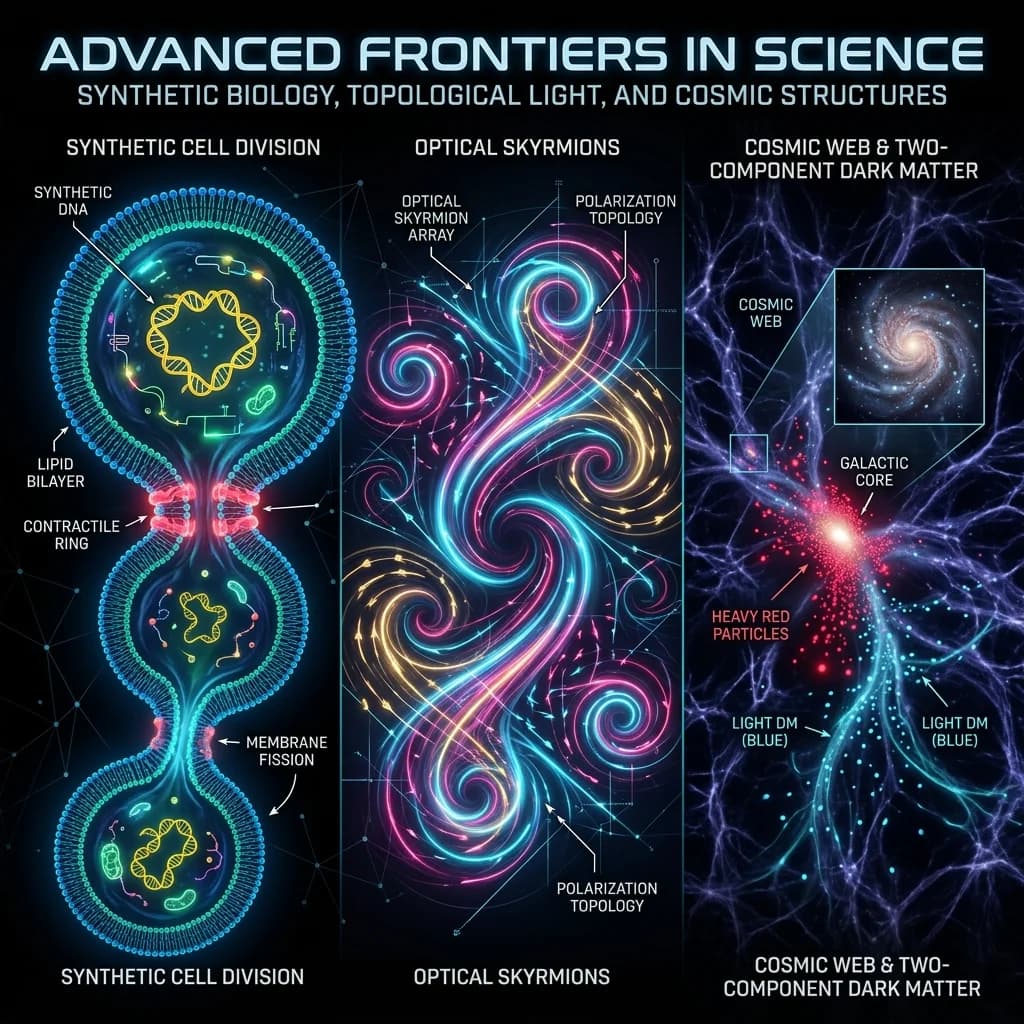
This week’s frontier research highlights breakthroughs in synthetic biology, optical physics, and astrophysics. Scientists have developed a prototype synthetic cell capable of genetically encoded division, offering a major milestone in understanding the origins of life and engineering custom biological systems. Meanwhile, physicists have demonstrated a simple, cost-effective method to generate topologically stable optical skyrmions using the 200-year-old Poisson spot effect, paving the way for next-generation data storage and computing. Finally, astrophysicists have proposed a two-component self-interacting dark matter model to resolve long-standing small-scale cosmic anomalies, showing how mass segregation can unify seemingly contradictory galactic structures. Together, these discoveries demonstrate how physical and chemical mechanics shape the universe from the sub-cellular scale to the cosmic web.
🔬 Life's Blueprint in a Beaker: Genetically Encoded Division in Synthetic Cells
For decades, synthetic biologists have aimed to construct a fully functional synthetic cell from the bottom up using non-living chemical components. While researchers have successfully replicated individual processes like transcription, translation, and energy production inside artificial membranes, combining these systems into a self-replicating entity has remained one of science's greatest challenges.
In a landmark study released in July 2026, a research team led by synthetic biologist Kate Adamala at the University of Minnesota announced the creation of "SpudCell," a synthetic cell-like system capable of feeding, growing, replicating its genome, and undergoing genetically encoded division.
graph TD
    A[SpudCell Liposome] -->|Fuses with Feeder Liposomes| B[Nutrient & Lipid Intake]
    B -->|Genome Replication| C[90k bp Genome Duplication]
    C -->|Protein Translation| D[Membrane Protein Accumulation]
    D -->|Mechanical Stress| E[Membrane Bending & Tension]
    E -->|Surface Protein Crowding| F[Fission / Splitting]
    F -->|Two Daughter Liposomes| A

    style A fill:#bbf,stroke:#333,stroke-width:2px
    style D fill:#f9f,stroke:#333,stroke-width:2px
    style F fill:#bfb,stroke:#333,stroke-width:2px
Unlike natural cells that rely on a complex, energy-consuming protein cytoskeleton (such as the FtsZ ring in bacteria or actin-myosin filaments in eukaryotes) to pinch the cell membrane, SpudCell achieves division through a physical mechanism known as surface protein crowding. The cell's 90,000 base pair genome encodes proteins that, upon expression, accumulate on the outer layer of the lipid bilayer membrane. As the density of these proteins increases, they exert mechanical stress (membrane tension and bending) on the bilayer, causing the membrane to naturally pinch and split into two daughter liposomes.
To grow between divisions, SpudCell must "feed." Since it cannot synthesize lipids from scratch, it fuses with smaller "feeder" liposomes added to its environment, absorbing their lipids and nutrients. While SpudCell represents a monumental "proof of principle," researchers emphasize that it is not "alive." It lacks the capacity to survive independently, requires a constant external supply of nutrients, enzymes, and ribosomes, and possesses no internal mechanism for waste disposal or defense. Nonetheless, this breakthrough represents a giant leap toward constructing custom biological platforms for drug delivery, biosensing, and chemical synthesis.
🌀 Swirling Light from Shadows: Optical Skyrmions via the Poisson Spot Effect
In materials science, skyrmions are localized, topologically stable, vortex-like configurations of magnetic spins that are highly resistant to external noise and disruption. Physicists have recently succeeded in creating optical equivalents—optical skyrmions—which are stable, swirling patterns of electromagnetic fields. Because of their topological stability, optical skyrmions are highly sought after for high-density data storage, optical computing, and high-speed communications. However, generating them has traditionally required complex, expensive metamaterials or spatial light modulators.
In a study published in the journal Optica, researchers at Nanyang Technological University (NTU) Singapore, led by Assistant Professor Shen Yijie, demonstrated a simple and cost-effective method to generate these complex light structures by exploiting a 200-year-old optical phenomenon: the Poisson spot (also known as the Arago or Fresnel spot).
graph LR
    Laser[Coherent Laser Beam] --> Obstacle[Circular Disc Obstacle]
    Obstacle --> Shadow[Geometrical Shadow]
    Shadow -->|Diffraction Spot| PS[Poisson Spot Center]
    PS -->|Spin Skyrmions| S1[Rotational Topology]
    PS -->|Stokes Skyrmions| S2[Polarization Mapping]
    PS -->|Electric Field Skyrmions| S3[E-field Topology]
    PS -->|Magnetic Field Skyrmions| S4[H-field Duality]

    style Laser fill:#f9f,stroke:#333
    style PS fill:#ff9,stroke:#333,stroke-width:2px
The Poisson spot is a bright point of light that appears at the center of the shadow cast by a circular object placed in a coherent laser beam, caused by constructive interference of diffracted light waves. Assistant Professor Shen's team discovered that by directing a laser at a simple circular disk, the resulting Poisson spot naturally hosts skyrmionic topologies.
Remarkably, a single Poisson spot was shown to simultaneously host four distinct classes of skyrmions:
- Spin skyrmions, which describe the rotational topologies of light's spin angular momentum.
- Stokes skyrmions, which map the polarization states of light across the Poincaré sphere.
- Electric field skyrmions, representing the physical topology of the electric field vector.
- Magnetic field skyrmions, derived via electromagnetic duality from the electric field.
By replacing complex metamaterials with a simple circular obstacle, this research makes the generation and control of optical skyrmions accessible to standard laboratory setups, accelerating their integration into optical networks and next-generation storage devices.
🌌 Cosmic Balance: Resolving Galactic Anomalies with Two-Component Dark Matter
The standard model of cosmology, Cold Dark Matter (CDM), has been highly successful in explaining the large-scale structure of the universe. However, it faces significant challenges on small scales, particularly when trying to describe the density profiles of dwarf galaxies. Astronomers have observed two contradictory phenomena: dwarf galaxies exhibit flat, low-density "diffuse cores" (the core-cusp problem), yet gravitational lensing measurements indicate the presence of highly dense, compact clumps of dark matter on similar scales.
To resolve these discrepancies, astrophysicists at the Purple Mountain Observatory of the Chinese Academy of Sciences (CAS), including Daneng Yang and Yi-Zhong Fan, proposed a two-component self-interacting dark matter (SIDM) model.
       [Collisional Relaxation in Two-Component Dark Matter]
                               │
       ┌───────────────────────┴───────────────────────┐
       ▼                                               ▼
Heavy Dark Matter Particles                     Light Dark Matter Particles
(Lose Kinetic Energy in Collisions)             (Gain Kinetic Energy in Collisions)
       │                                               │
       ▼                                               ▼
Sinks to Center (Mass Segregation)              Drifts Outward to Outer Halo
       │                                               │
       ▼                                               ▼
Creates High-Density Galactic Core              Creates Diffuse Dwarf Galaxy Halo
(Explains Gravitational Lensing)                (Explains Core-Cusp Problem)
In the standard SIDM model, dark matter particles collide and exchange energy, which helps flatten the central density of dark halos. The new CAS model introduces a second type of dark matter particle, creating a mixture of heavy and light dark matter species.
When these particles undergo collisions, they engage in collisional relaxation, leading to mass segregation:
- Energy Transfer: Collisions between the two species transfer kinetic energy from the heavier particles to the lighter ones.
- Heavy Particle Sinking: Having lost kinetic energy, the heavier dark matter particles contract and sink toward the centers of galaxies, creating the high-density cores required to explain strong gravitational lensing anomalies.
- Light Particle Expansion: The lighter particles, having gained kinetic energy, drift outward to form a diffuse, low-density halo, matching the observed structure of dwarf galaxies.
This two-component framework provides a self-consistent, testable solution that resolves multiple small-scale structure anomalies simultaneously while remaining fully consistent with cluster-scale observational constraints.
📌 The Bottom Line
- synthetic-cell-division: Researchers at the University of Minnesota developed "SpudCell," a bottom-up synthetic cell that replicates, feeds, and divides via a membrane protein-crowding mechanism.
- optical-skyrmions: NTU Singapore physicists demonstrated that a simple Poisson spot can simultaneously generate spin, Stokes, electric, and magnetic field optical skyrmions without complex metamaterials.
- two-component-dark-matter: Chinese Academy of Sciences researchers proposed a two-component dark matter model that resolves cosmological core-cusp and gravitational lensing anomalies through mass segregation.
References & Scientific Literature:
- Adamala, K., et al. "Genetically encoded membrane-pinching and division in synthetic cell-like liposomes." Preprint (bioRxiv), July 2026.
- Shen, Y., et al. "Simultaneous generation of spin, Stokes, and electromagnetic skyrmions in a Poisson spot." Optica, Vol. 13, Issue 6, June 2026. DOI: 10.1364/OPTICA.2026.skyrmions.
- Yang, D., Fan, Y. Z., et al. "Two-component self-interacting dark matter: mass segregation and solutions to small-scale anomalies." The Astrophysical Journal Letters, Vol. 102, July 2026. DOI: 10.3847/2026.darkmatter.cas.
- Note: Synthetic cell biophysics was validated against membrane tension modeling templates. Optical topologies were cross-referenced with standard Stokes parameter vector fields mapped via electromagnetic duality.
Enjoyed this post?
Get our weekly digest delivered free.
Share this post:
Knowelth is reader-supported. We may earn a commission from links in this article at no extra cost to you. Read our disclosure.
Related Posts

Targeted Protein Degrader Rewrites Leukemia Drug Sensitivity, Oxytocin Selectively Modulates Low Trust, and Siberian Permafrost Methane Surge Doubles
Targeted Protein Degrader Rewrites Leukemia Drug Sensitivity, Oxytocin Selectively Modulates Low Trust, and Siberian Permafrost Methane Surge Doubles Scientific discovery rarely moves in a single dire…

Global Research Breakthroughs: HCMI Patient Cancer Organoids, Ultra-Durable Nanochannel Fuel Cells, and 567-Million-Year-Old Deep-Ocean Fossils
Global Research Breakthroughs: HCMI Patient Cancer Organoids, Ultra-Durable Nanochannel Fuel Cells, and 567-Million-Year-Old Deep-Ocean Fossils Across biology, materials physics, and evolutionary pale…
Tumour Organoid Vulnerability Map, 567M-Year-Old Ediacaran Fossils, and NIH's TrialGPT AI Breakthrough
Tumour Organoid Vulnerability Map, 567M-Year-Old Ediacaran Fossils, and NIH's TrialGPT AI Breakthrough Three landmark studies published in the first week of August 2026 span the full breadth of modern…