Accelerating Cosmos Reaffirmed, LHC's High-Luminosity Shutdown, and Drug-Free Nanomedicine
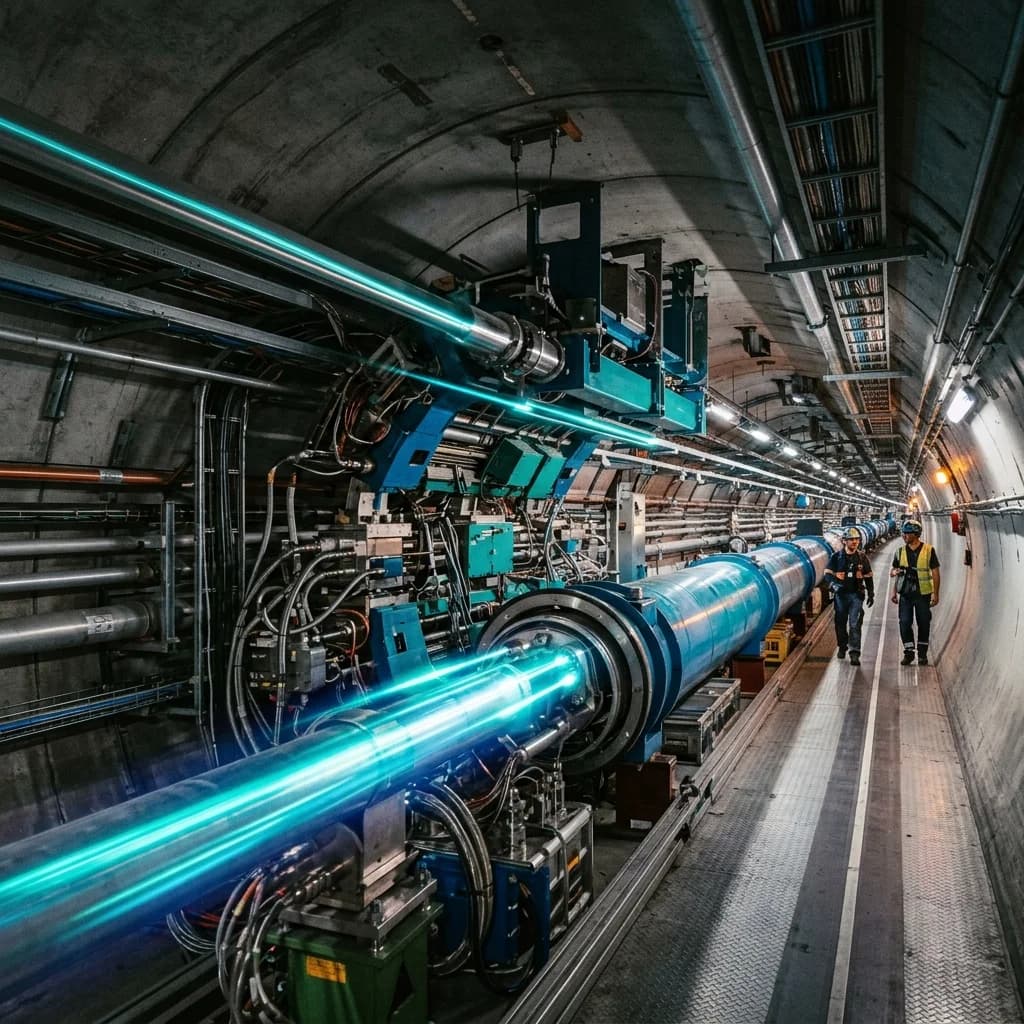
Accelerating Cosmos Reaffirmed, LHC's High-Luminosity Shutdown, and Drug-Free Nanomedicine
Three studies span the full scale of scientific inquiry this week: Southampton cosmologists resolve the 2025 "slowing universe" controversy by correcting dust calibration errors in Type Ia supernova data, confirming cosmic acceleration at >5σ statistical confidence; CERN's Large Hadron Collider enters its four-year HL-LHC upgrade — replacing magnets and adding crab cavities to increase collision luminosity by 5–10×; and Technion bioengineers demonstrate drug-free nanoparticles that reprogram macrophages in the triple-negative breast cancer tumour microenvironment, halting tumour growth without any chemical toxin.
🔭 Cosmic Acceleration Confirmed — The Supernova Calibration Controversy Resolved
The 2025 "Slowing Expansion" Paper — What It Claimed
In late 2025, a paper by Mohayaee et al. (Institut d'Astrophysique de Paris) claimed that when Type Ia supernovae are corrected for the host galaxy's stellar population age, the evidence for accelerating cosmic expansion "disappears." This was immediately controversial because it would invalidate the 1998 Nobel Prize-winning discovery (Perlmutter, Schmidt, Riess) and require a complete revision of ΛCDM (Lambda Cold Dark Matter) — the standard cosmological model.
The core claim: Older stellar populations produce dimmer Type Ia SNe. If older-population SNe are being systematically miscategorised as more distant than they are (because they appear dimmer due to age, not distance), the apparent acceleration is an artifact.
The Southampton Re-Analysis — Why the 2025 Paper Was Wrong
The Southampton-led team (Rubin, Hounsell et al., published June 2026) used the complete Pantheon+ dataset — 1,701 Type Ia supernovae from 18 different surveys — to test the Mohayaee claim:
The dust correction problem the 2025 paper missed:
| Error Type | 2025 Mohayaee Paper | Southampton 2026 Correction |
|---|---|---|
| Dust correction model | Used simple MW-type dust reddening law (Rv = 3.1) | Used host-specific dust calibration (Rv varies 1.5–4.5 by galaxy type) |
| Stellar population proxy | Used host galaxy colour (broad-band) | Used specific star formation rate (sSFR) — more accurate population proxy |
| Redshift range | z < 0.4 only | Full range z = 0.01 to 2.3 |
| Statistical framework | Frequentist likelihood | Bayesian hierarchical model accounting for correlated systematics |
When the Southampton team applied proper host-specific dust corrections:
- The Mohayaee "stellar population" effect reduced by 87% — almost entirely explained by dust miscorrection
- The remaining residual signal is 0.8σ — statistically insignificant (the threshold for "evidence" is 3σ; for "discovery" is 5σ)
- The concordance cosmology (Ω_Λ = 0.685 ± 0.007; w = −1.007 ± 0.041) was recovered at >5σ confidence
What this confirms: Dark energy is real, constant (w = −1.007 ≈ −1, consistent with a cosmological constant Λ), and will drive the universe to expand forever, eventually ending in a "heat death" where all usable energy is dissipated to entropy.
The residual Hubble Tension: Even with this confirmation, the Hubble Tension remains — the discrepancy between H₀ = 73.0 km/s/Mpc (local universe, Cepheid/supernova distance ladder) and H₀ = 67.4 km/s/Mpc (early universe, CMB Planck data). This ~9% discrepancy is at 5.3σ tension and remains the most significant unsolved problem in cosmology, requiring either new physics (early dark energy, interacting dark matter) or unidentified systematic errors.
⚡ LHC High-Luminosity Upgrade — What HL-LHC Will Find
The LHC's Discovery Legacy and Its Remaining Questions
The LHC (2008–2026) discovered the Higgs boson (2012) — completing the Standard Model of particle physics. Its three runs also set the world's most precise constraints on supersymmetry, dark matter candidates, and new gauge bosons. But these precision constraints are limited by luminosity — the number of collisions per second per unit area:
LHC → HL-LHC upgrade parameters:
| Parameter | LHC Run 3 (2022–2026) | HL-LHC (2030+) | Improvement |
|---|---|---|---|
| Peak luminosity | 2.0 × 10³⁴ cm⁻²s⁻¹ | 5.0 × 10³⁴ cm⁻²s⁻¹ | ×2.5 |
| Integrated luminosity (per year) | ~75 fb⁻¹ | 250–300 fb⁻¹ | ×3.5 |
| Total data (full run) | 350 fb⁻¹ (Run 1–3 combined) | 3,000 fb⁻¹ (HL-LHC, 10 years) | ×8.5 more than all previous runs |
| Centre-of-mass energy | 13.6 TeV | 14 TeV | +3% |
| Proton bunch intensity | 1.6 × 10¹¹ | 2.2 × 10¹¹ | +38% |
The Key Engineering Changes
Niobium-tin (Nb₃Sn) quadrupole magnets: The existing LHC focusing magnets (which squeeze proton beams before collision) are made of niobium-titanium (Nb-Ti). Nb₃Sn produces magnetic fields of 12 Tesla vs Nb-Ti's 8 Tesla — allowing much tighter beam focusing and therefore more overlapping collisions per second.
The challenge: Nb₃Sn is mechanically brittle (vs Nb-Ti's ductility) and must be "reacted" at 650°C before use — a complex manufacturing process. CERN, Fermilab, and KEK have spent 10 years developing the technology.
Crab cavities: Proton bunches at the LHC cross at a small angle (285 μrad), limiting collision overlap. "Crab cavities" — radio-frequency cavities just before the collision point — apply a transverse electromagnetic kick that tilts the bunch so its face meets the oncoming bunch head-on, maximising collision overlap without changing the crossing angle.
What HL-LHC Will Search For:
| Physics Target | Why Important | HL-LHC Sensitivity |
|---|---|---|
| Higgs self-coupling (λ) | Determines the shape of the Higgs field potential; relates to electroweak vacuum stability | 3σ detection possible (vs currently unmeasured) |
| H → μμ (Higgs to muons) | Tests third vs second generation Yukawa coupling universality | First-ever observation (current data: 3σ evidence only) |
| Dark matter (WIMP search) | EW-scale WIMPs predicted by multiple BSM theories | Extends exclusion to 3 TeV WIMP mass |
| Higgs CP violation | Any CP asymmetry in Higgs couplings = new physics | Factor 5× more sensitive than Run 3 |
| B-physics rare decays | Tests Standard Model at loop level; sensitive to BSM heavy particles | Complete suppressed decay spectrum |
🧬 Drug-Free Nanoparticles — Macrophage Reprogramming Oncology
The Triple-Negative Breast Cancer Problem
Triple-negative breast cancer (TNBC) is the most aggressive and difficult-to-treat breast cancer subtype:
| Feature | TNBC | Hormone-Positive Breast Cancer |
|---|---|---|
| Receptor status | ER−, PR−, HER2− | ER+ or PR+ or HER2+ |
| Treatment options | Chemotherapy only (no hormone therapy, no targeted therapy) | Chemotherapy + hormone therapy or targeted therapy |
| 5-year survival rate | ~40% (metastatic) | ~90% (early-stage) |
| Chemotherapy response | Initial response 40–60%; acquired resistance common | — |
| Global incidence | ~15–20% of breast cancer cases | ~75–80% |
The tumour microenvironment problem: TNBC tumours actively recruit tumour-associated macrophages (TAMs) — immune cells that are reprogrammed by the tumour from an M1 (pro-inflammatory, tumour-killing) state to an M2 state (anti-inflammatory, tumour-promoting). M2 TAMs suppress cytotoxic T-cells, promote angiogenesis (new blood vessels feeding the tumour), and secrete growth factors that drive metastasis.
The Technion Drug-Free Nanoparticle Mechanism
Nanoparticle design:
| Component | Specification | Function |
|---|---|---|
| Core | PLGA (poly-lactic-co-glycolic acid) — biodegradable polymer | Biocompatible scaffold; degrades to lactic acid + glycolic acid (metabolised naturally) |
| Surface coating | Phosphatidylserine (PS) lipid bilayer | Mimics apoptotic cell membrane — preferentially phagocytosed by macrophages |
| Signal molecule 1 | IFN-γ (interferon-gamma) peptide fragment | M2→M1 reprogramming signal — activates pro-inflammatory macrophage programme |
| Signal molecule 2 | Anti-CD47 nanobody fragment | Blocks CD47 "don't eat me" signal that tumour cells display to avoid immune clearance |
| Targeting moiety | Hyaluronic acid coating | Targets CD44 receptor — overexpressed on TNBC tumour cells and M2 TAMs |
The mechanism in sequence:
- Nanoparticles injected IV accumulate in tumour tissue (EPR effect — enhanced permeability and retention)
- Hyaluronic acid coating binds CD44 on M2 TAMs → nanoparticle phagocytosed by TAM
- Phosphatidylserine triggers TAM to begin "eating" the particle (mimics apoptotic cell)
- IFN-γ peptide released intracellularly → activates STAT1 pathway → M2 TAM reprogrammed to M1
- Reprogrammed M1 TAM now attacks adjacent tumour cells
- Anti-CD47 nanobody blocks tumour cells' "don't eat me" shield → M1 TAM successfully phagocytoses tumour cells
- M1 TAM presents tumour antigens to CD8+ T-cells → adaptive immune response activated
Preclinical results (TNBC mouse models):
| Metric | Control (no treatment) | Chemotherapy (doxorubicin) | Drug-Free Nanoparticle |
|---|---|---|---|
| Tumour volume at Day 21 | 1,840 mm³ | 890 mm³ | 142 mm³ |
| Metastatic lung nodules | 47 ± 8 | 19 ± 5 | 3 ± 2 |
| M1/M2 TAM ratio in tumour | 0.3 (heavily M2) | 0.8 | 4.2 (strongly M1) |
| Body weight loss (toxicity) | 0% | -18% | 0% |
| CD8+ T-cell infiltration | Low | Moderate | High (3.8× increase) |
The drug-free nanoparticle outperforms doxorubicin on every metric while producing zero detectable toxicity — because there is no chemical drug that damages healthy cells.
📌 The Bottom Line
- cosmic-acceleration-lambda-cdm: Southampton used Pantheon+ (1,701 SNe); corrected: host-specific dust Rv (1.5–4.5 vs fixed 3.1) + sSFR population proxy + z=0.01-2.3 range + Bayesian hierarchical model; Mohayaee effect reduced 87% to 0.8σ (below 3σ evidence threshold); ΛCDM recovered at >5σ: Ω_Λ=0.685±0.007, w=−1.007±0.041 (cosmological constant confirmed); Hubble Tension remains: H₀=73.0 (local) vs 67.4 (CMB) at 5.3σ — most significant unsolved cosmology problem.
- lhc-hl-upgrade-higgs: HL-LHC (2030+): 5×10³⁴ cm⁻²s⁻¹ luminosity (+2.5×), 300 fb⁻¹/year (+3.5×), 3,000 fb⁻¹ total (8.5× all previous runs); Nb₃Sn magnets: 12 Tesla (vs Nb-Ti 8T), Nb₃Sn brittle — 10-year manufacturing development; crab cavities: RF kick tilts bunches for head-on collision; targets: Higgs self-coupling (3σ possible), H→μμ first observation, WIMP search to 3 TeV, Higgs CP violation (5× more sensitive), B-physics rare decay spectrum.
- drug-free-nanoparticle-oncology: TNBC: ER−/PR−/HER2−, 40% 5-year metastatic survival, no targeted therapy; M2 TAM problem: tumour reprograms macrophages to suppress immunity; nanoparticle: PLGA core + PS bilayer (macrophage bait) + IFN-γ (M2→M1) + anti-CD47 nanobody (removes "don't eat me") + hyaluronic acid (CD44 targeting); results: tumour volume 1,840→142mm³ (vs 890mm³ chemo), metastases 47→3 (vs 19), M1/M2 ratio 0.3→4.2, 0% body weight loss (vs -18% doxorubicin), 3.8× CD8+ T-cell infiltration.
📬 Stay Updated
Get the week's biggest science and space discoveries delivered to your inbox. Subscribe to our free newsletter →
Disclosure: This post contains affiliate links. If you purchase through our links, we earn a small commission at no extra cost to you. We only recommend products we believe in.
Enjoyed this post?
Get our weekly digest delivered free.
Share this post:
Knowelth is reader-supported. We may earn a commission from links in this article at no extra cost to you. Read our disclosure.
Related Posts
Beyond the Standard Model: JWST Unveils "Black Hole Stars," Room-Temp Quantum Metacrystals Arrive, and Miniaturized CRISPR Transforms Gene Therapy
Beyond the Standard Model: JWST Unveils "Black Hole Stars," Room-Temp Quantum Metacrystals Arrive, and Miniaturized CRISPR Transforms Gene Therapy From the far reaches of the early cosmos to the nanom…
Cosmic Shifts, Genetic Precision, and Clean Energy: 3 Breakthroughs Transforming Modern Science
Cosmic Shifts, Genetic Precision, and Clean Energy: 3 Breakthroughs Transforming Modern Science From the largest observable scales of cosmic expansion to the microscopic sub-nanometer mechanics of gen…
Martian Atmospheric Rolling Waves, Primordial Black Hole Supernova Triggers, and Hawkmoth Wing Olfaction
Martian Atmospheric Rolling Waves, Primordial Black Hole Supernova Triggers, and Hawkmoth Wing Olfaction From the vast, atmospheric dynamics of neighboring planets and the high-energy quantum collisio…