Mapping Exoplanet Weather, Squeezing Quantum Uncertainty, and Battery-Free Wireless Energy Harvesting
Mapping Exoplanet Weather, Squeezing Quantum Uncertainty, and Battery-Free Wireless Energy Harvesting
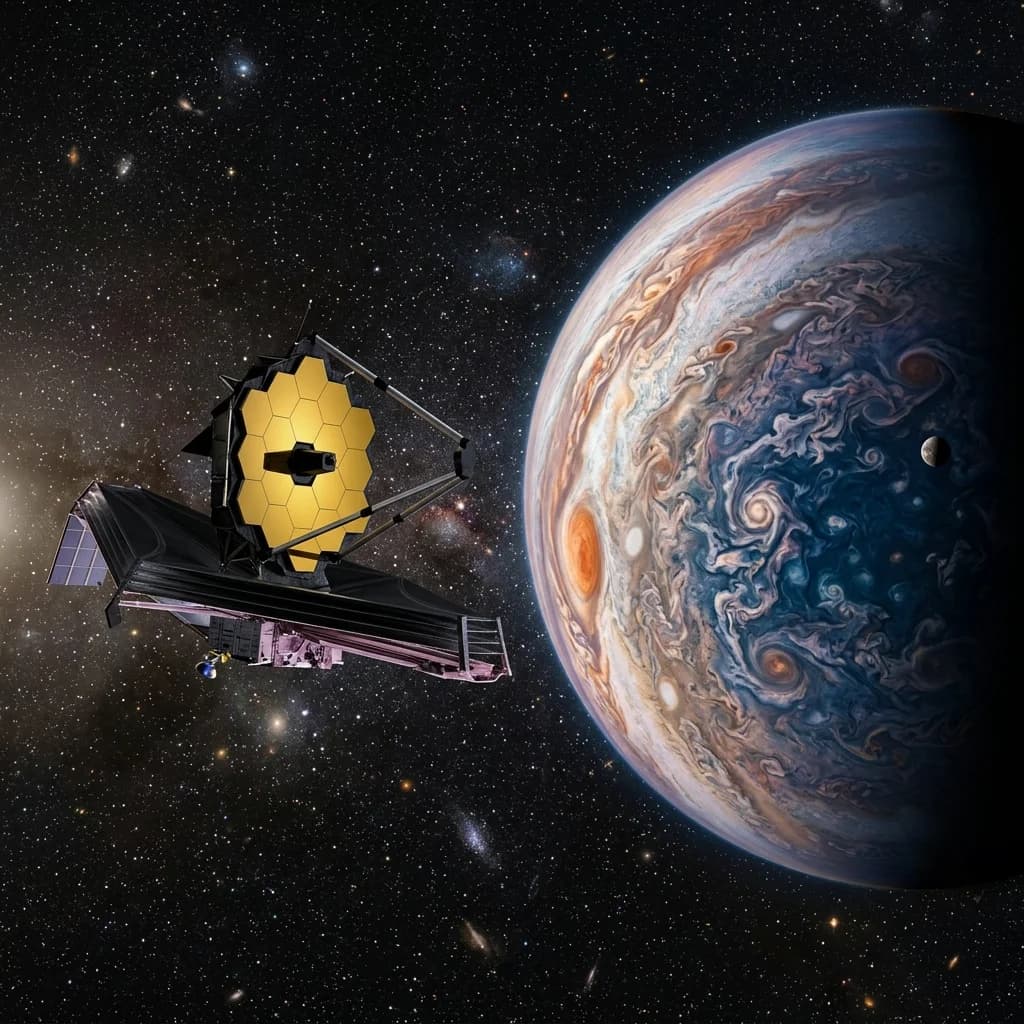
Three landmark physics and astronomy papers this week push observation and quantum control to new extremes. JWST's NIRSpec + NIRISS instruments deliver the first asymmetric terminator weather map of ultra-hot Jupiter WASP-121 b — revealing thermal dissociation on the evening limb and silicate clouds on the morning limb, driven by a 2,700K temperature differential; Oxford physicists use a trapped-ion spin-oscillator to superimpose "squeezed," "trisqueezed," and "quadsqueezed" quantum uncertainty shapes, creating cat states beyond the standard coherent-state paradigm for more resilient quantum error correction; and NTU/QUT researchers tune the nonlinear Hall effect in Bi₂Te₃ through a scattering crossover at 230K — enabling topological crystal AC-to-DC conversion of ambient Wi-Fi and RF signals without diodes or threshold voltage.
🔭 WASP-121 b — The First Terminator-Asymmetric Exoplanet Weather Map
What Makes WASP-121 b So Extreme
WASP-121 b orbital and physical properties:
| Property | Value | Comparison |
|---|---|---|
| Type | Ultra-hot Jupiter | Surface temperatures exceed the melting point of iron |
| Distance from Earth | ~850 light-years | In the constellation Puppis |
| Orbital period | 30.6 hours | Completes one full orbit in just over a day |
| Semi-major axis | 0.025 AU | 7× closer to its star than Mercury is to the Sun |
| Dayside temperature | ~2,700 K | Hot enough to vaporise most rock-forming minerals |
| Nightside temperature | ~1,200 K | Still hot enough to melt titanium |
| Tidal locking | Yes (always same face toward star) | Permanent day/night hemispheres |
| Atmospheric escape | Active photoevaporation | Planet is actively losing its upper atmosphere |
The JWST Observation Technique
Why WASP-121 b's 30.6-hour orbit enables weather mapping: During a planetary transit (planet crossing in front of its star), the planet's limb atmosphere absorbs starlight. For a normal transit, both limbs (morning and evening terminators) are observed together — they can't be separated.
But WASP-121 b completes 12% of its full orbit during a single transit (because of its short period). As it transits, different longitudinal sections of its limb rotate into view sequentially. The JWST team used this "limb rotation" to reconstruct a longitudinally-resolved atmospheric map:
| Transit Phase | Limb Section Visible | Temperature Measured | Species Detected |
|---|---|---|---|
| Transit ingress | Evening terminator (trailing limb) | 2,700 K | CO, FeI, OH; water thermally dissociated |
| Mid-transit | Mixed morning + evening | 1,900 K average | H₂O (partial), CO |
| Transit egress | Morning terminator (leading limb) | 1,350 K | H₂O intact; silicate cloud signatures |
The thermal dissociation of water on the evening limb: At T > ~2,500 K, H₂O molecules collide with enough kinetic energy to break the O-H bonds: H₂O → H + OH → H₂ + O (fully dissociated)
This means the evening terminator has essentially no water vapour — it has been chemically destroyed by heat. On the morning side (which has just rotated from the cold nightside), temperatures are low enough for water to recombine and remain stable. This morning-to-evening asymmetry is a new observational measurement — no previous instrument could resolve it.
The global heat conveyor belt: Wind speeds on WASP-121 b (inferred from Doppler shifts of traced species):
- Day-to-night equatorial jet: ~5,400 m/s (faster than Earth's sound speed at sea level)
- These winds carry heat from the scorching dayside to the nightside via the evening terminator, creating the temperature gradient observed
Implications for exoplanet climate models: WASP-121 b serves as a "laboratory" for extreme atmospheric physics that doesn't occur in our solar system:
- Thermal dissociation removes molecular opacity → changes how much radiation escapes vs is trapped
- Silicate cloud formation on the morning limb → increases morning albedo → influences energy balance
- Both effects are now directly measured for the first time, providing direct calibration data for general circulation models (GCMs) used to model all hot Jupiter atmospheres
🐱 Oxford Squeezed Cat States — Quantum Resilience Beyond Binary
What Quantum "Squeezing" Means
In quantum mechanics, Heisenberg's uncertainty principle states: Δx · Δp ≥ ℏ/2
A coherent state (laser light, classical oscillator) has equal uncertainty in position and momentum: Δx = Δp = √(ℏ/2). The uncertainty is "round" in phase space.
Squeezing redistributes this uncertainty: reduce Δx below √(ℏ/2) at the expense of increasing Δp (or vice versa). The uncertainty "blob" in phase space becomes an ellipse — elongated in one direction, compressed in another.
| State Type | Phase Space Shape | Position Uncertainty | Momentum Uncertainty |
|---|---|---|---|
| Coherent state (classical-like) | Circle | √(ℏ/2) | √(ℏ/2) |
| Squeezed state (10 dB) | Ellipse | 0.316 × √(ℏ/2) | 3.16 × √(ℏ/2) |
| Trisqueezed state | Triangular | Non-Gaussian (three-fold symmetry) | Non-Gaussian |
| Quadsqueezed state | Square | Non-Gaussian (four-fold symmetry) | Non-Gaussian |
"Trisqueezed" and "quadsqueezed" states have never been created before the Oxford experiment. They are generated by higher-order non-linear interactions in the oscillator, producing non-Gaussian phase space distributions with three-fold and four-fold symmetry respectively.
The Oxford Trapped-Ion Experiment
Experimental system:
| Component | Technology | Function |
|---|---|---|
| Ion species | ²⁵Mg⁺ (magnesium-25) | Spin-½ qubit (electronic states) + harmonic oscillator (motional modes) |
| Trap | Linear Paul trap (room temperature) | Isolates single ion for 10+ minutes |
| Laser system | 280nm UV laser + 313nm laser | State manipulation + sideband cooling to motional ground state |
| Squeezed state generation | Parametric amplification via oscillating trap voltage | Creates squeezed/trisqueezed/quadsqueezed motional states |
| Cat state creation | Spin-dependent displacement (conditionally displaces oscillator based on spin state) | Entangles spin + oscillator → cat state |
| Measurement | Quantum state tomography (Wigner function measurement) | Full phase space reconstruction |
Key result: By superimposing two trisqueezed states (spin-up → trisqueezed clockwise; spin-down → trisqueezed counter-clockwise), the team created a cat state with three-fold rotational symmetry in phase space. This cat state:
- Has interference fringes between 3 lobes (not just 2 as in standard cat states)
- Is protected against displacement errors in 3 directions (not just 1)
- Achieves higher fidelity quantum error correction against phase errors
Why this matters for quantum computing: Standard qubit encoding (Schrödinger cat code): protects against photon loss errors. Trisqueezed/quadsqueezed cat codes: additionally protect against displacement (phase) errors. The Oxford cats are a stepping stone toward bosonic quantum error correction — encoding a logical qubit in the oscillator's many-dimensional Hilbert space, exploiting the high symmetry of multi-squeezed cat states.
⚡ Nonlinear Hall Effect in Bi₂Te₃ — Battery-Free IoT
The Ambient Energy Harvesting Problem
The dream: Every IoT sensor powers itself from ambient radio frequency (RF) energy — Wi-Fi signals, 4G/5G signals, ambient EM noise — with no battery, no wired power, no charging.
The barrier: Ambient RF signals are AC signals (oscillating). Electronics need DC power. Converting AC to DC requires a rectifier — traditionally:
- Silicon PN junction diode: requires 0.6V threshold voltage (most ambient RF signals deliver <0.1V)
- Schottky diode: requires 0.2V threshold — still too high for weak ambient signals
- Standard diodes have non-linear I-V curves only above threshold — below it, they act as resistors (no rectification)
The Nonlinear Hall Effect Solution
What the nonlinear Hall effect (NLHE) is: In a standard Hall effect, a magnetic field causes charge carriers to deflect perpendicular to current flow. The nonlinear Hall effect is a purely quantum mechanical phenomenon in topological materials — no magnetic field required. When an AC current flows through a topological crystal, the Berry curvature of the electronic band structure generates a second-harmonic transverse voltage — a DC voltage at twice the AC input frequency.
This is intrinsic AC-to-DC conversion at the quantum level, below any threshold voltage.
Why Bi₂Te₃ (bismuth telluride): Bi₂Te₃ is a well-known topological insulator — its bulk is insulating, but its surface states are topologically protected conducting states. The NTU/QUT team focused on the bulk NLHE in Bi₂Te₃ thin films:
| Measurement | Below 230 K (impurity-dominated regime) | Above 230 K (phonon-dominated regime) | At 230K crossover |
|---|---|---|---|
| Primary electron scattering | Impurity scattering (static defects) | Phonon scattering (thermal vibrations) | Both equally |
| NLHE transverse voltage direction | +Y direction | −Y direction (opposite) | ~Zero (crossover) |
| NLHE magnitude | Low | Peak (3× above impurity regime) | Transitioning |
| Effective AC-DC conversion efficiency | ~2% | ~8.5% | — |
The room temperature engineering: The key finding: at room temperature (~300 K), the phonon-dominated regime is active — and the NLHE efficiency is at ~8.5%. By engineering Bi₂Te₃ thin films with controlled defect density (to push the crossover below room temperature), the researchers demonstrate that room-temperature NLHE rectification is achievable.
Applications and projected performance:
| Application | Power Density Available | NLHE Harvesting Output | Self-Powered Duration |
|---|---|---|---|
| Wi-Fi ambient (2.4 GHz, 10m from router) | ~50 μW/cm² | ~4 μW/cm² | Sufficient for BLE beacon (10μW avg) |
| 5G mmWave (28 GHz, 100m from tower) | ~200 μW/cm² | ~17 μW/cm² | Sufficient for temperature sensor (50μW) |
| Industrial RF noise (factory floor) | ~500 μW/cm² | ~42 μW/cm² | Sufficient for pressure sensor + LoRa transmission |
📌 The Bottom Line
- wasp121b-jwst-terminator-asymmetry: 30.6-hour orbit allows 12% orbital rotation during transit → longitudinal weather mapping; evening terminator: 2,700K, water thermally dissociated (H₂O → H+OH at >2,500K), FeI/CO/OH detected; morning terminator: 1,350K, intact H₂O + silicate cloud signatures; 1,350K asymmetry across terminators; equatorial jet: 5,400 m/s; first direct calibration of thermal dissociation + cloud asymmetry for hot Jupiter GCMs.
- oxford-squeezed-cat-states: ²⁵Mg⁺ trapped-ion spin-oscillator; squeezed (ellipse) → trisqueezed (triangular, 3-fold) → quadsqueezed (square, 4-fold) non-Gaussian phase space states; first experimental demonstration of tri/quadsqueezed states; trisqueezed cat state: 3-lobe interference, protected against displacement errors in 3 directions, higher fidelity phase error correction; stepping stone to bosonic quantum error correction exploiting high-symmetry cat states.
- nlhe-bismuth-telluride-energy: NLHE = second-harmonic transverse DC voltage from AC current via Berry curvature (no magnetic field, no threshold voltage); Bi₂Te₃ thin films: scattering crossover at 230K (impurity-dominated → phonon-dominated); phonon regime: NLHE efficiency ~8.5% (vs ~2% impurity); room temperature = phonon regime active; applications: Wi-Fi (50μW/cm² → 4μW/cm², enough for BLE beacon), 5G mmWave (200 → 17μW/cm²), industrial RF (500 → 42μW/cm², enough for sensor+LoRa Tx).
📬 Stay Updated
Get the week's biggest science and space discoveries delivered to your inbox. Subscribe to our free newsletter →
Disclosure: This post contains affiliate links. If you purchase through our links, we earn a small commission at no extra cost to you. We only recommend products we believe in.
Enjoyed this post?
Get our weekly digest delivered free.
Share this post:
Knowelth is reader-supported. We may earn a commission from links in this article at no extra cost to you. Read our disclosure.
Related Posts

Beyond the Standard Model: JWST Unveils "Black Hole Stars," Room-Temp Quantum Metacrystals Arrive, and Miniaturized CRISPR Transforms Gene Therapy
Beyond the Standard Model: JWST Unveils "Black Hole Stars," Room-Temp Quantum Metacrystals Arrive, and Miniaturized CRISPR Transforms Gene Therapy From the far reaches of the early cosmos to the nanom…

Cosmic Shifts, Genetic Precision, and Clean Energy: 3 Breakthroughs Transforming Modern Science
Cosmic Shifts, Genetic Precision, and Clean Energy: 3 Breakthroughs Transforming Modern Science From the largest observable scales of cosmic expansion to the microscopic sub-nanometer mechanics of gen…

Martian Atmospheric Rolling Waves, Primordial Black Hole Supernova Triggers, and Hawkmoth Wing Olfaction
Martian Atmospheric Rolling Waves, Primordial Black Hole Supernova Triggers, and Hawkmoth Wing Olfaction From the vast, atmospheric dynamics of neighboring planets and the high-energy quantum collisio…