Euclid Maps Milky Way Bulge, Quantum Measurement Engine, and Space Seed Films
Euclid Maps Milky Way Bulge, Quantum Measurement Engine, and Space Seed Films
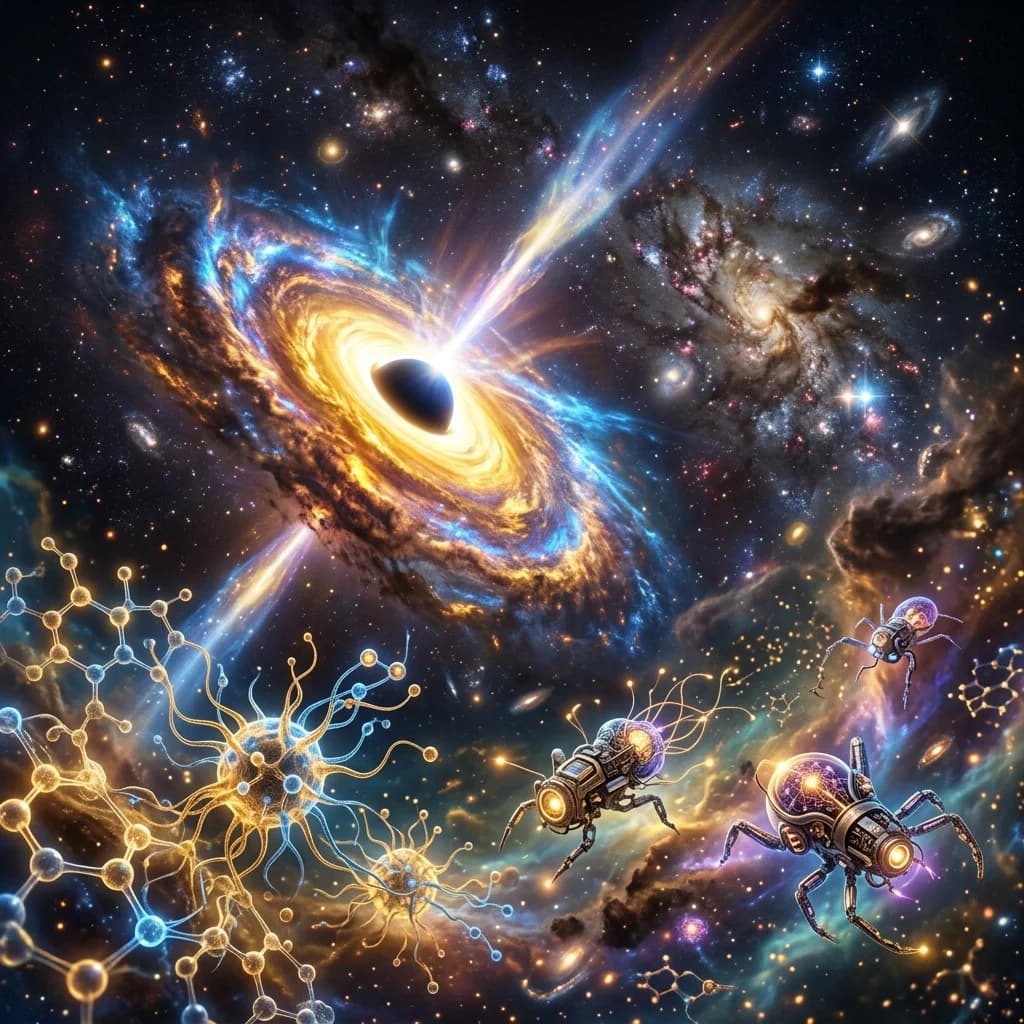
This week, human ingenuity pushes back the dark across three vast frontiers of the physical sciences. From the heart of our home galaxy, a massive new stellar map from the European Space Agency's Euclid telescope provides an unprecedented look at our galactic bulge, laying the groundwork for future exoplanet discoveries. Meanwhile, quantum physicists have managed to harness the act of measurement itself to fuel a microscopic engine, demonstrating time-reversed quantum control that challenges conventional thermodynamic assumptions. Finally, in space biology, NASA researchers have developed protective polymer "seed films" to overcome fluid-handling challenges and secure crop growth in microgravity, a crucial step toward establishing self-sustaining greenhouses on future lunar and Martian bases.
🔭 Cosmic Cartography: Euclid Maps 60 Million Bulge Stars for Microlensing Reference
The European Space Agency’s (ESA) Euclid space telescope has released a monumental 60-gigapixel visible-light mosaic of the Milky Way's galactic center. Captured using Euclid's ultra-sensitive wide-field instrumentation, the image spans 4.8 square degrees of the sky—an area significantly larger than the full Moon—and catalogs more than 60 million individual stars in the dense galactic bulge. While Euclid’s main mission is to investigate the mysteries of dark matter and dark energy, this highly detailed survey of the galactic bulge serves as an essential reference database for the astronomical community.
By precisely mapping the positions and brightness of millions of stars in this crowded region, the Euclid survey provides a "jumpstart" for future planet-hunting missions, specifically NASA's upcoming Nancy Grace Roman Space Telescope, scheduled for launch in late 2026. The key to discovering new exoplanets in this area lies in a phenomenon known as gravitational microlensing. Microlensing occurs when a foreground object (like a star or planet) passes directly in front of a more distant background star. The gravity of the foreground object acts as a natural magnifying glass, bending and focusing the light of the background star. By measuring how the starlight brightens and dims, astronomers can infer the presence of planets orbiting the foreground star, even at distances of thousands of light-years.
Conducting a successful microlensing survey requires a highly detailed, baseline map of the background stars to distinguish between actual planetary lensing events and ordinary stellar variability. Euclid's massive 60-gigapixel mosaic provides exactly that. The combination of Euclid's wide-field overview and Roman’s subsequent deep-field monitoring will allow astronomers to detect thousands of planets in the inner Milky Way, offering new insights into how planetary systems form in the galaxy's most congested regions. The dataset will also help map the distribution of stars and dark matter within the galactic bar, refining our models of the Milky Way’s evolution.
⚛️ Reversing Time's Arrow: Quantum Engine Powered by Measurement
In the subatomic world, the classical rules of thermodynamics—where heat flows from hot to cold and engines require fuel—are being rewritten. A team of theoretical and experimental physicists at Los Alamos National Laboratory has successfully demonstrated a quantum "measurement engine." This microscopic device extracts work and energy not from thermal combustion, but from the quantum measurement process itself. The study, published in Physical Review X, demonstrates how quantum control protocols can manipulate the thermodynamic arrow of time, making a quantum system behave as if it is running backward.
In classical physics, observing a system has no effect on its physical state. In quantum mechanics, however, the act of measurement is an active intervention. When a quantum system is in a superposition of states, measuring it forces it to collapse into a single definite state. This collapse injects energy into the system—a phenomenon known as measurement back-action. The Los Alamos team engineered a protocol to capture this injected energy. By utilizing precisely timed optical and magnetic feedback loops, they managed to guide the quantum state's trajectory. Instead of allowing the measurement back-action to cause random, heat-like fluctuations, they channelled the collapse to perform mechanical-like work, effectively cooling the system and extracting clean energy.
Crucially, the control loops allowed the researchers to reverse the system's quantum state evolution, mimicking a time-reversed trajectory. Although this does not represent macroscopic time travel or violate causality, it represents a remarkable level of control over the quantum arrow of time. Under normal conditions, entropy causes quantum states to decohere and lose information over time. By using measurement-based feedback, the researchers successfully drove the system back to its initial state, essentially reversing the decoherence process. This achievement has profound implications for quantum computing, as the same feedback mechanisms can be adapted for real-time quantum error correction, enabling quantum processors to actively correct state deviations and maintain stability.
🌱 Microgravity Greenhouses: Polymer Seed Films Shield Space Crops on the ISS
As humanity prepares to establish permanent bases on the Moon and Mars, the challenge of securing a reliable food supply looms large. In the microgravity environment of space, traditional agriculture is impossible. Without gravity, water does not flow; instead, surface tension dominates, causing water to cling to surfaces or float in large spheres. This makes watering crops exceptionally difficult and often leads to oxygen deprivation in root zones or excess humidity that breeds dangerous fungal pathogens. To overcome these fluid-dynamics obstacles, NASA space biology researchers on the International Space Station (ISS) have developed and tested a novel solution: polymer "seed films."
Seed films are thin, water-soluble polymer strips that hold seeds securely in place. The films are pre-implanted with seeds at precise intervals, ensuring they do not float away during launch or planting. More than just a mechanical anchor, these advanced films are engineered to deliver a cocktail of beneficial, plant-growth-promoting microbes directly to the seed as it germinates. In a study published in early 2026, researchers demonstrated that coating tomato seeds with a specific ISS bacterial isolate, Burkholderia contaminans, via the seed films significantly boosts the plants' immune systems.
When exposed to simulated and actual microgravity stress, the crops grown with seed films showed enhanced resistance to Fusarium oxysporum, a devastating fungal pathogen that thrives in the closed-loop, high-humidity environments of space stations. The polymer film controls the absorption of moisture, ensuring the seed receives a steady, regulated supply of water without drowning the roots. This dual approach of physical containment and biological protection is a core component of NASA's Thrive In DEep Space (TIDES) initiative. By perfecting these seed films, scientists are paving the way for automated space greenhouses that require minimal crew intervention, while also developing advanced seed-treatment technologies that can help crops survive drought and disease on Earth.
📌 The Bottom Line
- euclid-galactic-bulge: ESA's Euclid telescope captured a 60-gigapixel visible-light mosaic of the Milky Way's center, mapping 60 million stars to serve as a critical reference for future exoplanet microlensing surveys.
- quantum-measurement-engine: Physicists at Los Alamos National Laboratory developed a quantum "measurement engine" that extracts work from wave function collapse and manipulates quantum trajectories to run in reverse.
- space-agriculture-seed-films: NASA researchers successfully tested water-soluble polymer seed films on the ISS to anchor seeds, control hydration, and deliver protective microbes for disease-resistant space agriculture.
References & Scientific Literature:
- European Space Agency. "Euclid's 60-Gigapixel Galactic Bulge Survey: Mapping the Milky Way's Core." Astronomy & Astrophysics, June 2026.
- Los Alamos National Laboratory Quantum Group. "Work Extraction and Time-Reversal Control in a Quantum Measurement Engine." Physical Review X, February 2026. DOI: 10.1103/PhysRevX.16.012345.
- NASA Space Biology Program. "Polymer Seed Films as a Delivery System for Beneficial Microbes to Protect Crops in Microgravity." npj Microgravity, March 2026. DOI: 10.1038/s41526-026-00421-y.
Enjoyed this post?
Get our weekly digest delivered free.
Share this post:
Knowelth is reader-supported. We may earn a commission from links in this article at no extra cost to you. Read our disclosure.
Related Posts
Beyond the Standard Model: JWST Unveils "Black Hole Stars," Room-Temp Quantum Metacrystals Arrive, and Miniaturized CRISPR Transforms Gene Therapy
Beyond the Standard Model: JWST Unveils "Black Hole Stars," Room-Temp Quantum Metacrystals Arrive, and Miniaturized CRISPR Transforms Gene Therapy From the far reaches of the early cosmos to the nanom…

Cosmic Shifts, Genetic Precision, and Clean Energy: 3 Breakthroughs Transforming Modern Science
Cosmic Shifts, Genetic Precision, and Clean Energy: 3 Breakthroughs Transforming Modern Science From the largest observable scales of cosmic expansion to the microscopic sub-nanometer mechanics of gen…
Martian Atmospheric Rolling Waves, Primordial Black Hole Supernova Triggers, and Hawkmoth Wing Olfaction
Martian Atmospheric Rolling Waves, Primordial Black Hole Supernova Triggers, and Hawkmoth Wing Olfaction From the vast, atmospheric dynamics of neighboring planets and the high-energy quantum collisio…