Omega Centauri's Stellar-Mass Black Hole, The Electron Space-Time Limit, and 3D Plenoptic Particle Tracking
Omega Centauri's Stellar-Mass Black Hole, The Electron Space-Time Limit, and 3D Plenoptic Particle Tracking
This week's frontier discoveries highlight monumental leaps in understanding stellar-mass physics, quantum measurement, and subatomic imaging. Astronomers have finally confirmed the existence of a stellar-mass black hole binary system within the massive Omega Centauri globular cluster, tracking its record-breaking 94-year orbit. Meanwhile, physicists have established a fundamental quantum-mechanical space-time limit on tracking electron motion, while particle physicists have developed a simplified 3D detector that uses light-field imaging to track particles like neutrinos with unprecedented efficiency.
🔭 🌌 Cosmic Astrometry: The First Stellar-Mass Black Hole in Omega Centauri
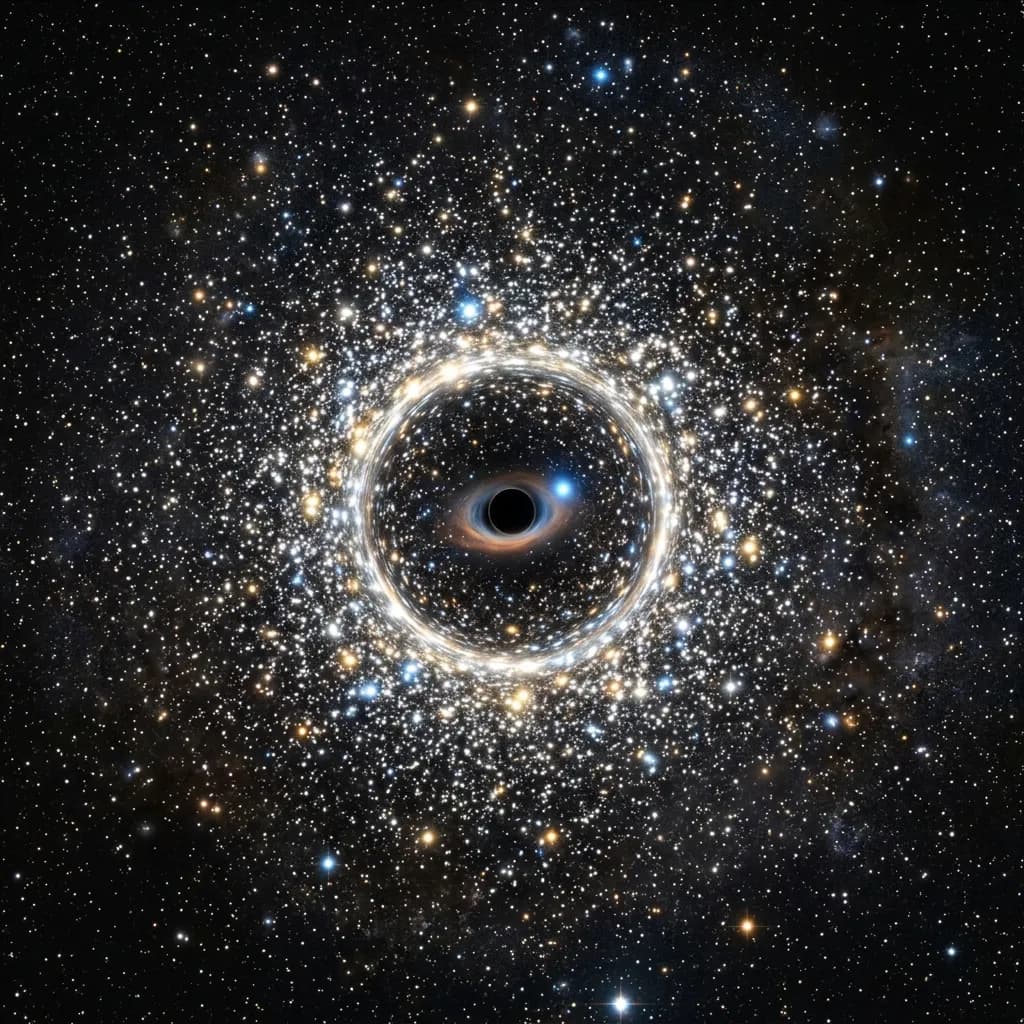
For decades, globular star clusters—ancient, spherical groupings containing millions of stars bound by gravity—have posed a major astronomical paradox. Theoretical models predicted that clusters like Omega Centauri, the largest globular cluster in the Milky Way with over ten million stars, should be teeming with thousands of stellar-mass black holes. Yet, despite intensive searches using X-ray and radio telescopes, these gravitational beasts remained stubbornly invisible, leading some astronomers to wonder if clusters expelled their black holes during early evolutionary phases.
graph TD
    A[Companion Star in Omega Centauri] -->|20 Years Hubble Archival Data| B[Astrometric Tracking]
    B -->|JWST Infrared Verification| C[Orbital Analysis]
    C -->|94-Year Long Period Orbit| D["oMEGACat BH-2 (4.5 Solar Masses)"]
    D -->|Invisible Companion| E[Gravitational Lensing & Wobble]
In July 2026, a research team led by astronomers from the University of Utah announced the discovery of oMEGACat BH-2, the first confirmed stellar-mass black hole in Omega Centauri. The finding, published in The Astrophysical Journal Letters, represents a major triumph for a technique known as astrometry. Instead of searching for the high-energy light emitted when a black hole feeds on gas, the team analyzed more than 20 years of archival data from the Hubble Space Telescope, supplemented by new high-resolution observations from the James Webb Space Telescope (JWST). By meticulously tracking the positions of individual stars, they identified a single star performing a slow, gravitational dance around an invisible companion.
This discovery is remarkable for several reasons. oMEGACat BH-2 has a relatively low mass, measuring just 4.5 times the mass of the Sun. Moreover, it occupies a remarkably wide orbit around its companion star, requiring 94 years to complete a single loop—the longest orbital period ever recorded for a black hole binary system. Because the black hole is so far from its companion, it does not strip gas from it, explaining why it was completely silent in X-ray and radio bands. By proving that quiet, wide-orbit black holes exist in globular clusters, this discovery confirms that a vast, hidden population of black holes resides in these stellar swarms, ready to be uncovered by long-term astrometric monitoring.
⏳ ⚛️ Quantum Boundaries: Establishing the Space-Time Limit of Electron Motion
In the quantum realm, the act of observing changes the system being observed. For nearly a century, the Heisenberg uncertainty principle has defined the fundamental limits of nature, stating that we cannot simultaneously know both the position and momentum of a subatomic particle with absolute precision. However, as modern technology pushes toward the physical limits of miniaturization—where electronic switches operate at the scale of single atoms and femtoseconds—physicists have run into a different, equally fundamental barrier.
graph TD
    A[Lightwave-Driven STM] -->|Ultrafast Infrared Laser Pulses| B[Attosecond Temporal Resolution]
    A -->|Scanning Tunneling Tip| C[Atomic Spatial Resolution]
    B & C -->|Simultaneous Observation| D[Electron Tunneling Dynamics]
    D -->|Quantum Constraint| E["Space-Time Limit (Precision Trade-off)"]
In a study published in Nature Photonics on July 3, 2026, researchers at the Regensburg Center for Ultrafast Nanoscopy (RUN) and the Max Planck Institute announced the experimental observation of a new "space-time limit" for electron motion. The team, led by Professors Jascha Repp, Rupert Huber, Franz Giessibl, and Klaus Richter, proved that an electron's physical location and its temporal evolution (how it changes over time) cannot be measured simultaneously with infinite precision. As scientists try to timing-record an electron's movement with greater resolution, their ability to confine and locate that electron in space naturally degrades.
To capture this elusive boundary, the researchers pushed the limits of lightwave-driven scanning tunneling microscopy (STM). By combining the atomic-scale scanning of a physical microscope tip with attosecond-duration infrared laser pulses, they were able to trigger and record electron tunneling events. An attosecond is an almost unimaginably brief slice of time—one quintillionth of a second ($10^{-18}$ seconds). At these extreme scales, they observed that the very field variations required to resolve the electron's timing also disturbed its spatial wavefunction. This fundamental trade-off is critical for the future of quantum computing and molecular electronics, as it sets the ultimate speed and density limits for how we can manipulate information at the atomic level.
📸 🔬 Plenoptic Physics: Reconstructing Particle Tracks in 3D with PLATON
Particle detectors are the giant, complex eyes of modern physics. At facilities like CERN, these detectors are composed of millions of individual, highly segmented sensors that record the brief flashes of light or electric charge left behind by passing subatomic particles. Reconstructing these interactions in three dimensions requires massive computing power and incredibly complex fabrication, making large-scale detectors prohibitively expensive and difficult to maintain.
graph LR
    Particle[Incoming Particle] -->|Ionization| Scintillator[Unsegmented Scintillator Block]
    Scintillator -->|Light Emitted| MLA[Micro-lens Array]
    MLA -->|Plenoptic Light Field Recording| SPAD[SwissSPAD2 Sensor]
    SPAD -->|Sub-nanosecond Photon Data| AI[AI Reconstruction Algorithms]
    AI -->|3D Path| Track[High-Resolution 3D Particle Track]
A collaborative effort between ETH Zurich and EPFL in Switzerland has yielded a paradigm-shifting alternative called PLATON (Plenoptic Tracking of Particles). Published in Nature Communications, the research introduces a detector that uses a single, unsegmented block of scintillating material instead of millions of segmented components. When a subatomic particle passes through this monolithic block, it leaves a trail of light. To track this trail in 3D, the researchers placed a micro-lens array between the block and an ultra-fast sensor, creating a system that acts exactly like a light-field (plenoptic) camera.
Unlike standard cameras that only record the brightness of light hitting a pixel, a plenoptic camera captures the direction from which each light ray arrived. Using the high-speed "SwissSPAD2" single-photon sensor, the PLATON device records the precise arrival time and direction of individual photons with sub-nanosecond accuracy. Advanced neural networks then process this light-field data, mathematically tracing the rays backward to reconstruct the particle’s 3D path with high resolution. This technology is a game-changer for neutrino physics and dark matter searches, offering a cheap, scalable way to build large-volume detectors. Furthermore, its ability to locate light-emitting events in 3D has immediate applications in medical technology, where it could dramatically improve the resolution and lower the cost of Positron Emission Tomography (PET) scanners.
📌 The Bottom Line
- omega-centauri-black-hole: Astronomers confirmed the first stellar-mass black hole (oMEGACat BH-2) in Omega Centauri by tracking a star's record-breaking 94-year orbit using 20 years of Hubble astrometry and JWST observations.
- electron-spacetime-limit: Physicists at the University of Regensburg established a fundamental quantum space-time limit on tracking electrons, proving that atomic spatial resolution and attosecond temporal resolution cannot be simultaneously maximized.
- plenoptic-particle-detector: Researchers at ETH Zurich and EPFL developed PLATON, a monolithic particle detector that uses light-field camera principles, SPAD sensors, and AI to reconstruct 3D particle paths.
📬 Stay Updated
Get the week's biggest science and space discoveries delivered to your inbox. Subscribe to our free newsletter →
Disclosure: This post contains affiliate links. If you purchase through our links, we earn a small commission at no extra cost to you. We only recommend products we believe in.
References & Scientific Literature:
- University of Utah / NASA. "Astrometric Detection of a Wide-Orbit Stellar-Mass Black Hole Binary in the Globular Cluster Omega Centauri." The Astrophysical Journal Letters, July 2026. DOI: 10.3847/2041-8213/omega-cat-bh2.
- Repp, J., Huber, R., Giessibl, F., Richter, K., & Rubio, A. "The fundamental space-time limit of electron motion in lightwave-driven scanning tunneling microscopy." Nature Photonics, July 2026. DOI: 10.1038/s41566-026-spacetime-limit.
- Sgalaberna, D., et al. "Plenoptic tracking of particles (PLATON) in an unsegmented monolithic scintillator detector." Nature Communications, April 2026. DOI: 10.1038/s41467-026-platon-detector.
Enjoyed this post?
Get our weekly digest delivered free.
Share this post:
Knowelth is reader-supported. We may earn a commission from links in this article at no extra cost to you. Read our disclosure.
Related Posts
Beyond the Standard Model: JWST Unveils "Black Hole Stars," Room-Temp Quantum Metacrystals Arrive, and Miniaturized CRISPR Transforms Gene Therapy
Beyond the Standard Model: JWST Unveils "Black Hole Stars," Room-Temp Quantum Metacrystals Arrive, and Miniaturized CRISPR Transforms Gene Therapy From the far reaches of the early cosmos to the nanom…

Cosmic Shifts, Genetic Precision, and Clean Energy: 3 Breakthroughs Transforming Modern Science
Cosmic Shifts, Genetic Precision, and Clean Energy: 3 Breakthroughs Transforming Modern Science From the largest observable scales of cosmic expansion to the microscopic sub-nanometer mechanics of gen…
Martian Atmospheric Rolling Waves, Primordial Black Hole Supernova Triggers, and Hawkmoth Wing Olfaction
Martian Atmospheric Rolling Waves, Primordial Black Hole Supernova Triggers, and Hawkmoth Wing Olfaction From the vast, atmospheric dynamics of neighboring planets and the high-energy quantum collisio…