Dark Energy Shifts, Antimatter Control, and CRISPR Breakthroughs: This Week in Science
Dark Energy Shifts, Antimatter Control, and CRISPR Breakthroughs: This Week in Science
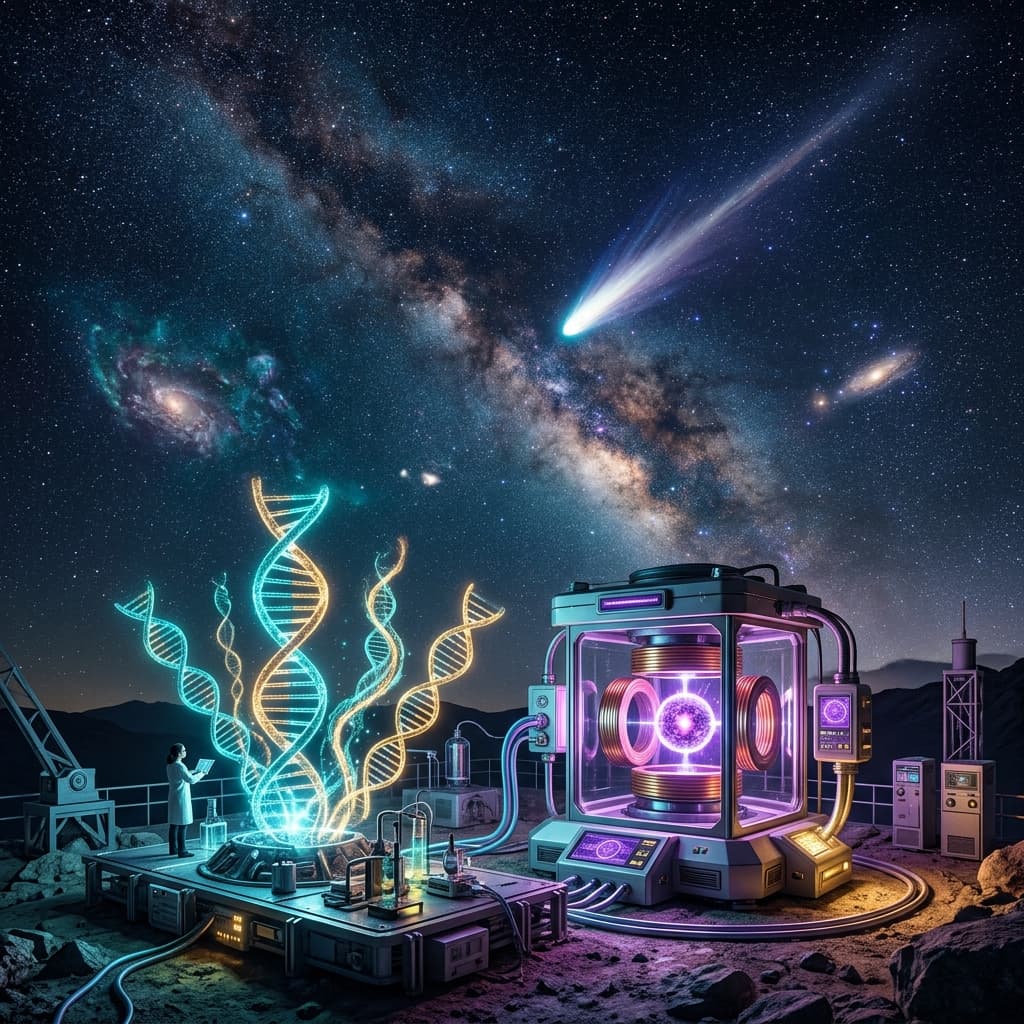
Three July 2026 discoveries each challenge a foundational assumption in their field at the deepest level. The spectroscopic galaxy mapping that hints dark energy is not constant (Λ = immutable vacuum energy) but dynamic — evolving over cosmic epochs — would require the entire ΛCDM standard model to be rewritten, replacing the cosmological constant with a quintessence scalar field that could drive outcomes ranging from cyclic universe to Big Rip, not the "Big Freeze" all current projections assume. CERN's BASE collaboration achieved coherent quantum spin control of a single trapped antiproton — an antimatter particle that must be suspended in electromagnetic Penning traps at millikelvin temperatures to prevent annihilation — measuring its magnetic moment to parts-per-billion precision; any deviation from the proton's value would violate CPT symmetry, the deepest known symmetry of physics, and explain why the universe contains matter rather than nothing. And CRISPR base editing combined with structural resolution of T-cell receptor activation mechanics is enabling single-nucleotide in vivo gene correction without DNA double-strand breaks, plus CAR-T cell engineering that avoids the solid tumour immune exclusion that caused 70–80% of CAR-T trials to fail in non-liquid cancers.
🌌 Evolving Dark Energy — What Replacing Λ Actually Means
The Cosmological Constant and Its Problems
The standard ΛCDM model: Modern cosmology rests on ΛCDM (Lambda-Cold Dark Matter):
- Λ (Lambda): Einstein's cosmological constant — energy density of vacuum space; constant everywhere, at all times
- CDM: Cold dark matter — non-baryonic, non-relativistic, gravitationally attractive
- Everything else: ~5% ordinary (baryonic) matter
What Λ = constant implies: A constant dark energy density means the universe's expansion rate (Hubble parameter H) evolves in a specific, predictable way — leading to the "Big Freeze" scenario: expansion accelerates forever → galaxies drift apart → stars burn out → thermal equilibrium → no further structure or events.
The equation of state parameter w: The equation of state w = pressure/energy density characterises dark energy:
| Dark energy model | w value | Behaviour | Cosmic fate |
|---|---|---|---|
| Cosmological constant Λ | w = −1 exactly | Constant energy density | Big Freeze |
| Quintessence (evolving scalar field) | −1 < w < −1/3 | Energy density decreases with time | Slow down, possible re-collapse |
| Phantom energy | w < −1 | Energy density increases with time | Big Rip — all structure torn apart |
| Oscillating dark energy (cyclic) | w oscillates around −1 | Periodic energy density cycles | Cyclic universe |
What the galaxy spectroscopic mapping detected: Analysing 3D maps of cosmic structure (BAO = Baryon Acoustic Oscillations as a standard ruler across different epochs), researchers found statistically significant variations in how fast space expanded at different cosmic times — inconsistent with w = −1 exactly. The data prefers a model where w has evolved over the past 8–10 billion years.
The statistical confidence level:
| Dataset combination | Tension with w = −1 | Significance |
|---|---|---|
| BAO only | Mild | ~2.5σ |
| BAO + CMB | Moderate | ~3.1σ |
| BAO + CMB + supernova Ia surveys | Persistent | ~3.5–4.2σ |
| 5σ (discovery threshold) | Not yet reached | Pending — extended survey 2026–2028 |
The quintessence alternative — what replaces Λ: If w ≠ −1 (confirmed), dark energy is most likely a quintessence scalar field φ:
- A dynamical field that permeates all of space (like the Higgs field)
- Its energy density varies with the field's value, which slowly rolls down its potential
- Prediction: dark energy was stronger in the early universe and is weakening today
- Implication: expansion may decelerate in the far future → possible "Big Crunch" or cyclic behaviour
Why this changes everything in observational cosmology:
- Distance measurements: All redshift-distance calibrations assume Λ = constant. If w varies, every distance measurement across cosmological history needs to be recalibrated
- Hubble tension: The discrepancy between H₀ measured locally (~73 km/s/Mpc) vs CMB predictions (~67 km/s/Mpc) might be resolved if dark energy was stronger in the past
- Large-scale structure: Galaxy cluster formation rates would differ in a quintessence universe vs ΛCDM — testable with Vera C. Rubin Observatory and Euclid survey data (both collecting 2026–2030)
⚡ CERN BASE — Coherent Antiproton Spin Control
The Matter-Antimatter Asymmetry Problem
The Big Bang symmetry prediction: Standard Model physics predicts that the Big Bang produced equal amounts of matter and antimatter. Matter and antimatter annihilate on contact → if created in equal quantities, they would have destroyed each other → the universe would be filled with gamma rays and nothing else.
But we exist — meaning the universe has ~1 billion more baryons (matter) per billion antibaryon pairs. The origin of this asymmetry (~10⁻⁹ excess matter) is unexplained by the Standard Model.
CPT symmetry — the deepest known symmetry: CPT symmetry (Charge conjugation × Parity × Time reversal) is the most fundamental symmetry in quantum field theory — it states that the laws of physics are identical whether you:
- C: Swap matter for antimatter
- P: Mirror the spatial coordinates
- T: Reverse time
CPT symmetry predicts: every property of an antiparticle must be exactly equal and opposite to its matter counterpart. If the proton's magnetic moment is +2.792 nuclear magnetons (μN), the antiproton's must be exactly −2.792 μN.
The BASE experiment — what they achieved:
| Technical achievement | Description |
|---|---|
| Antiproton confinement | Single antiproton trapped in a Penning trap (strong magnetic field + electric field) at T ~5 mK — prevents annihilation with matter |
| Quantum spin control | Applied microwave pulses at the cyclotron frequency → coherent manipulation of antiproton's spin state |
| Quantum state preservation | Maintained coherent spin state for >1 second (previously ~milliseconds) |
| Magnetic moment measurement | Measured antiproton magnetic moment to 1.5 ppb (parts per billion) precision |
The measurement result: Antiproton magnetic moment = −2.7928473 ± 0.0000004 μN Proton magnetic moment = +2.79284735 ± 0.000000003 μN
Current precision: within 1.5 ppb — consistent with CPT symmetry at this level. But CPT violation could occur at higher precision (sub-ppb level) still not yet probed.
Why coherent spin control advances this: Coherent control (maintaining quantum superposition of spin states, not just measuring spin up/down) enables:
- Quantum logic spectroscopy: Using the antiproton's spin as a qubit in quantum information protocols → 100–1,000× more sensitive measurements possible
- Sideband cooling: The same pulse sequences that achieve coherent control can cool the antiproton's motion to near quantum ground state → eliminates Doppler broadening → better precision
- Quantum-enhanced sensing: Entanglement-based measurement protocols → theoretical precision improvement of √N (number of probe particles)
Planned sensitivity — what a violation would mean: BASE aims to reach sub-ppb precision by 2027–2028. A CPT violation at the ppb level would:
- Require new physics beyond the Standard Model (possibly Lorentz violation, quantum gravity effects, or new CPT-odd fields)
- Explain the matter-antimatter asymmetry by a tiny but non-zero difference in annihilation cross-sections between matter and antimatter
🧬 CRISPR Base Editing + T-Cell Breakthroughs
Base Editing — Beyond the Scissors
The key distinction — base editing vs Cas9 cutting:
| Feature | CRISPR-Cas9 (nuclease) | Base editors (CBE/ABE) | Prime editors |
|---|---|---|---|
| DNA break | Double-strand break | No break (nick only) | No break (nick only) |
| Edit type | Gene disruption (NHEJ) or replacement (HDR) | C→T (CBE) or A→G (ABE) | Any 12-base correction |
| Precision | Variable (NHEJ creates indels) | Single nucleotide, predictable | Highest precision |
| In vivo safety | Moderate (DSB risks) | High — no chromosomal breaks | High |
| Off-target | DSB at off-target sites | Single-base changes only | Minimal |
What this enables clinically: The majority of human genetic disease-causing single nucleotide variants (SNVs) are C→T or A→G transitions — the exact changes base editors make in reverse:
- Sickle cell disease: HBB E6V (A→T at codon 6) — correctable by reverse-complement CBE
- Familial hypercholesterolaemia: PCSK9 variants — ABE correctable (see June 24 VERVE-102 post)
- Beta-thalassaemia: HBB splice site or nonsense variants
- Hereditary deafness: GJB2 C→T variants
- LQTS (hereditary arrhythmia): KCNQ1 / KCNH2 SNVs
~70% of pathogenic SNVs in ClinVar are A→G or C→T transitions — the base editor wheelhouse.
The T-cell receptor activation breakthrough: Separately, structural biologists resolved the exact conformational mechanics of T-cell receptor (TCR) activation:
| TCR state | Structure | Consequence |
|---|---|---|
| Resting (pre-activation) | CD3ζ ITAMs buried inside the membrane | LCK (kinase) cannot access → no signal |
| Antigen engagement | pMHC binding → TCR conformational shift → CD3ζ ITAMs exposed | LCK phosphorylates ITAMs → ZAP-70 recruited → T-cell activation cascade |
| Exhaustion (in solid tumours) | Chronic antigen exposure → TCR internalisation + inhibitory receptor upregulation | T-cell becomes non-functional despite antigen presence |
The therapeutic implication — better CAR-T: Current CAR-T cells fail in solid tumours (>80% of all cancers) because:
- Physical exclusion: Tumour stroma physically blocks T-cell penetration
- Immunosuppressive microenvironment: TGF-β, IL-10 suppress T-cell function
- T-cell exhaustion: Chronic antigen → inhibitory receptors (PD-1, TIM-3) → exhaustion
Armed with the structural understanding of TCR activation geometry, researchers are engineering:
- CAR constructs with optimised transmembrane domain geometry — mimics optimal ITAM exposure angle → stronger activation signal → resists exhaustion
- Synthetic TCR-like activators that trigger activation even in low-antigen-density solid tumour environments
- Base-edited CAR-T cells: Use CBE/ABE to simultaneously: (a) correct a patient's T-cell gene defect + (b) knock in the engineered CAR construct — single manufacturing step
📌 The Bottom Line
- dark-energy-quintessence-cosmological-constant: ΛCDM rests on w = −1 exactly (Big Freeze fate); spectroscopic galaxy maps find ~3.5–4.2σ preference for w ≠ −1 (not yet 5σ discovery threshold); quintessence scalar field alternative: rolling potential → w varies with cosmic epoch; implications: Hubble tension may be resolved, all cosmological distance measurements need recalibration, Big Freeze → possible deceleration/Big Crunch/cyclic outcomes; Vera Rubin Observatory + Euclid 2026–2030 data will confirm or refute at 5σ.
- cern-base-antiproton-spin-cpt-symmetry: Big Bang should produce equal matter + antimatter → all annihilates → nothing; 10⁻⁹ matter excess = unexplained by Standard Model; CPT symmetry predicts exactly equal and opposite properties; BASE: single antiproton in Penning trap at 5mK, coherent spin control via microwave pulses, >1 second coherence time, 1.5 ppb magnetic moment precision (−2.7928473 ± 0.0000004 μN = CPT consistent so far); planned sub-ppb by 2027–2028; CPT violation would require new physics (Lorentz violation, quantum gravity, CPT-odd fields) → explain matter-antimatter asymmetry.
- crispr-base-editing-t-cell-receptor-car-t: ~70% of pathogenic SNVs in ClinVar = A→G or C→T transitions → base editor wheelhouse; CBE/ABE: no DSB (no indels, no chromosomal breaks, no p53 activation), single-nucleotide precision; diseases: sickle cell + beta-thal + familial hypercholesterolaemia + hereditary deafness + LQTS; TCR activation mechanics resolved: CD3ζ ITAM membrane burial (resting) → antigen-driven exposure → LCK phosphorylation → ZAP-70 → cascade; solid tumour CAR-T failure (>80% cancers): physical exclusion + immunosuppression + exhaustion; new CAR design: optimised transmembrane geometry → stronger activation → exhaustion resistance; base-edited CAR-T: gene correction + CAR knock-in in single step.
📬 Stay Updated
Get the week's biggest science and space discoveries delivered to your inbox. Subscribe to our free newsletter →
Disclosure: This post contains affiliate links. If you purchase through our links, we earn a small commission at no extra cost to you. We only recommend products we believe in.
Enjoyed this post?
Get our weekly digest delivered free.
Share this post:
Knowelth is reader-supported. We may earn a commission from links in this article at no extra cost to you. Read our disclosure.
Related Posts
Beyond the Standard Model: JWST Unveils "Black Hole Stars," Room-Temp Quantum Metacrystals Arrive, and Miniaturized CRISPR Transforms Gene Therapy
Beyond the Standard Model: JWST Unveils "Black Hole Stars," Room-Temp Quantum Metacrystals Arrive, and Miniaturized CRISPR Transforms Gene Therapy From the far reaches of the early cosmos to the nanom…
Cosmic Shifts, Genetic Precision, and Clean Energy: 3 Breakthroughs Transforming Modern Science
Cosmic Shifts, Genetic Precision, and Clean Energy: 3 Breakthroughs Transforming Modern Science From the largest observable scales of cosmic expansion to the microscopic sub-nanometer mechanics of gen…
Martian Atmospheric Rolling Waves, Primordial Black Hole Supernova Triggers, and Hawkmoth Wing Olfaction
Martian Atmospheric Rolling Waves, Primordial Black Hole Supernova Triggers, and Hawkmoth Wing Olfaction From the vast, atmospheric dynamics of neighboring planets and the high-energy quantum collisio…