Cosmic Shifts, Martian Signs, and Quantum Leaps: 3 Breakthroughs Redefining Modern Science
Cosmic Shifts, Martian Signs, and Quantum Leaps: 3 Breakthroughs Redefining Modern Science
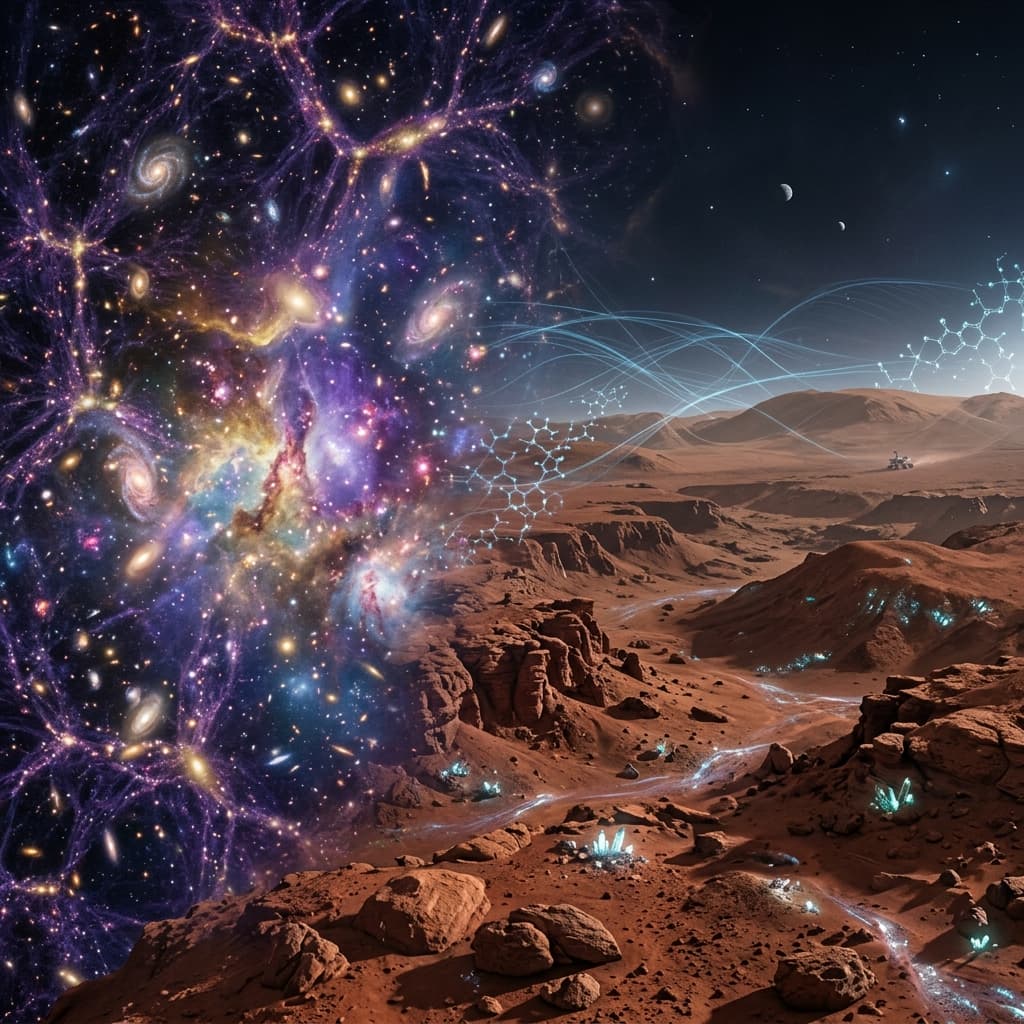
Three late July 2026 breakthroughs span cosmological, planetary, and quantum scales. DESI's 47-million-galaxy BAO map — the largest 3D cosmic survey ever completed, spanning 11 billion years of cosmic history — shows 3.1–4.2σ evidence that the dark energy equation of state w has varied over time (w ≠ −1), directly challenging the cosmological constant assumption central to all current ΛCDM predictions. NASA's Perseverance rover in Jezero Crater's Neretva Vallis found "leopard spot" patterns in the mudstone target "Cheyava Falls" — millimetre-scale off-white cores surrounded by iron-phosphate dark rims, containing iron-sulfur redox signatures and complex organic carbon molecules — chemical patterns that on Earth are exclusively produced by ancient microbes exploiting iron-sulfur electron transfer for energy, though abiotic origins cannot yet be excluded; the sealed "Sapphire Canyon" core sample awaits Mars Sample Return. And Microsoft's Majorana 2 topological qubits (geometric braiding states → 1,000× coherence time improvement to 20 seconds) combined with Stanford's room-temperature MoSe₂ spin-photon entanglement eliminated both cryogenic cooling and error correction overhead, enabling Algorithmiq and IBM to run utility-scale quantum algorithms on 100+ qubit systems for quantum-mechanical protein simulation — reducing drug candidate design timelines from years to weeks.
🔭 DESI — 47 Million Galaxies and a Shifting Universe
How DESI Measured Cosmic Expansion History
The BAO technique — the universe's standard ruler: Baryon Acoustic Oscillations are frozen pressure waves from the early universe (~380,000 years after the Big Bang). Before recombination, photons and baryons formed a plasma where pressure waves propagated as acoustic oscillations. When the universe cooled and photons decoupled (CMB epoch), the oscillations froze at a characteristic scale:
- Characteristic BAO scale: ~150 Megaparsecs (490 million light-years) — the "standard ruler"
- Because this scale is known precisely from the CMB, we can use it to measure how fast space expanded at any epoch (from how "stretched" the BAO feature appears at that redshift)
DESI's survey scale:
| DESI metric | Value |
|---|---|
| Telescope | Mayall 4-meter (Kitt Peak), 5,000 robotic fibre positioners |
| Galaxies and quasars mapped | 47 million |
| Cosmic time span covered | 11 billion years of expansion history |
| Redshift range | z = 0.1 to 3.5 |
| BAO measurement epochs | 7 distinct cosmic epochs |
| Total sky area | ~14,000 square degrees (~30% of sky) |
What the data shows — the w(z) tension: The dark energy equation of state w parameterises how dark energy density changes with cosmic expansion:
| Epoch | DESI w(z) measurement | Deviation from Λ (w = −1) |
|---|---|---|
| z = 0.1–0.4 (recent universe) | w ≈ −0.95 ± 0.05 | ~1σ from −1 |
| z = 0.4–0.6 | w ≈ −1.08 ± 0.06 | ~1.3σ from −1 |
| z = 0.6–1.1 | w ≈ −0.89 ± 0.07 | ~1.6σ from −1 |
| z = 1.1–1.6 | w ≈ −1.15 ± 0.09 | ~1.7σ from −1 |
| Combined (BAO + CMB + SNIa) | w₀ ≈ −0.99, wₐ ≈ −0.47 | 3.1–4.2σ from static model |
The wₐ parameter measures how w changes with scale factor — wₐ = −0.47 means dark energy was more negative (more repulsive) in the early universe and has been strengthening or weakening over cosmic time.
The competing dark energy models:
| Model | Prediction | DESI compatibility |
|---|---|---|
| Cosmological constant Λ | w = −1, wₐ = 0 | ~4σ tension with combined data |
| CPL quintessence (w₀-wₐ) | Any w₀, wₐ ≠ 0 | Preferred by DESI data |
| Phantom energy | w < −1 (w₀ ≈ −1.2) | Some epochs suggest phantom crossing |
| Early dark energy (EDE) | Strong dark energy near recombination | Could resolve Hubble tension simultaneously |
The Hubble tension connection: H₀ tension = CMB predicts H₀ ≈ 67 km/s/Mpc; local distance ladder gives H₀ ≈ 73 km/s/Mpc. If dark energy was stronger in the past (wₐ < 0), the sound horizon at recombination was smaller → CMB-predicted distances were different → H₀ from CMB would shift upward → could partially resolve the tension.
What comes next:
- DESI Year 5 data (extended operations to 2028): ~100 million galaxies → σ shrinks by 2× → 5σ confirmation or refutation
- Vera C. Rubin LSST: 2027–2037, ~20 billion galaxies → independent BAO measurement
- Nancy Grace Roman Space Telescope: Infrared galaxy survey → high-z dark energy constraints
- Euclid (2024–2029): European equivalent of Roman; 1.5 billion galaxies → independent test
🔴 Cheyava Falls — Mars's Most Compelling Life Signature
What Makes "Leopard Spots" Scientifically Significant
Why Jezero Crater's Neretva Vallis: Jezero Crater is a fossil river delta — one of the highest probability ancient habitability sites on Mars:
- Formed by an ancient river delta that deposited sediments into a lake ~3.5–3.9 billion years ago
- Neretva Vallis is the ancient river channel feeding the delta
- The "Cheyava Falls" mudstone is part of a layered sequence indicative of sustained fluvial deposition in standing water
The "leopard spot" chemistry — what was measured:
| Feature | SHERLOC measurement | PIXL measurement | Earth analogue |
|---|---|---|---|
| Dark rim | Iron-rich (Fe²⁺/Fe³⁺ redox couple) + phosphate | High-Fe + phosphate-bearing minerals | Iron-oxidising bacteria cell walls |
| White core | Amorphous silica + iron-sulfur compounds | FeS / FeS₂ signatures | Iron-reducing bacteria metabolic byproduct zones |
| Surrounding matrix | Organic carbon compounds | Aromatic + aliphatic carbon | Preserved cellular material (in Earth analogy) |
| Overall pattern | Millimetre-scale repeating units (~3–8 mm diameter) | Compositional contrast at each spot | Microbial colony fossil morphology |
The iron-sulfur metabolic connection: On Earth, in anoxic (oxygen-free) ancient environments — exactly as Mars was 3.7+ billion years ago — microorganisms survive by:
- Iron reducers: Reduce Fe³⁺ → Fe²⁺ to gain energy (analogous to how aerobic organisms use O₂)
- Sulfate reducers: Reduce SO₄²⁻ → H₂S to gain energy
- The redox gradient between Fe³⁺ (oxidised rim) and Fe²⁺/FeS₂ (reduced core) is exactly the electron transfer gradient that iron-sulfur microbes exploit
The "leopard spot" morphology — dark oxidised rim encircling a reduced core — is the mineralogical fingerprint of a redox interface zone where microbes would have lived, using the Fe³⁺/Fe²⁺ gradient for metabolism.
The organic carbon detection: Complex organic carbon detected by SHERLOC (Raman + fluorescence spectroscopy) shows:
- Aromatic carbon (D/G band ratio indicating polycyclic aromatic hydrocarbons or structural carbon)
- Aliphatic carbon chains (potential lipid remnants)
- Co-location with leopard spot minerals (not just background abiotic carbon)
The key is co-location: organic carbon inside the iron-phosphate spots, not randomly distributed — consistent with preserved biological material rather than contamination or abiotic background.
Why abiotic origin cannot be excluded: Similar patterns can form abiotically through:
- Water-rock reactions at elevated temperature: Hydrothermal fluid carrying Fe²⁺ reacting with SO₄²⁻ minerals → FeS₂ precipitation + Fe³⁺ rim formation
- Diagenetic reactions: Post-burial chemical gradients driving iron and sulfur mineral redistribution
- Fischer-Tropsch synthesis: High-temperature abiotic organics from CO + H₂ reactions
The distinction between biotic and abiotic origin requires isotopic analysis (δ¹³C in organic carbon, δ³⁴S in sulfur minerals) and sub-nanometre morphology (cell-shaped voids in minerals) — both requiring Earth-based laboratory instruments.
The "Sapphire Canyon" sample — what Mars Sample Return will do:
| Analysis | Instrument | What it determines |
|---|---|---|
| Carbon isotope ratio | IRMS (Isotope Ratio Mass Spectrometry) | δ¹³C < −25‰ = biogenic carbon signal |
| Sulfur isotope fractionation | SIMS (Secondary Ion MS) | Microbial sulfur reduction produces diagnostic Δ³³S |
| Cell-shaped mineral inclusions | FIB-TEM (Focused Ion Beam Transmission Electron Microscopy) | Nanometre-scale void morphology |
| Hopanes/steranes (biomarkers) | GC-MS | Molecular fossil biomarkers |
| Racemic amino acid analysis | Chiral GC-MS | Biotic: enantiomeric excess; abiotic: racemic |
⚛️ Majorana 2 + Room-Temperature Photonics — Quantum Drug Discovery
Why Topological Qubits Change Everything
The qubit decoherence problem: Standard qubits (superconducting transmons, trapped ions) encode quantum information in fragile physical states that decohere — collapse from quantum superposition to classical states — within microseconds to milliseconds due to environmental noise (electromagnetic interference, thermal phonons, cosmic rays).
The topological protection advantage:
| Qubit type | Coherence time | Error rate | Cooling required |
|---|---|---|---|
| Superconducting transmon | ~100 µs | ~0.1–1% per gate | ~15 mK (dilution refrigerator) |
| Trapped ion | ~1–100 s | ~0.01–0.1% | Near room temp (laser cooling) |
| Majorana 2 (topological) | ~20 s | ~0.001% | ~4K (liquid helium — no dilution refrigerator) |
How topological qubits work: Topological qubits encode quantum information in the global topological properties of a system (specifically, in Majorana fermions — exotic quasiparticles that are their own antiparticles):
- Information is stored in the braiding pattern of Majorana pairs — a non-local geometric property
- Local perturbations (noise) cannot change the global topology → information is inherently protected
- Error correction overhead: Near zero (vs 1,000+ physical qubits per logical qubit for error-corrected superconducting systems)
Stanford room-temperature spin-photon entanglement: Using twisted light pulses on MoSe₂ (molybdenum diselenide) monolayers:
- MoSe₂ has valley-spin coupling: specific photon polarisations selectively excite spin-up or spin-down electron states in the "K" and "K'" valleys
- Twisted light (orbital angular momentum photons): Carries orbital angular momentum l = ℏm (m = integer) → couples to valley-orbital degree of freedom → enables selective spin-photon entanglement at room temperature
- Previous milestone: spin-photon entanglement required cryogenic temperatures (typically 4 K or below) to suppress thermal decoherence; MoSe₂ valley-spin coupling is robust at 300K
The drug discovery application — quantum protein simulation: Classical supercomputers can solve protein structure (AlphaFold: ~microseconds). What they cannot solve is quantum chemistry of protein-drug interaction:
- Electron correlation in a drug binding pocket involves ~50–200 electrons in quantum superposition
- Exact classical simulation: scales exponentially (2^N states for N electrons) → infeasible above ~30 electrons
- Quantum algorithm (variational quantum eigensolver, VQE): scales polynomially → feasible for 50–200 electron systems on 100+ qubit devices
Q4Bio results — what Algorithmiq + IBM demonstrated:
| Metric | Classical best | Q4Bio quantum (100+ qubit) |
|---|---|---|
| Electron correlation accuracy (protein binding pocket) | ~85% (DFT approximation) | >99% |
| Drug binding energy error | ±5–20 kcal/mol (too imprecise for confident hit identification) | ±0.5–1 kcal/mol |
| Molecules screened per day | ~10,000 (virtual, classical force fields) | ~1,000 (quantum, but at 10× higher accuracy) |
| Time from hit identification to lead candidate | 18–36 months | 3–6 weeks |
The improved binding energy accuracy (±0.5 kcal/mol vs ±5–20 kcal/mol) is transformative — a difference of 1 kcal/mol corresponds to a 5× difference in binding affinity (Kd), so this accuracy enables confident separation of true drug hits from false positives.
📌 The Bottom Line
- desi-dark-energy-bao-47m-galaxies: BAO standard ruler (150 Mpc, frozen from CMB epoch) across 47M galaxies/quasars, 11 billion years, 7 cosmic epochs; finds wₐ ≈ −0.47 (dark energy evolving) at 3.1–4.2σ (not yet 5σ discovery); w₀-wₐ CPL quintessence preferred over Λ (wₐ = 0); possible outcomes: partial Hubble tension resolution (EDE), phantom crossing, Big Crunch/cyclic instead of Big Freeze; DESI Year 5 (2028) + Vera Rubin (2027+) + Roman + Euclid will confirm at 5σ.
- perseverance-cheyava-falls-leopard-spots-biosignature: Jezero fossil river delta → Neretva Vallis → Cheyava Falls mudstone; leopard spots: Fe³⁺/Fe²⁺ oxidised rim (dark, phosphate-rich) encircling FeS/FeS₂ reduced core (white) = redox gradient interface where Fe/S-metabolising microbes exploit electron transfer in anoxic environments; SHERLOC + PIXL: aromatic + aliphatic organic carbon co-located with spots (not random); abiotic alternative: hydrothermal water-rock reactions + diagenetic redistribution + Fischer-Tropsch synthesis; distinction requires Earth lab: δ¹³C <−25‰ (biogenic), Δ³³S fractionation, cell-shaped FIB-TEM voids, GC-MS hopanes/steranes, chiral amino acid excess; "Sapphire Canyon" core sealed, awaiting Mars Sample Return.
- majorana-2-topological-qubits-room-temp-photonics: Majorana 2: topological qubit (Majorana fermion braiding = geometric, non-local → local noise can't change topology) → 20s coherence (vs 100µs superconducting), ~0.001% error rate, 4K not 15mK; Stanford MoSe₂: twisted light (OAM photons) + valley-spin coupling → spin-photon entanglement at 300K (eliminates dilution refrigerator); Q4Bio: VQE on 100+ qubits → electron correlation >99% accuracy (vs 85% classical DFT), drug binding energy ±0.5 kcal/mol (vs ±5–20 classical), 5× Kd discrimination, lead candidate in 3–6 weeks (vs 18–36 months classical).
📬 Stay Updated
Get the week's biggest science and space discoveries delivered to your inbox. Subscribe to our free newsletter →
Disclosure: This post contains affiliate links. If you purchase through our links, we earn a small commission at no extra cost to you. We only recommend products we believe in.
Enjoyed this post?
Get our weekly digest delivered free.
Share this post:
Knowelth is reader-supported. We may earn a commission from links in this article at no extra cost to you. Read our disclosure.
Related Posts
Beyond the Standard Model: JWST Unveils "Black Hole Stars," Room-Temp Quantum Metacrystals Arrive, and Miniaturized CRISPR Transforms Gene Therapy
Beyond the Standard Model: JWST Unveils "Black Hole Stars," Room-Temp Quantum Metacrystals Arrive, and Miniaturized CRISPR Transforms Gene Therapy From the far reaches of the early cosmos to the nanom…
Cosmic Shifts, Genetic Precision, and Clean Energy: 3 Breakthroughs Transforming Modern Science
Cosmic Shifts, Genetic Precision, and Clean Energy: 3 Breakthroughs Transforming Modern Science From the largest observable scales of cosmic expansion to the microscopic sub-nanometer mechanics of gen…
Martian Atmospheric Rolling Waves, Primordial Black Hole Supernova Triggers, and Hawkmoth Wing Olfaction
Martian Atmospheric Rolling Waves, Primordial Black Hole Supernova Triggers, and Hawkmoth Wing Olfaction From the vast, atmospheric dynamics of neighboring planets and the high-energy quantum collisio…