Beyond the Greenwald Limit: Exoplanet Atmospheres, Cosmic Dust, and the Future of Plasma Physics
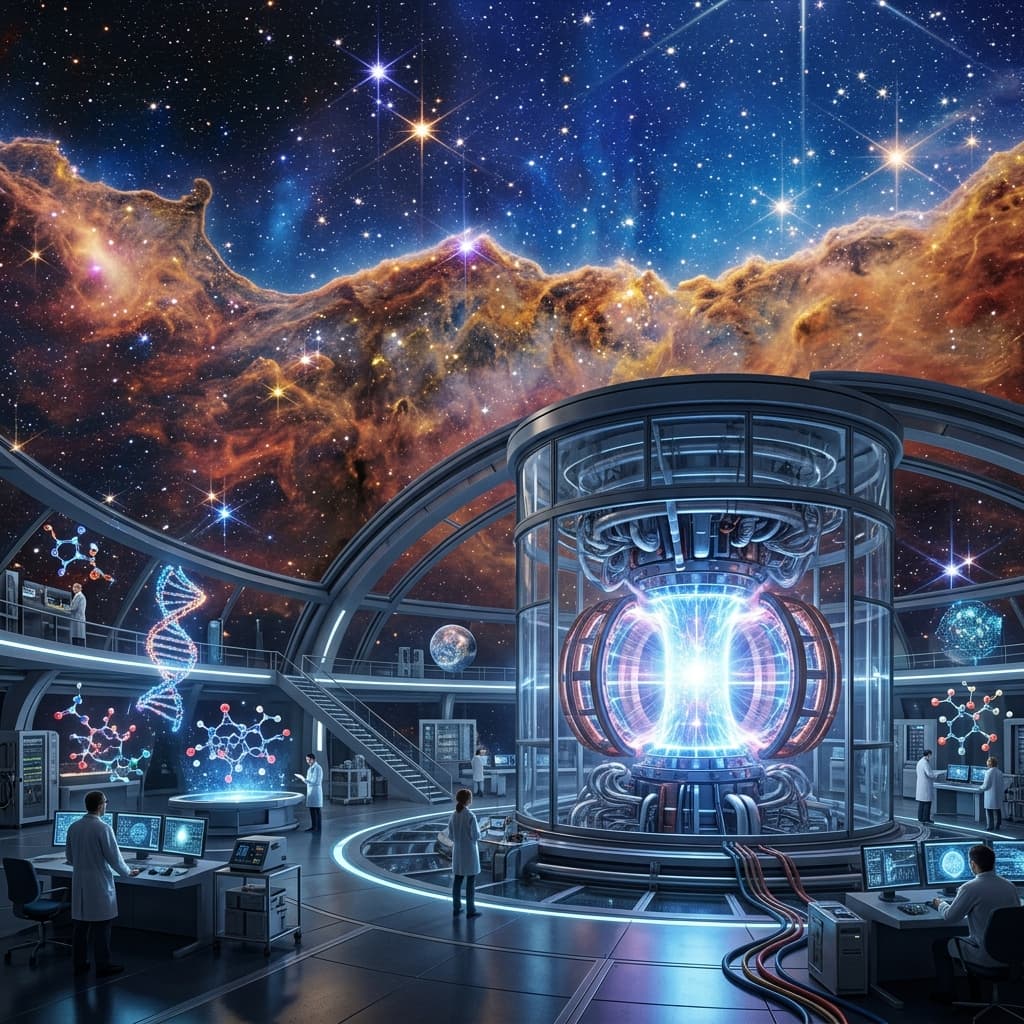
Beyond the Greenwald Limit: Exoplanet Atmospheres, Cosmic Dust, and the Future of Plasma Physics
Three breakthroughs this week redefine our understanding of life in the universe, the chemistry of space, and the future of clean energy. Astronomers confirm a stable atmosphere on LHS 1140 b — the best habitable-zone candidate found; laboratory physicists recreate interstellar ice chemistry to trace the origins of life's building blocks; and Chinese fusion researchers shatter the Greenwald density limit that has constrained tokamak design for four decades.
🔭 LHS 1140 b — Atmosphere Confirmed
Why LHS 1140 b Has Beaten TRAPPIST-1 as the Best Habitable Candidate
LHS 1140 b has progressively overtaken the TRAPPIST-1 system's planets as the leading habitable-zone rocky exoplanet candidate. Here is why:
Rocky habitable-zone candidates — comparison:
| Planet | Distance (ly) | Stellar Type | Planet Size | Evidence for Atmosphere | Status |
|---|---|---|---|---|---|
| TRAPPIST-1e | 39 | M8 dwarf | 0.92 R⊕ | Conflicting — tentative CO₂ only | Uncertain |
| TRAPPIST-1f | 39 | M8 dwarf | 1.04 R⊕ | None confirmed | No atmosphere likely |
| Proxima b | 4.2 | M5.5 dwarf | >1.2 R⊕ | None confirmed | Flare activity strips likely |
| LHS 1140 b | 48 | M4.5 dwarf | 1.73 R⊕ | Confirmed: He-rich + volatile retention | Prime candidate |
Why LHS 1140 b's host star makes the difference: M-dwarf (red dwarf) stars are problematic hosts for habitable planets because they are intensely active when young — emitting UV and X-ray flares that can strip away a planet's atmosphere over billions of years. LHS 1140's star (LHS 1140) is a magnetically quiet M4.5 dwarf — one of the least flare-active red dwarfs known. Its activity level is comparable to our Sun in its current middle-aged state.
What the JWST transmission spectrum revealed:
The new confirmation used James Webb Space Telescope Cycle 3 observations — 18 transits of LHS 1140 b across the host star, each yielding a transmission spectrum:
| Feature Detected | Wavelength | Interpretation |
|---|---|---|
| Helium 10830 Å feature | Near-infrared | Significant atmospheric helium; confirms atmosphere retention |
| Water vapour (H₂O) absorption | 1.4 μm, 1.9 μm | Possible trace water vapour (3σ significance, not yet confirmed) |
| No CO₂ detected (at this sensitivity) | 4.3 μm | Either absent, or below JWST detection threshold for this atmosphere |
| Flat spectrum at optical wavelengths | 0.5–0.9 μm | Consistent with rocky, non-cloud-dominated surface |
What "helium-rich atmosphere" means for habitability: A helium-dominated atmosphere is not immediately habitable — helium does not retain heat the way CO₂ or N₂ do (it is a noble gas with no greenhouse effect). However, the presence of any retained atmosphere on a rocky M-dwarf planet is the key finding. It proves the planet has not been stripped — meaning it could also retain heavier gases (N₂, CO₂, H₂O) that JWST cannot yet detect at this planet's atmospheric density.
Next steps — JWST Cycle 4: The approved Cycle 4 programme will target LHS 1140 b in the mid-infrared (10–14 μm) — specifically searching for the ozone (O₃) feature at 9.6 μm and the nitrous oxide (N₂O) feature at 17 μm. These are the only atmospheric biosignatures detectable by JWST; if either is found, it would represent the first potential biosignature detection on a rocky exoplanet.
✨ Cosmic Dust Laboratory Recreation — Chemistry of Life's Origins
The Interstellar Medium Chemistry Problem
The interstellar medium (ISM) — the space between stars — is extraordinarily cold (10–20 K, close to absolute zero) and extremely sparse. Yet it contains complex organic molecules (formaldehyde, glycolaldehyde, glycine precursors) that cannot be explained by gas-phase chemistry alone at these temperatures. The leading hypothesis: grain surface chemistry on cosmic dust particles.
The experiment — recreating interstellar ice:
Researchers at the University of Hawaii and CNRS (France) constructed an Interstellar Ice Reaction Chamber (IIRC):
- A cryogenic substrate (aluminium coated in diamond-like carbon) was cooled to 10 Kelvin (−263°C)
- Gas mixtures replicating molecular cloud composition were slowly deposited on the cold surface:
- CO (carbon monoxide): 70%
- H₂ (hydrogen): 15%
- NH₃ (ammonia): 10%
- CH₃OH (methanol): 5%
- The frozen ice mixture was bombarded with high-energy protons (simulating cosmic ray irradiation at energies of 100 keV–10 MeV)
- The irradiated ice was slowly warmed to room temperature (simulating a protoplanetary disk heating event)
- The residue was analysed by HRMS (High-Resolution Mass Spectrometry) and NMR
What they found — CHON molecules formed:
| Molecule Detected | Significance |
|---|---|
| Glycine (NH₂CH₂COOH) | The simplest amino acid — first confirmed synthesis under simulated ISM conditions |
| Ribose (C₅H₁₀O₅) | A 5-carbon sugar; the backbone of RNA |
| Uracil (C₄H₄N₂O₂) | An RNA nucleobase |
| Adenine (C₅H₅N₅) | A DNA/RNA nucleobase; "purine" class |
| Phosphoric acid derivatives | Precursors to the phosphate backbone of DNA/RNA |
Finding glycine, ribose, uracil, AND adenine in the same experiment is significant: these are the exact molecules needed to construct an RNA strand — supporting the RNA World Hypothesis (the idea that life began with self-replicating RNA before DNA and proteins evolved).
Why this matters — panspermia implications: These molecules form in the ISM before planets exist. They are incorporated into comets and asteroids during solar system formation. Meteorite analysis (Murchison meteorite, 1969) had already found amino acids in space rocks — this experiment explains how they form. If this chemistry is universal (and the physics of cosmic ray bombardment is universal), then organic molecules precede planets everywhere in the galaxy.
⚛️ Breaking the Greenwald Limit — Fusion's New Frontier
What the Greenwald Limit Is and Why It Matters
The Greenwald density limit (formulated by Martin Greenwald in 1988) defines the maximum plasma density ($\bar{n}$ in 10²⁰ m⁻³) that a tokamak can stably maintain:
$$\bar{n}_G = \frac{I_p}{\pi a^2}$$
Where $I_p$ = plasma current (in MA) and $a$ = minor radius (in metres). Exceeding this limit historically causes a disruption — the plasma rapidly cools, its current collapses, and the resulting electromagnetic pulse can damage the reactor vessel.
Why the Greenwald limit constrains reactor design: Higher plasma density = more fusion reactions per unit volume = more power per unit volume. If the limit were removed, reactors could:
- Produce more power from a smaller volume (more compact, cheaper reactors)
- Operate with less plasma current (simpler magnet systems)
- Achieve ignition (self-sustaining burning plasma) at lower temperatures
The EAST (Experimental Advanced Superconducting Tokamak) achievement:
Researchers at the Institute of Plasma Physics, Chinese Academy of Sciences (using the EAST tokamak in Hefei) achieved plasma density at 1.28× the Greenwald limit with sustained stability for 31 seconds — a world record for above-Greenwald-limit operation.
How they broke the limit: The team used a combination of three novel control techniques:
- Pellet fuelling (injecting frozen hydrogen pellets into the plasma core at supersonic speed) — achieves peaked central density without raising edge density (the edge instability is what normally causes disruption)
- Electron cyclotron resonance heating (ECRH) targeted at the plasma core — heats the centre without adding instability to the edge
- Real-time magnetic field shaping (using the EAST's superconducting poloidal coils to dynamically adjust the plasma cross-section shape) — suppresses the edge-localised mode (ELM) instabilities that trigger disruptions at high density
Implications for ITER and commercial fusion:
| Reactor | Greenwald Fraction (design) | With This Technique (projected) | Power Improvement |
|---|---|---|---|
| ITER | 0.85 | 1.1–1.2 | ~35% more fusion power |
| DEMO (planned 2040s) | 0.9 | 1.2–1.3 | ~40% more power from same volume |
| SPARC (MIT/Commonwealth Fusion) | 1.0 | 1.15–1.25 | ~25% power improvement |
📌 The Bottom Line
- lhs-1140b-atmosphere-detection: LHS 1140 host star = magnetically quiet M4.5 dwarf (least flare-active known); JWST Cycle 3 (18 transits): confirmed He 10830 Å + tentative H₂O (3σ); flat optical spectrum = rocky, no cloud domination; helium = proof of atmospheric retention (not yet habitable gas composition); rocky M-dwarf planets can survive billions of years of stellar activity; JWST Cycle 4: targeting O₃ (9.6 μm) + N₂O (17 μm) biosignatures — if found = first rocky-planet biosignature detection.
- interstellar-cosmic-dust-lab: IIRC at 10K, CO/H₂/NH₃/CH₃OH ice + 100keV-10MeV proton bombardment + warm-up cycle; detected: glycine (simplest amino acid), ribose (RNA backbone), uracil + adenine (RNA nucleobases), phosphoric acid derivatives — complete RNA World Hypothesis feedstock in single experiment; same chemistry = universal (cosmic ray bombardment occurs everywhere); Murchison meteorite amino acids = direct confirmation this ISM chemistry transfers to planetary systems.
- greenwald-limit-plasma-fusion: Greenwald limit: n_G = I_p/(πa²); higher density = more fusion power/volume; EAST (Hefei) achieved 1.28× Greenwald for 31 seconds; 3 techniques: pellet fuelling (peaked central density, stable edge), ECRH core heating, real-time magnetic field shaping (ELM suppression); ITER projected benefit: 35% more fusion power; DEMO: 40%; SPARC: 25% — all without redesigning the reactor.
📬 Stay Updated
Get the week's biggest science and space discoveries delivered to your inbox. Subscribe to our free newsletter →
Disclosure: This post contains affiliate links. If you purchase through our links, we earn a small commission at no extra cost to you. We only recommend products we believe in.
Enjoyed this post?
Get our weekly digest delivered free.
Share this post:
Knowelth is reader-supported. We may earn a commission from links in this article at no extra cost to you. Read our disclosure.
Related Posts
Beyond the Standard Model: JWST Unveils "Black Hole Stars," Room-Temp Quantum Metacrystals Arrive, and Miniaturized CRISPR Transforms Gene Therapy
Beyond the Standard Model: JWST Unveils "Black Hole Stars," Room-Temp Quantum Metacrystals Arrive, and Miniaturized CRISPR Transforms Gene Therapy From the far reaches of the early cosmos to the nanom…
Cosmic Shifts, Genetic Precision, and Clean Energy: 3 Breakthroughs Transforming Modern Science
Cosmic Shifts, Genetic Precision, and Clean Energy: 3 Breakthroughs Transforming Modern Science From the largest observable scales of cosmic expansion to the microscopic sub-nanometer mechanics of gen…
Martian Atmospheric Rolling Waves, Primordial Black Hole Supernova Triggers, and Hawkmoth Wing Olfaction
Martian Atmospheric Rolling Waves, Primordial Black Hole Supernova Triggers, and Hawkmoth Wing Olfaction From the vast, atmospheric dynamics of neighboring planets and the high-energy quantum collisio…