Sensex and Nifty Hit Highs, RBI Drains ₹1.19 Lakh Crore Liquidity, and Rupee Hovers at 95.28
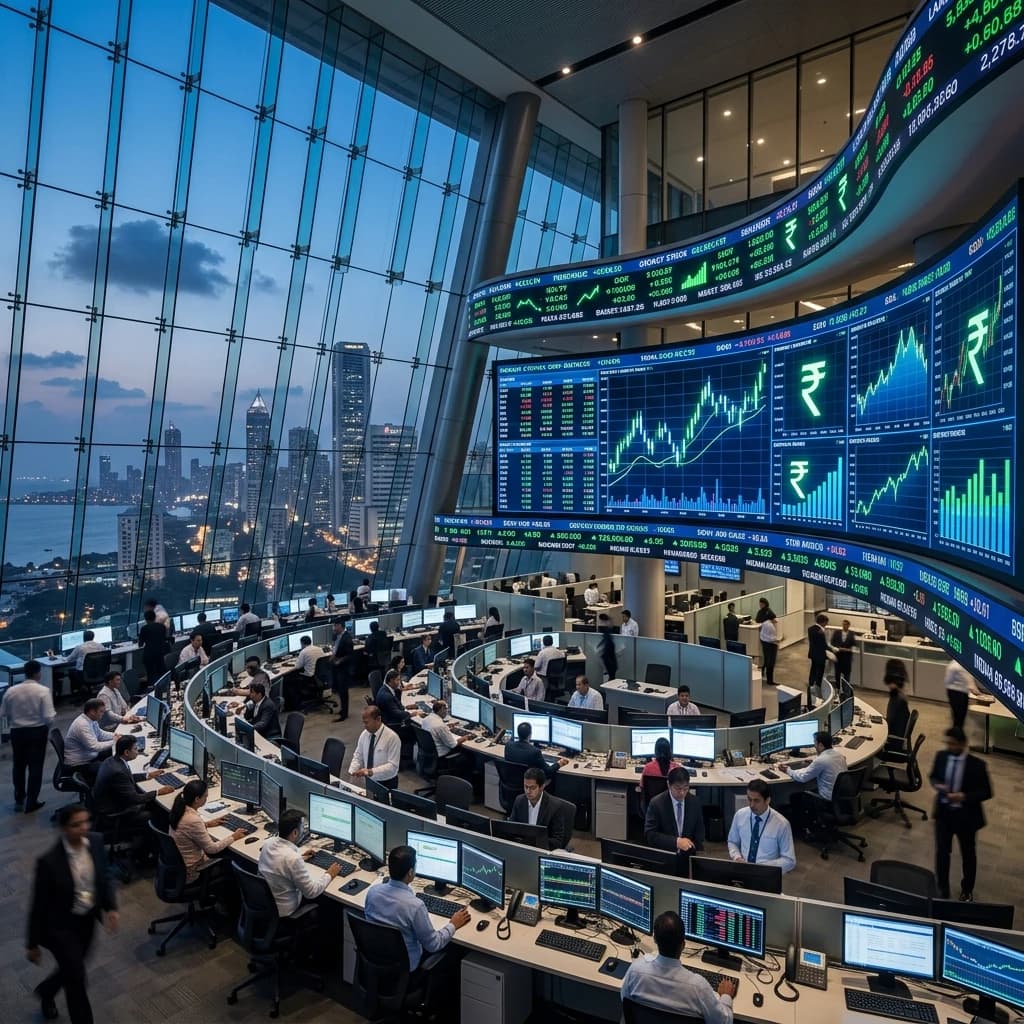
Sensex and Nifty Hit Highs, RBI Drains ₹1.19 Lakh Crore Liquidity, and Rupee Hovers at 95.28
Indian financial markets exhibited strong momentum on July 7, 2026, as equities extended their winning streak to a fifth consecutive session amid broad-based institutional buying. While the stock indices hovered at elevated levels, money markets faced tighter conditions due to aggressive liquidity withdrawals by the central bank. Meanwhile, the domestic currency remained under pressure against the US dollar, reflecting the central bank's strategic prioritization of reserve accumulation over currency appreciation.
📊 Sensex and Nifty Extend Rally to Fifth Session Led by Banks and IT
The benchmark NSE Nifty 50 and BSE Sensex continued their upward trajectory on Tuesday, July 7, 2026, extending the equity market's winning streak to a fifth consecutive trading session. The Nifty 50 opened at 24,464.45 and traded steadily around the 24,450 level, while the BSE Sensex opened at 78,461.16, gaining over 57 points shortly after the opening bell.
This build-up follows Monday's session where the BSE Sensex closed at 78,285.07, up 521.16 points (+0.67%), and the NSE Nifty 50 closed at 24,430.35, gaining 159.50 points (+0.66%). The market's bullish tone was reinforced by institutional participation. Domestic Institutional Investors (DIIs) drove the rally on Monday, recording net purchases of ₹3,791.42 crore, while Foreign Institutional Investors (FIIs) supported the momentum with net inflows of ₹243.03 crore.
Sectoral performance showed a strong rotation, with IT stocks spearheading the gains on Tuesday, providing a cushion against a sharp decline in consumption-heavy stocks, notably Trent. Banking heavyweights, particularly HDFC Bank, along with auto, realty, metals, and energy stocks, led the broad-based buying in the preceding session. Market breadth on the NSE remained constructive with an advance-decline ratio of approximately 1.6:1, while India VIX held below 13.50 — a signal of sustained calm in the derivatives market.
🔬 Technical Analysis: Nifty Reaches Overbought Territory Near 24,450
The Nifty 50's five-session rally has pushed the index into near-overbought territory from a short-term momentum perspective. The RSI-14 has risen to 63.2 — approaching the 65–70 zone that typically signals the need for a pause or consolidation before the next leg higher. However, this is not a sell signal — rather, it's a caution flag that the index may need a 2–5% consolidation before establishing fresh highs.
Key technical readings on July 7:
- RSI-14: 63.2 (approaching overbought zone; not yet triggering)
- India VIX: 13.45 (calm; supports bullish trend continuation)
- MACD: Positive crossover with widening histogram — bullish momentum intact
- Bollinger Bands: Price testing the upper band (~24,500); a decisive close above would be strongly bullish
Level map:
- Resistance: 24,500 (upper Bollinger Band and previous swing high) — the key test for bulls
- Support: 24,200 (50-day EMA — healthy pullback support)
- Strong support: 24,000 (psychological and options market anchor)
A five-session winning streak historically leads to one of two outcomes: a breakout above resistance (here, 24,500) if earnings or macro catalysts align, or a 1–3% consolidation that digests gains before the next directional move. The July 10 TCS earnings announcement will likely determine which path materialises.
🏦 RBI Withdraws ₹1.19 Lakh Crore to Tighten Money Market Liquidity
The Reserve Bank of India (RBI) actively managed banking system liquidity by withdrawing a net ₹1.19 lakh crore from the money market on July 6, 2026. This major liquidity drain reflects the central bank's ongoing vigilance in keeping short-term rates aligned with its monetary policy stance. The absorption of surplus funds from the banking channel is designed to prevent excessive liquidity from fueling inflationary pressures and to ensure orderly conditions in the call money market.
To understand the scale of ₹1.19 lakh crore: this represents roughly 0.9% of India's annual GDP, or approximately 5% of the total banking system's deposit base. Draining this quantum of liquidity in a single operation pushes the overnight call money rate toward the upper bound of the RBI's policy corridor (repo rate + 25 bps). When rates approach the policy upper bound, banks have an incentive to lend less overnight and hold more assets — subtly tightening financial conditions without formally raising the repo rate.
In tandem with these liquidity management measures, the central bank announced a scheduled auction of Government of India Securities (G-Secs) worth ₹32,000 crore for July 10, 2026. The auction includes the re-issue of the 6.36% GS 2031 and the long-term 7.71% GS 2066 paper. These primary auctions are critical for:
- Funding the government's fiscal deficit without crowding out private borrowing
- Setting the sovereign yield curve anchors that determine corporate bond spreads
- Providing liquid, risk-free investment assets for banks and insurance companies
The yield on the benchmark 10-year government bond remained stable as investors adjusted portfolios ahead of the Friday auction, confirming that the RBI's liquidity operations are not causing undue bond market stress.
💵 Rupee Under Pressure Near 95.28 Despite Institutional Inflows
The Indian Rupee (INR) faced persistent depreciation pressure, trading around 95.28 against the US Dollar (USD) on July 6–7, 2026. Despite a supportive backdrop of steady capital inflows into the domestic equity market from both foreign and domestic institutions, the local currency struggled to gain ground.
The apparent paradox — equity markets rising while the rupee weakens — is explained by the RBI's deliberate policy of reserve accumulation. Instead of allowing the rupee to appreciate freely in response to capital inflows, the central bank has reportedly been actively buying dollars at lower levels. This policy of reserve accumulation acts as a buffer against potential external shocks, global financial volatility, or sudden capital outflows.
From a fundamental perspective, the RBI's preference for reserves over rupee strength is well-calibrated. India has already experienced two sharp rupee depreciation episodes in 2025–2026 (triggered by Fed tightening fears and Middle East geopolitics). Maintaining a large reserve buffer (currently $674+ billion) ensures the RBI can intervene decisively in future stress episodes without depleting its firepower too quickly. The cost — a slightly weaker rupee — is a price worth paying for this insurance.
For importers (particularly oil companies and electronics manufacturers), rupee weakness at 95.28/USD adds to input costs. The impact on India's aggregate trade balance is approximately a 1–1.5% expansion of the import bill for every 2% rupee depreciation, all else equal.
💡 Investor Takeaway: Five Consecutive Up Sessions — Manage Risk on Leveraged Positions
For equity investors, a five-session winning streak to multi-month highs calls for disciplined risk management rather than aggressive fresh buying. Here's the framework:
- Long-term investors (12+ months horizon): No action required; continue SIP investments and hold quality large-caps. The structural bull market in India is intact.
- Medium-term investors (3–12 months): Consider booking 20–25% profits on positions that have risen >15% from purchase price. Rotate proceeds into slightly lagging quality names (defensives, pharma, rural plays) for the next leg.
- Short-term traders: Tighten stop-losses on long positions to below 24,200 on the Nifty 50. The RSI is approaching levels where historical mean-reversion dips have occurred. Wait for the TCS earnings reaction on July 10 for directional clarity.
📌 The Bottom Line
- equities-rally-nifty-sensex: The Nifty 50 held near 24,450 and Sensex at 78,461, extending their winning streak to five sessions on DII net purchases of ₹3,791.42 crore. RSI at 63.2 flags near-overbought conditions requiring vigilance.
- rbi-liquidity-operations: The RBI drained a net ₹1.19 lakh crore (~0.9% of GDP) from the money market on July 6 to keep overnight rates anchored. A ₹32,000 crore G-Sec auction was announced for July 10.
- rupee-depreciation-usd: The Indian Rupee traded at 95.28/USD as the RBI deliberately accumulated foreign exchange reserves rather than permitting rupee appreciation, providing insurance against future external shocks.
📬 Stay Updated
Get India market analysis delivered to your inbox every trading day. Subscribe to our free newsletter →
Disclosure: This post contains affiliate links. If you purchase through our links, we earn a small commission at no extra cost to you. We only recommend products we believe in.
Enjoyed this post?
Get our weekly digest delivered free.
Share this post:
Knowelth is reader-supported. We may earn a commission from links in this article at no extra cost to you. Read our disclosure.
Related Posts
India Markets Daily: Sensex Rebounds to 78,080 as Nifty Drags, RBI Proposes Loan Reset Rules, FIIs Sell ₹1,006 Cr
India Markets Daily: Sensex Rebounds to 78,080 as Nifty Drags, RBI Proposes Loan Reset Rules, FIIs Sell ₹1,006 Cr Indian financial markets navigated a divergent trading session on August 13, 2026, as …
India Markets Update: Nifty Drops Below 24,450 Amid Oil Spike, RBI Holds Repo Rate at 5.25%, and FII Inflows Resume
India Markets Update: Nifty Drops Below 24,450 Amid Oil Spike, RBI Holds Repo Rate at 5.25%, and FII Inflows Resume Indian benchmark indices drifted lower for a second consecutive session as global en…
Nifty Snaps 4-Day Rally as Pre-RBI Policy Jitters & Crude Surge Trigger Profit Booking; Bharti Airtel Q1 Profit Soars 37%
Nifty Snaps 4-Day Rally as Pre-RBI Policy Jitters & Crude Surge Trigger Profit Booking; Bharti Airtel Q1 Profit Soars 37% Indian benchmark equity indices snapped their four-session winning streak on A…