Rubidium Atom Mini-Universe, BharatGen's 22-Language Milestone, and the U.S.-Iran Peace Agreement
Rubidium Atom Mini-Universe, BharatGen's 22-Language Milestone, and the U.S.-Iran Peace Agreement
Welcome to today's fourth digest, where we analyze quantum breakthroughs, the scaling of sovereign digital public infrastructure, and major geopolitical shifts. Today, we cover the University of Birmingham's creation of a rubidium-atom "mini-universe" to study quantum time, India's BharatGen AI completing support for all 22 scheduled languages, and the market rally sparked by a U.S.-Iran peace agreement. Here are the key stories you need to know today, June 15, 2026.
🔬 Science: Quantum Cosmology and the Emergence of Time
Rubidium Atom "Mini-Universe" Laboratory Tests the Nature of Time
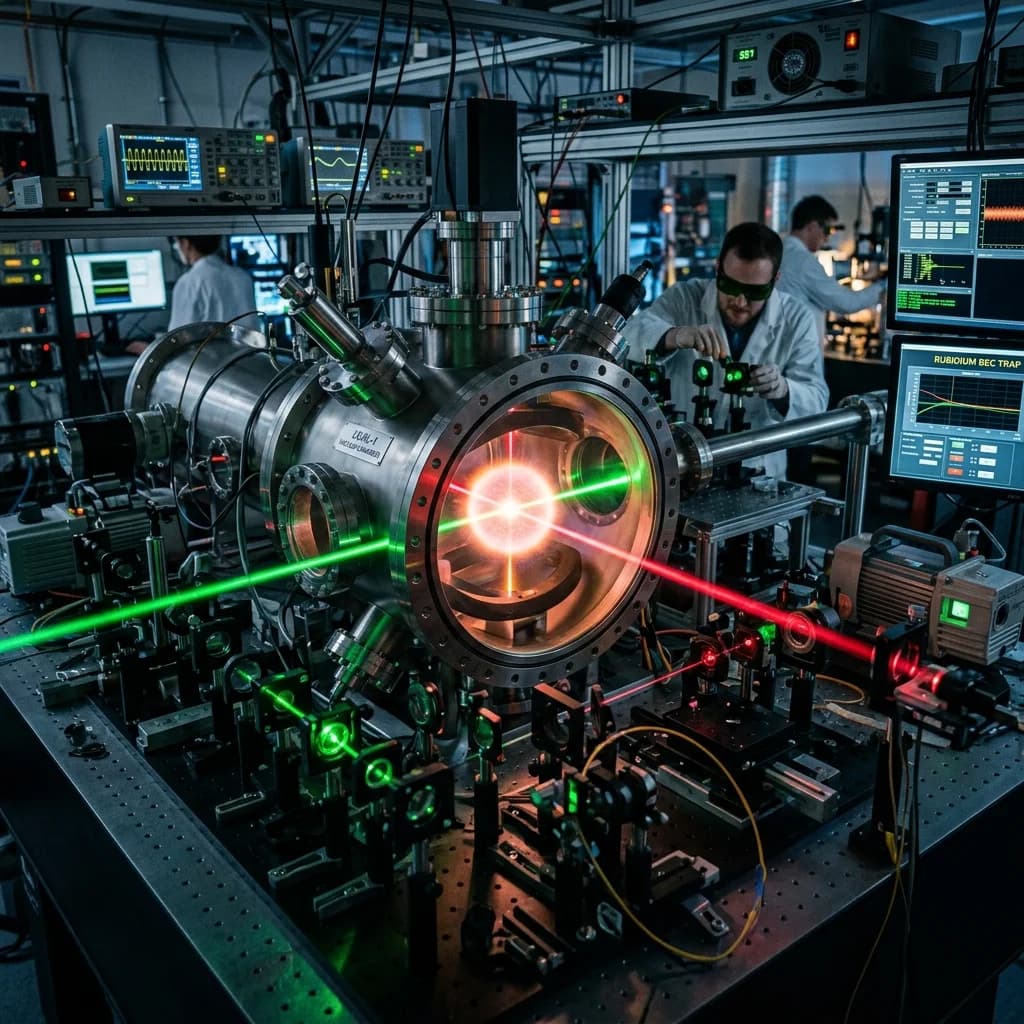
In a significant experiment published in Physical Review Research on June 12, 2026, researchers at the University of Birmingham, led by Professor Giovanni Barontini, successfully created a "mini-universe" using a cloud of 24,000 ultracold rubidium atoms. The research was designed to tackle the "problem of time" in quantum cosmology and gravity, testing the hypothesis derived from the Wheeler–DeWitt equation that the universe does not possess a master external clock. Instead, the team cooled the atoms to a few billionths of a degree above absolute zero and used high-precision laser beams to split the atomic cloud into a "bright" (observed) sector and a "dark" (unobserved) sector. By monitoring the internal dynamics, they demonstrated that the flow of time and sequential events can emerge purely from internal entropy and correlation between the two sectors without referencing any external clock.
The researchers observed that the "bright" sector of the atomic cloud underwent cycles of expansion and collapse, mimicking a miniature model of a "Big Bang" followed by a "Big Crunch." This breakthrough provides physicists with a highly controllable laboratory platform to study how quantum gravity behaves in extreme conditions, bridging a longstanding gap between general relativity and quantum mechanics. By proving that time can be measured dynamically and internally within a closed quantum system, this experimental milestone challenges the traditional view of an absolute, external time dimension and paves the way for new theories of quantum cosmology and the fundamental architecture of the cosmos.
💻 Technology: Sovereign AI and Multilingual Foundation Models
India's Sovereign BharatGen AI Reaches Full 22-Language Milestone
India's sovereign artificial intelligence initiative, BharatGen, has achieved a critical milestone by completing foundational text support for all 22 scheduled Indian languages. Developed under the National Mission on Interdisciplinary Cyber-Physical Systems (NM-ICPS) by the Department of Science and Technology (DST), the project is coordinated centrally by the Technology Innovation Hub at IIT Bombay. Unlike Western commercial foundation models trained predominantly on English-centric corpora, BharatGen has been engineered from the ground up to be culturally aligned, ethical, and representative of India's linguistic diversity. The model integrates advanced speech-to-text, text-to-speech, and vision-language systems, with speech capabilities already operational across 15 regional languages.
The completion of the multilingual framework is poised to democratize digital access and public service delivery across India's public and private sectors, especially in healthcare, agriculture, and rural education. By providing local enterprises and government agencies with a secure, sovereign AI platform, BharatGen reduces dependency on foreign cloud infrastructure and addresses critical concerns regarding data privacy and digital sovereignty. This landmark achievement was highlighted alongside the country's growing startup ecosystem at the "Bharat Innovates 2026" summit in Nice, France, cementing India's position as a major global player in deep-tech and public digital infrastructure.
📈 Market: Geopolitics and Energy Markets
U.S.-Iran Peace Agreement Drives 4% Plunge in Global Crude Prices
Global energy markets experienced a dramatic shift as crude oil prices plummeted by over 4% following the surprise announcement of a comprehensive peace agreement between the United States and Iran. Brokered in part by Pakistani Prime Minister Shehbaz Sharif and subsequently confirmed by U.S. and Iranian officials, the landmark memorandum of understanding establishes an immediate and permanent cessation of military operations across the Middle East, including fronts in Lebanon. A key component of the deal involves the immediate lifting of the U.S. naval blockade and the reopening of the Strait of Hormuz, a vital maritime chokepoint through which approximately one-fifth of the world’s oil consumption passes daily, significantly easing supply chain bottlenecks that have plagued the industry since February.
The announcement of the Geneva peace summit, scheduled for June 19, 2026, sparked a widespread rally in global equity markets, with major indices in the U.S., Europe, and India posting strong gains as fears of energy-driven stagflation receded. While the agreement institutes a 60-day window for intensive negotiations regarding Iran's nuclear program and sanctions relief, the immediate stabilization of oil prices provides critical breathing room for central banks struggling to manage persistent inflation. Institutional investors have quickly adjusted their portfolios, moving capital back into growth and technology sectors, though some analysts warn that the durabilities of the deal will depend on overcoming resistance from domestic hardline factions in both Washington and Tehran.
The Bottom Line
- Science: Researchers at the University of Birmingham utilize a cloud of 24,000 ultracold rubidium atoms to simulate a "mini-universe," proving that time can emerge dynamically from internal quantum relations without an external clock.
- Technology: India's sovereign BharatGen AI initiative achieves its roadmap goal of full text support for all 22 scheduled Indian languages, scaling digital inclusion and public service delivery.
- Market: A landmark U.S.-Iran peace agreement drives a 4% drop in global crude oil prices and opens the Strait of Hormuz, triggering a relief rally across international stock markets.
Enjoyed this post?
Get our weekly digest delivered free.
Share this post:
📌 Disclosure: This post may contain affiliate links. If you make a purchase through our links, we may earn a commission at no extra cost to you. We only recommend products we believe in. See our Affiliate Disclosure.
Related Posts
U.S.-Iran Military Escalation, 3.2-Billion-Year-Old Enzymes Reconstructed, and Apple's $30 Billion U.S. Chip Deal
U.S.-Iran Military Escalation, 3.2-Billion-Year-Old Enzymes Reconstructed, and Apple's $30 Billion U.S. Chip Deal A dramatic military escalation in the Middle East has disrupted global energy markets,…
NATO Summit in Ankara, Saudi Arabia's Historic Crude Oil Price Slashes, and World's First Sub-1 GHz Massive MIMO 5G Network
NATO Summit in Ankara, Saudi Arabia's Historic Crude Oil Price Slashes, and World's First Sub-1 GHz Massive MIMO 5G Network July 7, 2026, represents a landmark day for international security allian…
UN AI Governance Summit, ISRO PSLV Resumption, and Norway's Historic World Cup Triumph
UN AI Governance Summit, ISRO PSLV Resumption, and Norway's Historic World Cup Triumph On July 6, 2026, the global landscape reflects a dynamic convergence of international policy, technological br…