Scramblase Single-Protein Imaging, the U.S. Ban on Anthropic's Fable 5, and PhysicsX's $300 Million Venture Round
Scramblase Single-Protein Imaging, the U.S. Ban on Anthropic's Fable 5, and PhysicsX's $300 Million Venture Round
Welcome to today's seventh digest for June 15, 2026, where we examine major advancements in molecular biophysics, artificial intelligence regulation, and industrial simulation venture capital. Today, we analyze a new fluorescence-based technique mapping individual cell membrane scramblase protein activity, the U.S. national security order directing Anthropic to disable its Fable 5 and Mythos 5 models, and PhysicsX's massive Series C funding round to scale AI-native engineering design. Here are the key global updates for today, June 15, 2026.
🔬 Science: Molecular Biology and Cell Membrane Dynamics
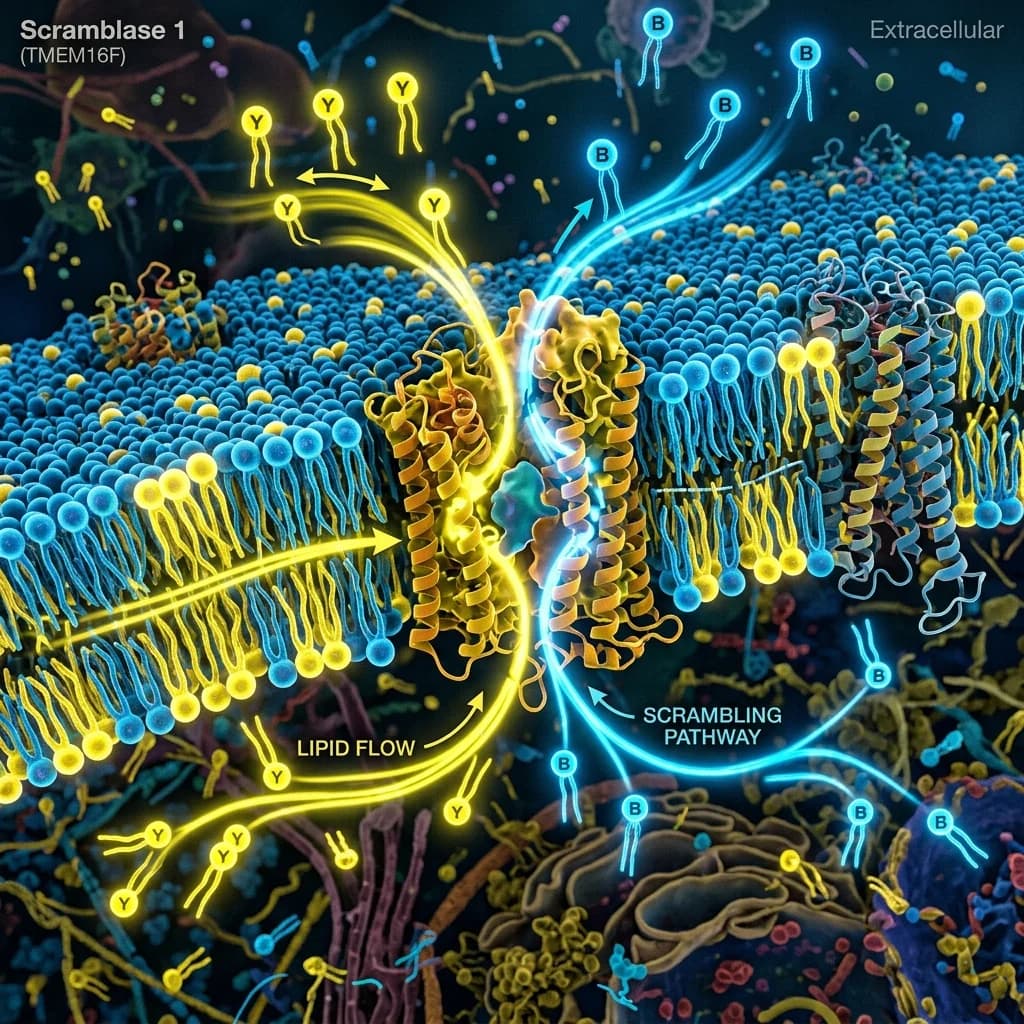
Biophysical Fluorescence Assay Unveils Single-Protein Scramblase Activity
In a major advancement for cell biology and membrane biophysics, researchers from Weill Cornell Medicine and Ruhr University Bochum have developed a novel fluorescence-based assay capable of measuring the activity of individual scramblase proteins in real time. Scramblases are specialized membrane proteins responsible for the transbilayer movement of lipids, actively disrupting the lipid asymmetry of the cell membrane's outer and inner leaflets. This process of lipid scrambling is crucial for various physiological functions, including blood coagulation, cell signaling, and apoptosis. Historically, scientific studies have been limited to bulk assays that measure the collective behavior of thousands of scramblase proteins simultaneously, which inevitably masks the discrete, stochastic dynamics of individual molecules.
Published in the journal Nature Structural & Molecular Biology, the new technique leverages high-resolution fluorescence imaging to track the transport of individual lipid molecules across reconstituted membrane vesicles. By isolating single scramblase channels, the research team successfully observed the precise rates and mechanism of lipid translocation, revealing that individual scramblases operate with distinct activation kinetic states and structural conformations. This high-fidelity biophysical profiling provides crucial insights into how scramblase dysregulation contributes to diseases like Scott syndrome and various cardiovascular disorders. Ultimately, the ability to monitor single-protein dynamics opens up new pathways for screening targeted therapeutics designed to modulate scramblase activity and restore cellular membrane homeostasis.
💻 Technology: Artificial Intelligence and National Security Regulations
U.S. Directive Forces Anthropic to Disable Fable 5 and Mythos 5 Models
In a sudden intervention highlighting the growing intersection of artificial intelligence and national security, the U.S. government has issued an emergency order directing Anthropic to disable its advanced AI models, Fable 5 and Mythos 5. The directive was prompted by federal concerns regarding potential "jailbreaks" that could allow malicious actors to exploit the models' advanced code-generation capabilities for automated software vulnerability discovery and weaponization. While Anthropic representatives publicly expressed disagreement with the severity of the order—arguing that the identified security gaps were minor and already mitigable through standard guardrails—the company complied with the federal mandate to maintain regulatory alignment and avoid severe legal penalties.
Simultaneously, Anthropic implemented a major overhaul of its commercial access model for automated and programmatic usage. Effective June 15, 2026, tools such as the Claude Agent SDK and Claude Code, which run in headless or continuous integration (CI/CD) environments, were migrated from standard monthly subscription tiers to a metered billing system billed at API consumption rates. This restructuring is designed to better align revenue with the heavy compute demands of agentic workflows, while also providing Anthropic with more granular telemetry to monitor for unauthorized usage patterns. These combined regulatory and pricing adjustments signal a broader industry shift toward stricter oversight and tighter monetization of autonomous AI agents operating in enterprise environments.
📈 Market: Venture Capital and Industrial AI Valuation
PhysicsX Secures $300 Million Series C to Scale AI-Native Simulation Software
Venture capital inflows into deeptech and industrial AI hit a major milestone as London-based PhysicsX announced a successful US$300 million Series C funding round. Led by Singapore's sovereign wealth fund Temasek, with significant participation from industry giants NVIDIA and Siemens, the funding round values the AI-native engineering startup at approximately US$2.4 billion. PhysicsX specializes in developing deep learning models that predict complex physical behaviors—such as aerodynamics, thermal dynamics, and structural stress—at a fraction of the time required by traditional computer-aided engineering (CAE) and finite element analysis (FEA) software.
This capital injection underscores the growing market demand for AI-driven simulation in high-value manufacturing sectors, including aerospace, automotive design, defense, and semiconductor fabrication. By replacing slow, iterative physics solvers with neural networks trained on massive synthetic and physical datasets, PhysicsX allows engineers to optimize complex designs in real time. The involvement of strategic partners like NVIDIA and Siemens indicates a broader industry consensus that AI-native simulation will become the foundation of next-generation digital twins and product lifecycle management (PLM) workflows. The funding will support PhysicsX's expansion of its engineering teams and the deployment of its cloud-based simulation platform to enterprise customers globally.
The Bottom Line
- Science: A new fluorescence-based imaging assay developed by Weill Cornell and Bochum researchers captures the real-time activity of individual scramblase proteins, providing a new biophysical tool for membrane research and drug discovery.
- Technology: Under a U.S. national security directive, Anthropic disables its Fable 5 and Mythos 5 models, while transitioning programmatic developer tools to a metered credit system to manage compute demands and monitor compliance.
- Market: PhysicsX's $300 million Series C funding round, backed by Temasek, NVIDIA, and Siemens, drives its valuation to $2.4 billion, signaling a major market shift toward AI-native physical simulation for industrial engineering.
Enjoyed this post?
Get our weekly digest delivered free.
Share this post:
📌 Disclosure: This post may contain affiliate links. If you make a purchase through our links, we may earn a commission at no extra cost to you. We only recommend products we believe in. See our Affiliate Disclosure.
Related Posts

U.S.-Iran Military Escalation, 3.2-Billion-Year-Old Enzymes Reconstructed, and Apple's $30 Billion U.S. Chip Deal
U.S.-Iran Military Escalation, 3.2-Billion-Year-Old Enzymes Reconstructed, and Apple's $30 Billion U.S. Chip Deal A dramatic military escalation in the Middle East has disrupted global energy markets,…

NATO Summit in Ankara, Saudi Arabia's Historic Crude Oil Price Slashes, and World's First Sub-1 GHz Massive MIMO 5G Network
NATO Summit in Ankara, Saudi Arabia's Historic Crude Oil Price Slashes, and World's First Sub-1 GHz Massive MIMO 5G Network July 7, 2026, represents a landmark day for international security allian…
UN AI Governance Summit, ISRO PSLV Resumption, and Norway's Historic World Cup Triumph
UN AI Governance Summit, ISRO PSLV Resumption, and Norway's Historic World Cup Triumph On July 6, 2026, the global landscape reflects a dynamic convergence of international policy, technological br…