Self-Driving Chemistry Labs, the UK Under-16 Social Media Ban, and India's SHANTI Act Nuclear Reforms
Self-Driving Chemistry Labs, the UK Under-16 Social Media Ban, and India's SHANTI Act Nuclear Reforms
Welcome to today's digest, where we cover the automation of molecular discovery, the tightening regulations of youth digital environments, and the decolonization and deregulation of national infrastructures. Today, we analyze the commercial deployment of Atinary's closed-loop AI-robotics research platforms, Sir Keir Starmer's comprehensive under-16 social media ban in the United Kingdom, and the landmark SHANTI Act that dismantles India's state monopoly on nuclear power. Here are the key stories you need to know today, June 23, 2026.
🔬 Science: Closed-Loop Automation and Space Edge Computation
Closed-Loop Robotics and AI Accelerate Materials and Pharmaceutical Discovery
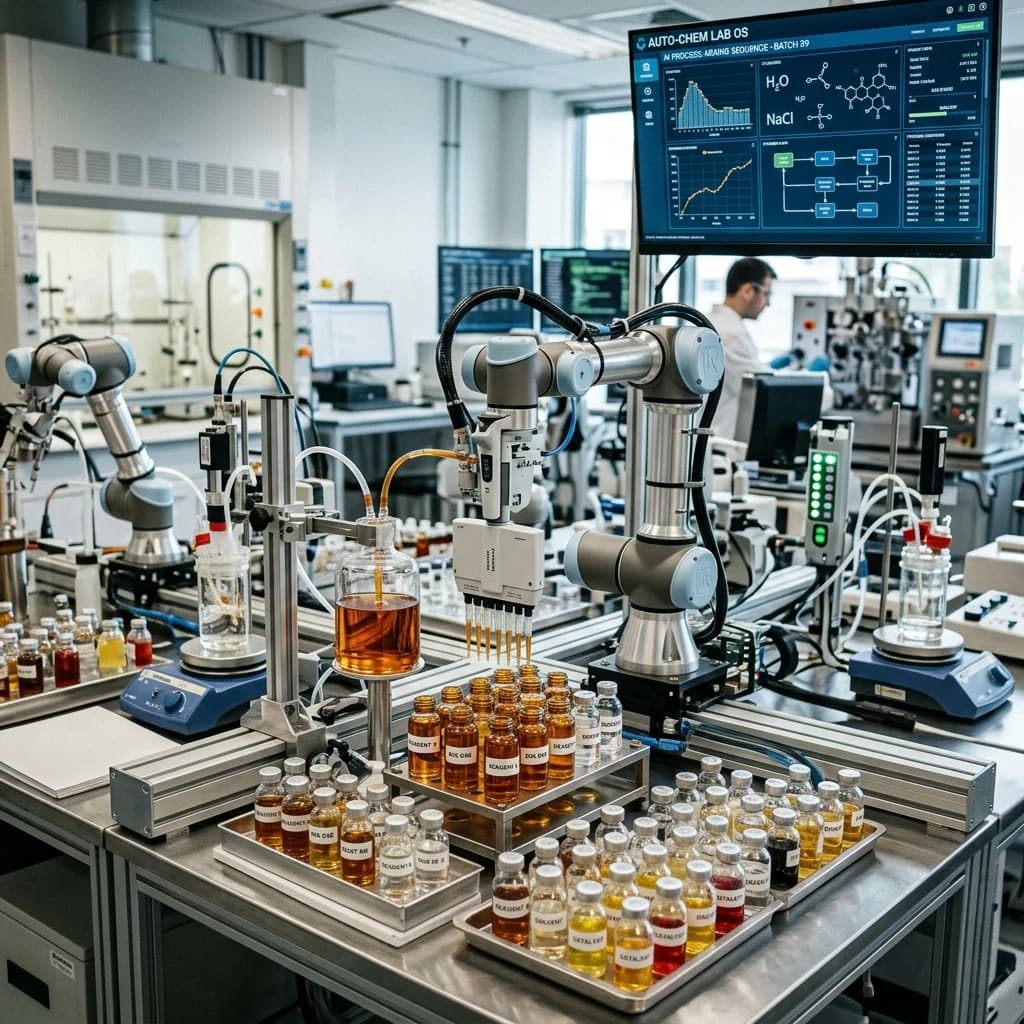
The laboratory environment of 2026 is undergoing a paradigm shift as research transitions from human-driven experimentation to autonomous, closed-loop systems. A prime example of this evolution is the Switzerland-based startup Atinary, recently recognized as a World Economic Forum Technology Pioneer. By integrating machine learning algorithms with automated robotic synthesizers, Atinary's platform functions as a "self-driving lab." This system autonomously formulates chemical hypotheses, schedules and executes physical experiments, analyzes molecular yields, and refines reaction pathways in real time. By bypassing traditional manual prototyping, the platform compresses material and drug discovery timelines from years to days, allowing researchers to optimize complex chemical routes with unprecedented speed.
This closed-loop methodology is already being applied to validate fundamental chemical processes, including the prebiotic reactions that explain how life originated on Earth. Specifically, researchers are utilizing self-driving labs to scan mineral nanozymes (MN-zymes)—inorganic nanoparticles with enzyme-like catalytic properties. The "Nanozymes Hypothesis" suggests that these natural mineral catalysts acted as critical bridges under early Earth conditions, facilitating the synthesis of amino acids and nucleotides. By automating the high-throughput screening of these mineral catalysts, Atinary’s platform accelerates both the exploration of biogenesis and the design of next-generation green fuels, proving that AI-driven automation is essential to decoding complex molecular chemistry.
Orbital AI Infrastructure and Radiation-Hardened Silicon Expand the Compute Edge
Computation is expanding beyond terrestrial limits to the orbital edge, driven by the need to process petabyte-scale telemetry data from satellite mega-constellations. SpaceX and other major aerospace institutions are preparing to deploy and test high-performance AI modules equipped with radiation-hardened Nvidia chips in orbit. Traditionally, satellites transmit raw telemetry data to ground stations for processing, a workflow constrained by high latency, limited bandwidth, and weather disruptions. By performing local, space-based AI inference, these orbital edge compute servers can process Earth observation imagery, manage collision avoidance, and optimize satellite navigation autonomously, significantly reducing the reliance on ground-based computing systems.
To secure these space-based networks, aerospace engineers are implementing new validation protocols, such as The Aerospace Corporation's "Trusted AI Framework." This framework ensures that orbital AI models operate within safe, verifiable parameters, preventing erratic autonomous decisions caused by cosmic radiation or algorithmic anomalies. Furthermore, local orbital computation helps bypass terrestrial network bottlenecks, allowing satellites to cross-reference sensor data with neighboring spacecraft in real time. As these radiation-hardened silicon architectures mature, space edge compute will shift from a hardware-only paradigm to an active, intelligent network, laying the computational groundwork for autonomous deep-space exploration and near-instantaneous global Earth intelligence.
💻 Technology: Global Digital Safety and Sovereign Innovation Networks
The UK Mandates Comprehensive Under-16 Social Media Ban to Safeguard Youth
In a landmark policy move, United Kingdom Prime Minister Sir Keir Starmer has announced a comprehensive ban on social media access for children under the age of 16. Labeled an "Australia-plus" model, the regulation aims to protect younger generations from the documented harms of addictive algorithms, cyberbullying, and online harassment. The ban is slated to cover major platforms including TikTok, Instagram, Facebook, X, Snapchat, Reddit, Threads, and Twitch, while also introducing strict new controls to block direct messaging between children and strangers within multiplayer gaming networks. This sweeping legislation follows an extensive public consultation involving over 116,000 parents and educators, highlighting deep societal concern over youth mental health.
The UK’s policy signals a major regulatory confrontation with United States-based technology conglomerates, which have historically lobbied against direct age-access restrictions. Implementing the ban will require platforms to deploy highly robust, privacy-preserving age-verification systems, prompting intense debate over user data protection and digital surveillance. By enforcing these strict digital boundaries, the UK is establishing a significant global precedent for child online safety. This move is expected to influence digital safety policies across Europe and the Commonwealth, forcing tech companies to restructure their algorithmic architectures and user verification mechanisms to comply with sovereign digital safety mandates.
India-France Partnership Scales Sovereign Tech via the Innovation Roadmap 2030
At the "Bharat Innovates 2026" summit in Nice, France, Prime Minister Narendra Modi and French President Emmanuel Macron formally adopted the India-France Innovation Roadmap 2030. Building on the established Horizon 2047 framework, this strategic bilateral agreement places a heavy emphasis on sovereign technology and ethical AI development. A key pillar of the roadmap is the establishment of a Joint Working Group on Trusted AI, tasking researchers and policymakers with designing transparent, explainable machine learning systems. The collaboration also establishes the DST-INRIA Centre of Digital Sciences to foster joint research between institutions in Kanpur and Nice, creating a direct innovation corridor for deeptech startups in both nations.
Beyond collaborative AI research, the roadmap focuses on expanding digital public infrastructure, most notably through the wider integration of India's Unified Payments Interface (UPI) across French retail and hospitality sectors. By allowing tourists and businesses to execute cross-border transactions seamlessly, this expansion reduces dependency on traditional credit card networks and lowers transaction friction. The roadmap also outlines joint aerospace initiatives, including a new research center in Kanpur to support satellite technologies and clean energy integration. Together, these initiatives represent a coordinated effort to secure technological sovereignty, demonstrating that bilateral tech alliances are crucial to building resilient, democratic digital ecosystems.
📈 Market: Sovereign Regulatory Reforms and Energy Corridor Security
Decolonization Dress Reforms and the SHANTI Act Reshape India’s Institutional Landscape
The Indian Army has released its comprehensive dress regulations manual, "Army Uniforms–2026," marking a deliberate shift away from colonial-era British traditions. The 174-page manual introduces the traditional closed-neck Bandi jacket into the civil dress code for officers and phases out archaic British terminology like "Royal" from official ceremonies. In a significant structural reform, carrying swords is no longer mandatory for reviewing officers during parades, restricting the practice strictly to active parade commanders and national events. These symbolic changes coincide with the introduction of a modern Battle Jacket to replace the traditional jersey-based winter working dress by 2029, alongside updated guidelines allowing women officers to wear sober-colored sarees and kurta-salwars paired with straight trousers, aligning military attire with modern Indian cultural values.
Simultaneously, India has enacted the landmark Sustainable Harnessing and Advancement of Nuclear Energy for Transforming India (SHANTI) Act, dismantling the state's long-held monopoly on nuclear power generation. The SHANTI Act replaces the Atomic Energy Act of 1962 and the Civil Liability for Nuclear Damage (CLND) Act of 2010, allowing private Indian firms to build, own, and operate nuclear power plants. It also permits up to 49% Foreign Direct Investment (FDI) and resolves a decade-long supplier deadlock by channeling liability exclusively to the plant operator. While the government retains control over the strategic fuel cycle, this reform paves the way for joint ventures with international partners like France, leveraging private capital to help India reach its ambitious goal of 100 GW of nuclear capacity by 2047.
Maritime Rescues and Essential Commodities Mandates Safeguard India's Strategic Fuel Supply
In a demonstration of high maritime coordination, the Indian Navy and Coast Guard, in collaboration with the U.S. Navy, successfully rescued 14 crew members from the Indian-flagged dhow MSV Virat-1 off the coast of Oman. The vessel had suffered a catastrophic engine failure and began taking on water in the Gulf of Oman. However, this successful rescue occurred against a backdrop of diplomatic friction between New Delhi and Washington. Tensions escalated following the deaths of three Indian seafarers in the Gulf of Oman during a U.S. military strike, which was conducted as part of the blockade of the Strait of Hormuz. India has registered a formal protest with U.S. authorities, emphasizing the vulnerability of vital shipping corridors responsible for the transit of its oil and gas imports.
To safeguard domestic fuel distribution from this global volatility, the Indian government invoked the Essential Commodities Act (ECA) for petrol and diesel. The intervention was triggered by reports of private oil marketing companies capping retail fuel sales and halting bulk supplies to industrial consumers to offset refining margin pressures. By declaring fuel as an essential commodity, the Ministry of Consumer Affairs has mandated that all retail outlets maintain uninterrupted supplies, prohibiting hoarding or arbitrary rationing. This immediate policy intervention protects agricultural, transport, and industrial sectors from supply bottlenecks during the crucial monsoon planting season, ensuring domestic economic stability despite rising geopolitical risks in the Middle East.
The Bottom Line
- Science: Atinary's closed-loop "self-driving labs" accelerate chemical and materials discovery by automating experiment workflows, while SpaceX prepares to test orbital AI servers equipped with radiation-hardened Nvidia chips.
- Technology: The United Kingdom announces a comprehensive under-16 ban on major social media platforms to safeguard youth, while the India-France Innovation Roadmap 2030 establishes a Joint Working Group on Trusted AI.
- Market: India decolonizes military dress regulations via the "Army Uniforms-2026" manual and dismantles its nuclear monopoly through the SHANTI Act, while invoking the Essential Commodities Act to stabilize domestic fuel supplies.
Enjoyed this post?
Get our weekly digest delivered free.
Share this post:
📌 Disclosure: This post may contain affiliate links. If you make a purchase through our links, we may earn a commission at no extra cost to you. We only recommend products we believe in. See our Affiliate Disclosure.
Related Posts
U.S.-Iran Military Escalation, 3.2-Billion-Year-Old Enzymes Reconstructed, and Apple's $30 Billion U.S. Chip Deal
U.S.-Iran Military Escalation, 3.2-Billion-Year-Old Enzymes Reconstructed, and Apple's $30 Billion U.S. Chip Deal A dramatic military escalation in the Middle East has disrupted global energy markets,…
NATO Summit in Ankara, Saudi Arabia's Historic Crude Oil Price Slashes, and World's First Sub-1 GHz Massive MIMO 5G Network
NATO Summit in Ankara, Saudi Arabia's Historic Crude Oil Price Slashes, and World's First Sub-1 GHz Massive MIMO 5G Network July 7, 2026, represents a landmark day for international security allian…
UN AI Governance Summit, ISRO PSLV Resumption, and Norway's Historic World Cup Triumph
UN AI Governance Summit, ISRO PSLV Resumption, and Norway's Historic World Cup Triumph On July 6, 2026, the global landscape reflects a dynamic convergence of international policy, technological br…