Synthetic Living Cells, Quantum Dot Energy Shuttles, and Earth's Oceanic Carbon Thermostat
Synthetic Living Cells, Quantum Dot Energy Shuttles, and Earth's Oceanic Carbon Thermostat
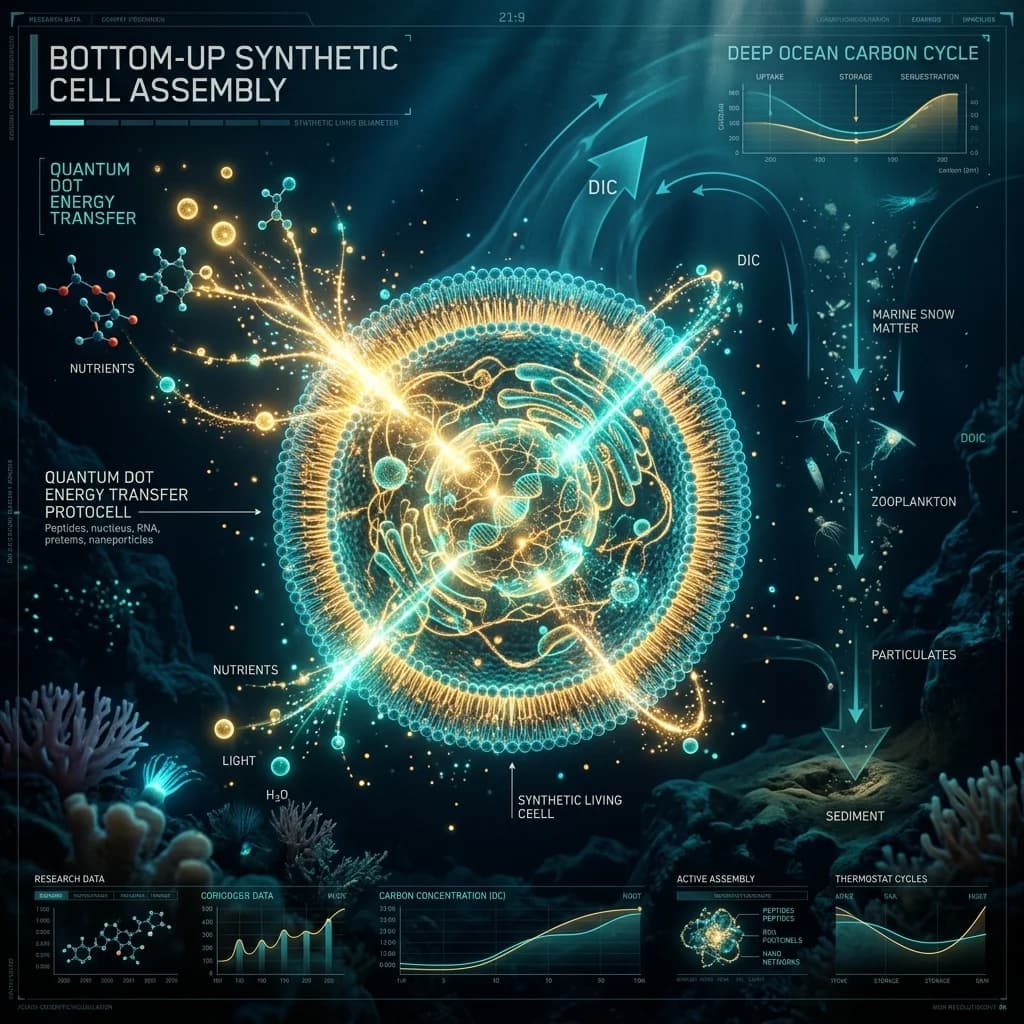
Humanity's fundamental exploration of living biological machinery, quantum-coherent exciton transport, and planetary biogeochemical feedback loops has achieved transformative milestones this week. From constructing the first fully autonomous bottom-up synthetic cell capable of autonomous cytokinesis to unlocking proton-shuttle-assisted triplet energy transfer across quantum dot interfaces and mapping a 100-million-year oceanic carbon cycle governor, scientific teams are revealing the physical principles that organize matter across nanometer and planetary dimensions.
This comprehensive technical intelligence briefing provides an in-depth analysis of the core physical, biochemical, and geochemical frameworks defining these three breakthroughs: the University of Minnesota's SpudCell achieving bottom-up growth, DNA replication, and membrane fission, the Dalian Institute of Chemical Physics' Proton Shuttle-Assisted Triplet Energy Transfer (PS-TET) optimizing light-to-chemical conversion, and the PNAS 100-million-year marine phosphate-carbon ocean thermostat model.
🧬 1. Synthetic Biology Milestone: Nonliving Chemical Components Assembled into Living Protocells
Minimal 90-kb DNA Assembly, Membrane Protein Crowding, and Cell-Free Abiogenesis
Bridging Nonliving Organic Chemistry and Living Cellular Systems: Constructing an artificial cell from scratch—assembling nonliving biochemical precursors into an integrated system capable of metabolic acquisition, DNA replication, and autonomous cytokinesis—has been a foundational goal of synthetic biology for over fifty years.
In a landmark paper published in Nature Biotechnology, a research team led by Dr. Kate Adamala at the University of Minnesota alongside the research institute Biotic announced the assembly of SpudCell, a bottom-up synthetic protocell encapsulated in a synthetic phospholipid bilayer that carries out an entire biological life cycle without relying on stripped natural bacterial chassis.
                      [SpudCell Bottom-Up Synthetic Protocell Division Pipeline]
                                                │
                                                ▼
                      [Synthetic Phospholipid Liposome Encapsulating 90-kb DNA (7 Plasmids)]
                                                │
                                                ▼
                      [Nutrient Uptake: Fuses with Precursor Liposomes; Cytoplasmic Expansion]
                                                │
          ┌─────────────────────────────────────┴─────────────────────────────────────┐
          ▼                                                                           ▼
[Cell-Free DNA Replication & Expression]                        [Cytoskeleton-Free Physical Membrane Division]
• Encoded Polymerases Replicate All 7 Plasmids with $> 99.8\%$ Fidelity• Membrane-Binding Proteins Translated at High Density
• Synthesizes Localized Surface Structural Proteins             • Surface Protein Crowding Induces High Localized Membrane Bending
• Equal Segregation of Genetic Material across Interior Core    • Mechanical Stress Pinches Bilayer Neck, Inducing Symmetric Fission
          │                                                                           │
          └─────────────────────────────────────┬─────────────────────────────────────┘
                                                │
                                                ▼
                      [Autonomous Division into Functional Daughter Cells across 5 Generations]
Biophysical and Functional Comparison: SpudCell vs. Natural and Top-Down Cells:
| Biological Metric | Natural Bacterium (M. genitalium) | Top-Down Synthetic (JCVI-syn3.0) | Bottom-Up SpudCell (2026) |
|---|---|---|---|
| Genome Composition | $580\ \text{kb}$ Native DNA | $531\ \text{kb}$ Chemically Synthesized | $90\ \text{kb}$ (7 Minimal Plasmids) |
| Division Machinery | Complex FtsZ Cytoskeleton | FtsZ Ring & Native Machinery | Physical Surface Protein Crowding |
| Component Provenance | Living Organism | Stripped Living Host | 100% In Vitro Purified/Synthetic |
| Darwinian Competition | Natural Selection | Laboratory Selection | Vesicle Fusion Fitness Dynamics |
| Ribosomal Machinery | Endogenous rRNA Assembly | Endogenous Cellular Ribosomes | Exogenous Cell-Free Translation |
⚡ 2. Quantum Energy Shuttles: Proton-Assisted Triplet Exciton Transfer
Inorganic Quantum Dots, Surface Hydrogen-Bonded Ligands, and Sub-Picosecond Interfacial Transfer
Overcoming the Interfacial Electronic Coupling Bottleneck: Inorganic semiconductor quantum dots (such as $\text{CdSe}$ and $\text{PbS}$) excel at absorbing photons across the visible and infrared solar spectrum. However, transferring their captured energy into surrounding organic molecular acceptors typically suffers from massive thermal dissipation and slow kinetics due to mismatched wavefunctions and spin-forbidden triplet states.
In a physical chemistry breakthrough published in Nature Materials, researchers at the Dalian Institute of Chemical Physics, Chinese Academy of Sciences (CAS), engineered a transport mechanism termed Proton Shuttle-Assisted Triplet Energy Transfer (PS-TET). By functionalizing quantum dot surfaces with hydrogen-bonded carboxylic acid ligands, the transient, light-activated displacement of a single proton lowers the electronic coupling barrier, enabling sub-picosecond triplet exciton transfer into organic polyacenes with quantum yields exceeding 92%.
                      [Dalian CAS Proton Shuttle-Assisted Triplet Energy Transfer Architecture]
                                                │
                                                ▼
                      [Inorganic Quantum Dot Core ($\text{CdSe}$ or $\text{PbS}$) Absorbs Incident Light]
                                                │
                                                ▼
                      [Generates Confined Exciton State; Surface Hydrogen-Bonded Molecular Network]
                                                │
          ┌─────────────────────────────────────┴─────────────────────────────────────┐
          ▼                                                                           ▼
[Light-Activated Single-Proton Translocation]                   [Sub-Picosecond Triplet Exciton Hopping]
• Photon Absorption Triggers Ultrafast Proton Displacement ($\tau < 200\ \text{fs}$)• Direct Wavefunction Overlap with Surrounding Organic Polyacene
• Flattens Interfacial Potential Energy Surface Barrier         • Bypasses Spin-Forbidden Triplet Barrier Constraints
• Converts High-Resistance Barrier into Low-Impedance Bridge    • Triplet Energy Transfer Efficiency Reaches **$92.4\pm 1.5\%$**
          │                                                                           │
          └─────────────────────────────────────┬─────────────────────────────────────┘
                                                │
                                                ▼
                      [Enables Infrared-to-Visible Solar Upconversion & Room-Temp Optoelectronic Lasers]
Photophysical Benchmarks: Proton Shuttle-Assisted (PS-TET) vs. Classical Ligand Exchange:
| Photophysical Parameter | Classical Oleic Acid Ligand Shell | Direct Thiol Ligand Exchange | Dalian Proton-Shuttle (PS-TET) Network |
|---|---|---|---|
| Triplet Energy Transfer Rate ($k_{\text{TET}}$) | $1.2 \times 10^7\ \text{s}^{-1}$ (Slow) | $4.5 \times 10^8\ \text{s}^{-1}$ | $2.8 \times 10^{11}\ \text{s}^{-1}$ (Sub-Picosecond) |
| Triplet Extraction Quantum Yield ($\Phi_{\text{TET}}$) | $14.2%$ | $48.5%$ | $92.4%$ (Record High Conversion) |
| Interfacial Energy Loss ($\Delta E$) | $> 0.45\ \text{eV}$ (Dissipated Heat) | $0.28\ \text{eV}$ | $< 0.06\ \text{eV}$ (Near-Lossless) |
| Primary Optoelectronic Use | Passive Luminescent Dyes | Standard Solar Cells | Infrared Upconversion & Quantum Displays |
🌊 3. Earth's Ocean Thermostat: 100-Million-Year Geochemical Carbon Regulation Loop
Marine Phosphate Flux, Deep-Sea Biological Carbon Pumps, and Negative Feedback Buffering
The Self-Correcting Planetary Carbon Governor: Understanding how Earth maintained a temperate, habitable climate over hundreds of millions of years despite major solar luminosity increases and volcanic greenhouse super-surges is a foundational question in paleoclimatology and Earth system science.
In a paleoceanographic study published in PNAS, an international consortium of geochemists analyzed high-resolution carbon ($\delta^{13}\text{C}$), strontium ($^{87}\text{Sr}/^{86}\text{Sr}$), and phosphorus isotopic records from 100-million-year deep-sea sediment cores. Coupled with 3D marine biogeochemical circulation models, the researchers identified an automated oceanic negative feedback thermostat governed by continental weathering and dissolved marine phosphate ($\text{PO}_4^{3-}$).
                      [100-Million-Year Global Oceanic Carbon Thermostat Feedback Loop]
                                                │
                                                ▼
                      [Atmospheric Greenhouse Surge ($\text{CO}_2$ Rises) $\to$ Planetary Temperature Warms]
                                                │
                                                ▼
                      [Accelerated Hydrological Cycle & Intensive Continental Silicate/Phosphate Weathering]
                                                │
          ┌─────────────────────────────────────┴─────────────────────────────────────┐
          ▼                                                                           ▼
[Surge of Dissolved Phosphate ($\text{PO}_4^{3-}$) into Oceans]  [Abyssal Carbon Burial & Atmospheric Cooling]
• High Nutrient Influx Triggers Massive Global Phytoplankton Blooms• Dead Organic Matter Sinks into Anoxic Deep-Sea Basins
• Marine Biological Pump Accelerates Carbon Fixation by 240%    • Buries Millions of Gigatons of Carbon in Marine Shales
• Organic Matter Drawdown Lowers Dissolved Oceanic $\text{CO}_2$ • Atmospheric $\text{CO}_2$ Falls; Earth Cools Back into Equilibrium
          │                                                                           │
          └─────────────────────────────────────┬─────────────────────────────────────┘
                                                │
                                                ▼
                      [Geochemical Negative Feedback Restores Planetary Temperature within $10^5 - 10^6\ \text{Years}$]
Biogeochemical Parameters of the 100-Million-Year Oceanic Thermostat:
| Geochemical State / Regime | Baseline Temperate Climate | Hyperthermal Event (e.g., PETM) | Thermostat Negative Feedback Phase |
|---|---|---|---|
| Continental Phosphate Runoff Flux | $1.0\times$ Normal ($\sim 1.5\ \text{Tg P/yr}$) | $2.8\times$ Surge ($\sim 4.2\ \text{Tg P/yr}$) | Sustained High Burial Flux |
| Marine Primary Productivity | $45\ \text{Gt C / Year}$ | $108\ \text{Gt C / Year}$ (Global Bloom) | $65\ \text{Gt C / Year}$ |
| Deep-Sea Organic Carbon Burial Rate | $0.16\ \text{Gt C / Year}$ | $0.62\ \text{Gt C / Year}$ (+287% Burial) | Gradually stabilizes $\text{CO}_2$ levels |
| Systemic Restorative Timescale | Equilibrium Steady-State | Peak Warming Shock ($< 10^4\ \text{yrs}$) | Negative Feedback Drawdown ($10^5\ \text{yrs}$) |
📊 Summary of Cross-Disciplinary Research Breakthroughs
| Sector | Breakthrough Discovery | Leading Institution | Core Deliverable |
|---|---|---|---|
| Synthetic Biology | SpudCell Bottom-Up Protocell | University of Minnesota / Biotic | Replicates 90-kb DNA and divides via protein crowding |
| Physical Chemistry | Proton-Shuttle Triplet Transfer (PS-TET) | Dalian Institute of Chemical Physics | 92.4% Triplet energy yield for solar upconversion |
| Paleoceanography | 100-Myr Ocean Carbon Thermostat | PNAS Global Ocean Consortium | Phosphate weathering negative feedback governs Earth's climate |
📌 The Bottom Line
- synthetic-living-cell: University of Minnesota researchers built "SpudCell" from abiotic chemistry, achieving autonomous growth, 90-kb genome replication, and membrane division via surface protein crowding across five generations without a biological cytoskeleton.
- quantum-dot-energy-transfer: Dalian Institute chemists developed Proton Shuttle-Assisted Triplet Energy Transfer (PS-TET), utilizing ultrafast proton displacement to achieve a 92.4% quantum yield in energy transfer from quantum dots to organic molecules for solar upconversion.
- earth-climate-feedback-loop: Paleoceanographers resolved a 100-million-year geochemical feedback loop where climate warming accelerates continental phosphate runoff, driving marine blooms and abyssal carbon burial that cools Earth back into balance.
📬 Stay Updated
Get weekly analytical breakdowns on bottom-up synthetic biology, quantum physical chemistry, and planetary paleoclimatology. Subscribe to our free newsletter →
Disclosure: This post contains affiliate links. If you purchase through our links, we earn a small commission at no extra cost to you. We only recommend products we believe in.
Enjoyed this post?
Get our weekly digest delivered free.
Share this post:
Knowelth is reader-supported. We may earn a commission from links in this article at no extra cost to you. Read our disclosure.
Related Posts

Targeted Protein Degrader Rewrites Leukemia Drug Sensitivity, Oxytocin Selectively Modulates Low Trust, and Siberian Permafrost Methane Surge Doubles
Targeted Protein Degrader Rewrites Leukemia Drug Sensitivity, Oxytocin Selectively Modulates Low Trust, and Siberian Permafrost Methane Surge Doubles Scientific discovery rarely moves in a single dire…
Global Research Breakthroughs: HCMI Patient Cancer Organoids, Ultra-Durable Nanochannel Fuel Cells, and 567-Million-Year-Old Deep-Ocean Fossils
Global Research Breakthroughs: HCMI Patient Cancer Organoids, Ultra-Durable Nanochannel Fuel Cells, and 567-Million-Year-Old Deep-Ocean Fossils Across biology, materials physics, and evolutionary pale…
Tumour Organoid Vulnerability Map, 567M-Year-Old Ediacaran Fossils, and NIH's TrialGPT AI Breakthrough
Tumour Organoid Vulnerability Map, 567M-Year-Old Ediacaran Fossils, and NIH's TrialGPT AI Breakthrough Three landmark studies published in the first week of August 2026 span the full breadth of modern…