The Week in Research: Generalist Neurons, Solid-State Battery Breakthroughs, and Tripled Methanol Catalysis
The Week in Research: Generalist Neurons, Solid-State Battery Breakthroughs, and Tripled Methanol Catalysis
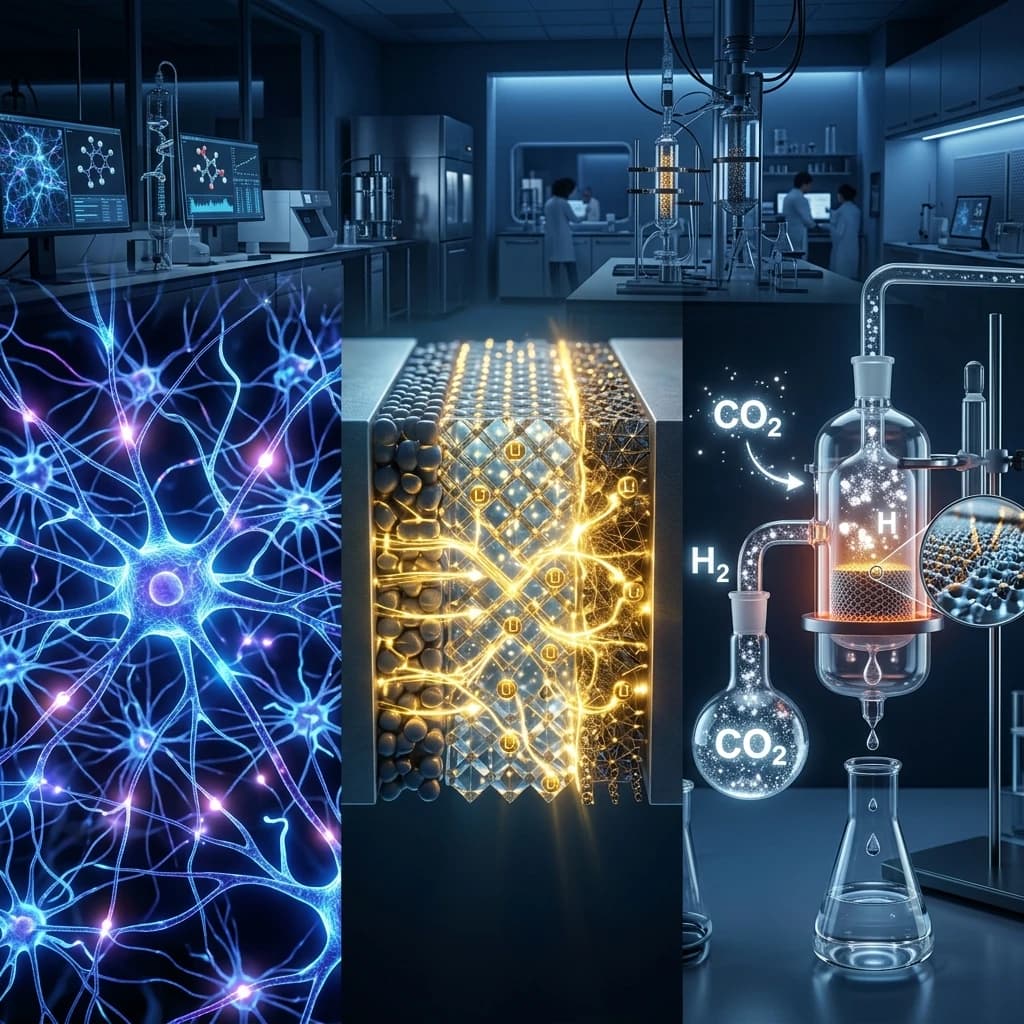
Three Nature-family papers in the final week of July 2026 each overturn a foundational assumption in their field. Columbia University's Zuckerman Institute (Nature, July 2026) used high-density calcium imaging + population-level neural geometry analysis to demonstrate that the dominant model of cortical specialisation is wrong: the vast majority of cortical neurons are flexible "generalists" that reconfigure their tuning across tasks — not dedicated "specialists" wired to a single function. Max Planck Institute for Sustainable Materials (Nature Materials, July 2026) identified the exact nanomechanical mechanism triggering lithium dendrite formation in solid-state batteries — not pore penetration but void collapse at high current densities generating intergranular shear fractures — and demonstrated a nanocomposite interlayer that prevents it for 1,000+ cycles at ambient temperature. And an international consortium (Nature Chemistry, June/July 2026) engineered a tandem catalyst with hydrophobic zeolitic nano-capillaries that continuously evacuate water byproduct from the CO₂ hydrogenation reaction — tripling single-pass methanol yield from captured CO₂ by pushing the reaction past its thermodynamic equilibrium limit.
🧠 Generalist Neurons — Columbia's Cortical Flexibility Breakthrough
The Specialist Neuron Paradigm and Why It's Incomplete
The classical model of cortical specialisation: Since Hubel and Wiesel's Nobel Prize-winning work (1981) describing V1 neurons tuned to specific edge orientations, neuroscience has built on the principle that cortical neurons are specialised: each cell has a preferred stimulus, preferred action, or preferred context, and fires most strongly to that specific input. This formed the basis of how the brain "codes" information — a feature detector model.
| Evidence for specialisation | Evidence against (now challenged) |
|---|---|
| V1 orientation-selective neurons (Hubel & Wiesel) | Most V1 neurons also respond to colour, motion, depth |
| Motor cortex "arm movement" neurons | Same neurons also respond to cognitive context and reward |
| Hippocampal "place cells" | Also encode time, context, and social information |
| Prefrontal "rule neurons" | Reconfigure to encode reward, working memory, attention simultaneously |
The Columbia finding — generalists dominate: Using high-density electrophysiological arrays and two-photon calcium imaging tracking thousands of neurons simultaneously across multiple cortical regions in mice performing:
- A dynamic visual decision-making task (discriminate flickering patterns)
- A contextual pattern recognition task (respond differently to same stimulus depending on recent history)
The team found:
| Neuron type | % of recorded cortical neurons | Firing behaviour |
|---|---|---|
| "Generalists" | ~75–80% | Reconfigure tuning across tasks — fire for Task A in one pattern, Task B in a completely different pattern |
| "Specialists" | ~10–15% | Respond to single stimulus or action type consistently across contexts |
| "Mixed" | ~10% | Some context-dependence but not full reconfiguration |
The population geometry analysis — why single-neuron recording missed this: Previous studies tracked individual neurons (single-unit recordings). The Columbia team used population-level "neural geometry" — analysing the collective geometric structure of neural activity in high-dimensional space (1 dimension per neuron):
- Each brain state (task context, stimulus, decision) is a point in neural space
- A specialist brain would have separate, non-overlapping regions for each task
- A generalist brain would have overlapping but rotated representations — same neurons, different activation patterns
They found the second: brain states are geometrically rotated projections in neural space — the same population of neurons represents multiple tasks simultaneously through orthogonal coding subspaces.
Why This Matters for AI and Medicine
Implications for AI architecture: Current neural networks (transformers, CNNs) implement a specialised architecture: attention heads become specialised to specific token patterns; convolutional filters specialise to specific visual features. This causes catastrophic forgetting — learning Task B degrades performance on Task A because the same weights are overwritten.
Generalist neurons in biology avoid catastrophic forgetting through orthogonal subspace representation: the same weights simultaneously encode multiple tasks in non-interfering subspaces. Bio-inspired architecture implications:
- Subspace separation during training — force new tasks into orthogonal subspaces of the weight matrix
- Shared multi-purpose representations — fewer parameters needed if each neuron/weight can serve multiple functions
- Continual learning — models could learn new tasks without forgetting old ones
Clinical implications — Alzheimer's and neurodegeneration: If most cortical neurons are generalists that maintain cognitive flexibility through dynamic reconfiguration, then:
- Early Alzheimer's impairment may manifest as loss of reconfiguration capacity (neurons becoming "stuck" in one mode) before neuron death
- Early biomarker: Population-geometry imaging (fMRI + population decoding) could detect loss of subspace flexibility years before clinical symptoms
- Therapeutic target: Interventions that restore neural reconfiguration (neuromodulation, specific drug targets) could delay cognitive decline
🔋 Solid-State Battery Dendrites — Max Planck's Nanomechanical Solution
The Dendrite Problem in Solid-State Batteries
Why solid-state batteries are the prize:
| Property | Liquid electrolyte Li-ion (current standard) | Solid-state Li-metal (target) |
|---|---|---|
| Energy density (Wh/kg) | ~250–300 | ~500–700 (2× improvement) |
| Fire risk | High (flammable organic liquid electrolyte) | Near zero (solid ceramic — non-flammable) |
| Operating temperature range | -20°C to +60°C | -40°C to +120°C |
| Charge speed | C/3 to 2C | Theoretically >4C (limited by dendrites) |
| Cycle life | ~500–1,000 cycles | >2,000 cycles (if dendrite problem solved) |
| Market barrier | — | Dendrites — the only major unsolved engineering problem |
What dendrites are and how they form (previous understanding): Lithium dendrites are metallic filaments that grow from the lithium metal anode through the solid ceramic electrolyte separator, eventually reaching the cathode and causing a short circuit. Previous models suggested dendrites grew by mechanically pushing through electrolyte pores — so solutions focused on using electrolytes with smaller pores.
What the Max Planck study found — the real mechanism: Using cryo-focused ion beam scanning electron microscopy (cryo-FIB-SEM) combined with synchrotron X-ray nano-tomography (imaging at nanometre resolution without disturbing the sample), the team captured dendrite formation in real time at high current densities:
| Observed step | Mechanism |
|---|---|
| 1. High current density | >2 mA/cm² causes non-uniform lithium stripping at anode-electrolyte interface |
| 2. Void formation | Localised lithium depletion creates microscopic voids (2–20 nm) at the interface |
| 3. Void collapse | High mechanical stress causes voids to collapse — creating extreme localised pressure concentrations |
| 4. Intergranular fracture | Stress concentration exceeds fracture toughness of ceramic grain boundaries → intergranular shear fractures propagate |
| 5. Lithium nucleation | Liquid lithium under high pressure migrates into fractures → solidifies → extends the crack further |
| 6. Short circuit | Dendritic lithium path completes from anode to cathode |
The key insight: Dendrites don't push through pores — they exploit stress fractures caused by void collapse. This means smaller-pore electrolytes are necessary but not sufficient — the mechanical stress concentration is the primary failure mode.
The nanocomposite interlayer solution: Armed with the void-collapse mechanism, the Max Planck team engineered a 25-nm nanocomposite interlayer between the lithium anode and ceramic electrolyte:
| Layer property | Design | Effect |
|---|---|---|
| Composition | Li₃PO₄ + Al₂O₃ nanoparticle composite | Mechanically tough; ionically conductive |
| Thickness | ~25 nm | Minimal added resistance; maximum stress distribution |
| Mechanical function | Distributed stress — absorbs and spreads pressure from void collapse | No localised stress concentrations → no intergranular fractures |
| Ion distribution | Uniform Li⁺ flux across full interface area | No localised high-current spots → no void formation |
Results with nanocomposite interlayer:
| Metric | Without interlayer | With nanocomposite interlayer |
|---|---|---|
| Dendrite formation (at 3 mA/cm²) | <50 cycles | >1,000 cycles — none observed |
| Capacity retention at 1,000 cycles | N/A (failed) | >95% capacity |
| Operating temperature | N/A | Ambient temperature (25°C) |
| Coulombic efficiency | N/A | >99.8% |
⚗️ Tripled Methanol Yield — Hydrophobic Zeolitic Tandem Catalyst
The CO₂-to-Methanol Thermodynamic Problem
Why conventional CO₂ hydrogenation fails at high yield: The methanol synthesis reaction:
CO₂ + 3H₂ → CH₃OH + H₂O (ΔG < 0, thermodynamically feasible)
The problem is water poisoning of the thermodynamic equilibrium:
- As methanol and water form, water molecules accumulate at the catalytic active sites
- Water competes with CO₂ and H₂ for active sites → rate inhibition
- More critically, Le Chatelier's principle: water accumulation shifts the reaction equilibrium backwards → limits single-pass conversion to ~10–20%
- Low single-pass yield forces industrial plants to use high pressure (50–100 bar) + high temperature (200–300°C) + recycling loops — all energy-intensive
The hydrophobic nano-capillary solution:
| Catalyst component | Material | Function |
|---|---|---|
| Active metal sites | Cu-ZnO nanoparticles | CO₂ hydrogenation → methanol synthesis |
| Hydrophobic zeolitic framework | Silicalite-1 (MFI zeolite, methylated surface) | Selectively evacuates water; lets methanol diffuse normally |
| Sub-nanometer capillaries | 0.53 nm pore diameter (ZSM-5 framework) | Physically too small for methanol (kinetic diameter 0.38 nm) to be retained; but water (kinetic diameter 0.26 nm) is selectively drawn out by hydrophobic capillary forces |
Wait — if water is smaller, why does the hydrophobic capillary preferentially remove it? The counterintuitive mechanism:
- Hydrophobic surfaces repel water → water at the methanol synthesis site is thermodynamically driven to leave the hydrophobic environment → evacuated through the capillary channels
- Methanol is less polar than water → methanol is more compatible with the hydrophobic zeolite environment → it stays near the active site for further conversion or accumulates in the product stream
- Result: continuous water removal shifts equilibrium forward → conversion proceeds far beyond the standard thermodynamic limit
Performance results:
| Condition | Standard Cu-ZnO catalyst | Tandem Cu-ZnO/hydrophobic zeolite |
|---|---|---|
| Single-pass CO₂ conversion | ~12–18% | ~38–52% (3× improvement) |
| Methanol selectivity | 50–60% | >80% (water removal reduces side reactions) |
| Required pressure | 50–100 bar | <30 bar (lower pressure feasible due to higher per-pass yield) |
| Required temperature | 250–300°C | 220–260°C |
| Catalyst lifetime | ~500 hours | >2,000 hours (less water = less sintering of Cu nanoparticles) |
Why methanol matters as a green fuel and feedstock:
- Marine fuel: Maersk and other shipping companies already operate dual-fuel methanol vessels (methanol combustion: CO₂-neutral if produced from green H₂ + captured CO₂)
- Hydrogen carrier: Methanol easier to transport and store than compressed H₂; can be reformed to H₂ at destination
- Chemical feedstock: Precursor for formaldehyde, acetic acid, olefins → entire plastics and materials supply chain can be decarbonised if green methanol is cheap enough
- DAC economics: Every 3× yield improvement reduces the required scale (and cost) of CO₂ capture equipment by 3× for equivalent methanol output
📌 The Bottom Line
- generalist-neurons-columbia-cortical-flexibility: Classical specialist model (Hubel & Wiesel) shows ~75–80% of cortical neurons are actually generalists that reconfigure across tasks; population geometry analysis reveals orthogonal subspace coding (same neurons, different activation patterns per task, non-interfering); catastrophic forgetting in AI caused by specialist architecture — generalist orthogonal subspace training could enable true continual learning; Alzheimer's early biomarker: loss of reconfiguration capacity detectable via population-geometry fMRI before neuron death.
- solid-state-dendrite-max-planck-nanocomposite: Solid-state vs liquid Li-ion: 2× energy density + non-flammable; dendrite mechanism corrected: NOT pore penetration → void collapse (microscopic voids from Li depletion at >2 mA/cm²) → intergranular shear fractures → Li nucleation in cracks; cryo-FIB-SEM + synchrotron X-ray nano-tomography used; 25nm Li₃PO₄+Al₂O₃ nanocomposite interlayer: distributes stress + uniformises Li⁺ flux → zero dendrites at 1,000 cycles, >95% capacity, >99.8% Coulombic efficiency at ambient temperature.
- co2-methanol-hydrophobic-tandem-catalyst: CO₂ hydrogenation blocked by water poisoning (water shifts equilibrium backward, inhibits active sites); Cu-ZnO + silicalite-1 hydrophobic zeolite (0.53nm capillaries): thermodynamically drives water out of hydrophobic environment while methanol (less polar) remains near active sites → continuous equilibrium shift forward; results: 3× single-pass conversion (~12-18% → ~38-52%), >80% methanol selectivity, pressure halved (<30 bar), catalyst lifetime 4× (>2,000 hours less water = less Cu sintering); applications: green shipping fuel (Maersk dual-fuel vessels) + H₂ carrier + decarbonised plastics feedstock.
📬 Stay Updated
Get the week's most important research breakthroughs delivered to your inbox. Subscribe to our free newsletter →
Disclosure: This post contains affiliate links. If you purchase through our links, we earn a small commission at no extra cost to you. We only recommend products we believe in.
Enjoyed this post?
Get our weekly digest delivered free.
Share this post:
Knowelth is reader-supported. We may earn a commission from links in this article at no extra cost to you. Read our disclosure.
Related Posts
Targeted Protein Degrader Rewrites Leukemia Drug Sensitivity, Oxytocin Selectively Modulates Low Trust, and Siberian Permafrost Methane Surge Doubles
Targeted Protein Degrader Rewrites Leukemia Drug Sensitivity, Oxytocin Selectively Modulates Low Trust, and Siberian Permafrost Methane Surge Doubles Scientific discovery rarely moves in a single dire…
Global Research Breakthroughs: HCMI Patient Cancer Organoids, Ultra-Durable Nanochannel Fuel Cells, and 567-Million-Year-Old Deep-Ocean Fossils
Global Research Breakthroughs: HCMI Patient Cancer Organoids, Ultra-Durable Nanochannel Fuel Cells, and 567-Million-Year-Old Deep-Ocean Fossils Across biology, materials physics, and evolutionary pale…
Tumour Organoid Vulnerability Map, 567M-Year-Old Ediacaran Fossils, and NIH's TrialGPT AI Breakthrough
Tumour Organoid Vulnerability Map, 567M-Year-Old Ediacaran Fossils, and NIH's TrialGPT AI Breakthrough Three landmark studies published in the first week of August 2026 span the full breadth of modern…