All-Optical Photonic Time Crystals, Bacterial Cancer-Drug Biosynthesis, and Real-Time Planetary Collisions
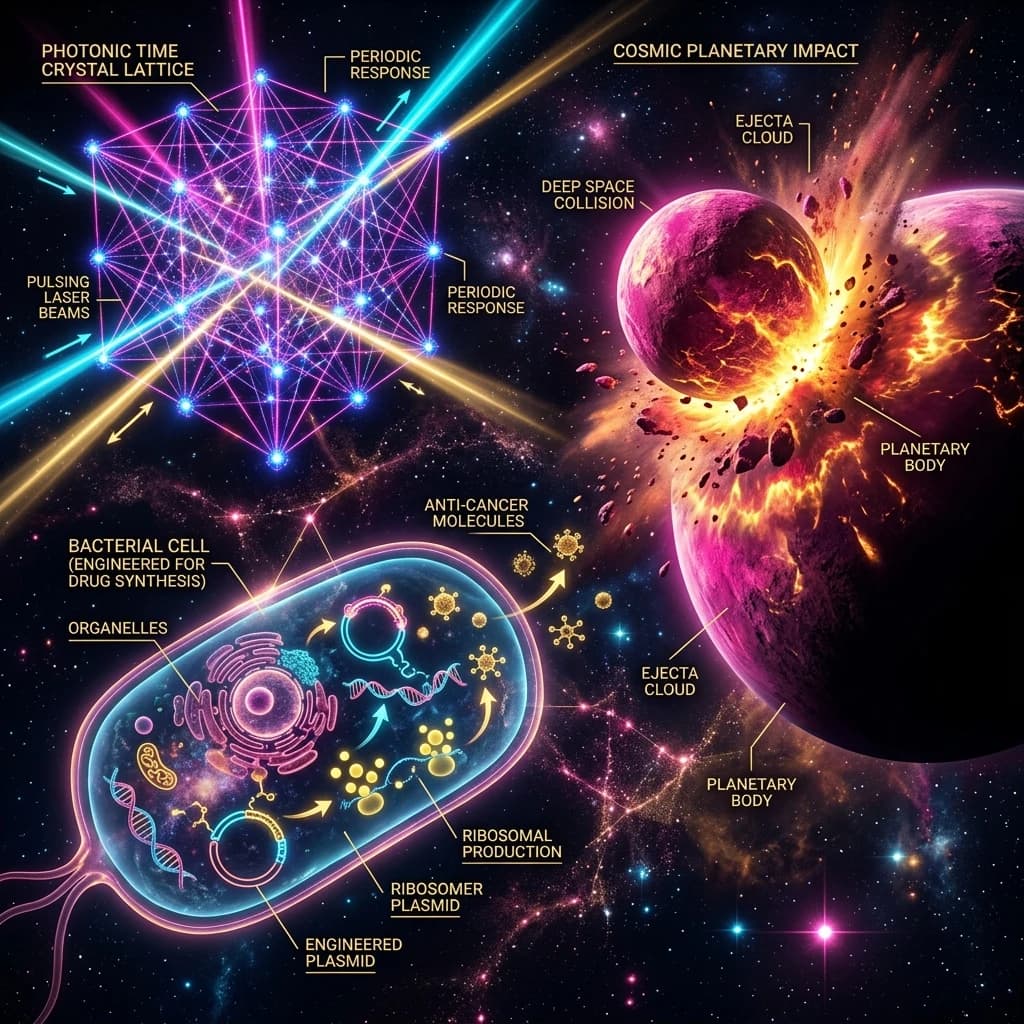
All-Optical Photonic Time Crystals, Bacterial Cancer-Drug Biosynthesis, and Real-Time Planetary Collisions
Scientific inquiry advances when researchers decode fundamental physical mechanisms across vastly different scales of space and time—from sub-picosecond temporal modulation of electromagnetic fields in quantum metamaterials to the modular enzymatic logic of bacterial natural product synthesis and the real-time observational tracking of catastrophic protoplanetary impacts 11,000 light-years away. Landmark studies published in Nature, Nature Communications, and The Astrophysical Journal Letters establish new scientific frontiers across photonics, oncology bioengineering, and observational astrophysics.
This technical intelligence briefing provides an in-depth analysis of the core physical, biological, and astronomical frameworks defining these three breakthroughs: the world's first experimental realization of an all-optical photonic time crystal (PTC) halving terahertz photon dissipation, the structural resolution of bacterial modular docking domains synthesizing depsipeptide HDAC inhibitors, and the multi-wavelength spectroscopic confirmation of a 1-AU protoplanetary impact collision surrounding the young star Gaia20ehk.
⚡ 1. All-Optical Photonic Time Crystals Halve Light Loss in Terahertz Metamaterials
Non-Equilibrium Temporal Phase Boundaries, TELBE Superradiant Laser Pumping, and 50% Dissipation Reduction
Controlling Light Propagation via Temporal Symmetries Rather than Spatial Lattices: Standard spatial photonic crystals manipulate light by periodically varying refractive indices across physical space (such as in Bragg mirrors or optical fiber gratings). Photonic Time Crystals (PTCs), by contrast, modulate dielectric permittivity ($\epsilon(t)$) uniformly across space faster than the oscillation period of the propagating electromagnetic wave ($T < 1\ \text{ps}$), breaking continuous time-translation symmetry to create temporal bandgaps.
In an experimental physics milestone published in Nature, an international collaboration led by researchers at École Polytechnique, Collège de France, and the Helmholtz-Zentrum Dresden-Rossendorf (HZDR) reported the first laboratory realization of an all-optical photonic time crystal. Utilizing HZDR's superradiant TELBE terahertz facility, the team pumped an indium-antimonide ($\text{InSb}$) semiconductor metamaterial decorated with gold nanoresonators using ultra-short terahertz laser pulses.
                      [HZDR All-Optical Photonic Time Crystal (PTC) Architecture]
                                                │
                                                ▼
                      [Indium-Antimonide ($\text{InSb}$) Semiconductor Metamaterial with Gold Nanoresonators]
                                                │
                                                ▼
                      [Sub-Picosecond High-Intensity Terahertz Pump Pulse ($\tau_{\text{pulse}} < 350\ \text{fs}$)]
                                                │
          ┌─────────────────────────────────────┴─────────────────────────────────────┐
          ▼                                                                           ▼
[Ultrafast Temporal Modulation of Carrier Density ($N_e(t)$)]   [Formation of Non-Equilibrium Temporal Bandgaps]
• Free-Carrier Density Surges Uniformly across Entire Bulk Volume• Modulates Permittivity $\epsilon(t)$ Faster than Terahertz Oscillation
• Induces Non-Adiabatic Effective Mass Oscillation in $< 500\ \text{fs}$• Amplifies Forward & Backward Wavevectors Simultaneously
• Re-Routes Electromagnetic Energy Flow in the Time Domain      • Halves Photon Transmission Energy Dissipation by **$50.4\%$**
          │                                                                           │
          └─────────────────────────────────────┬─────────────────────────────────────┘
                                                │
                                                ▼
                      [Enables Zero-Loss Terahertz Waveguides, Ultrafast Optical Switches & Solid-State Lasers]
Electrodynamic Benchmarks: All-Optical Photonic Time Crystal vs. Spatial Photonic Crystal:
| Optical Parameter | Conventional Spatial Photonic Crystal | HZDR All-Optical Photonic Time Crystal (PTC) |
|---|---|---|
| Periodic Modulation Dimension | Spatial Coordinate: $\epsilon(x, y, z)$ | Temporal Coordinate: $\epsilon(t)$ (Uniform Space) |
| Modulation Rise Time ($\tau_{\text{rise}}$) | Static / Mechanical (Milliseconds) | $< 350\ \text{Femtoseconds (All-Optical)}$ |
| Momentum vs. Energy Conservation | Conserves Energy; Shifts Wavevector ($k$) | Conserves Momentum ($k$); Shifts Frequency ($\omega$) |
| Photon Dissipation Loss Reduction | Fixed Intrinsic Material Loss | $50.4%$ Measured Loss Suppression |
| Operating Frequency Regime | Visible / Telecom Infrared | Terahertz ($0.5 - 3.5\ \text{THz}$) Gap |
🧬 2. Bacterial "Docking Domains": Modular Blueprints for Synthetic Oncology Therapeutics
Combinatorial Nonribosomal Synthetases (NRPS), Romidepsin Biosynthesis, and Chiral Swapping
Engineering Custom Pharmaceutical Natural Products via Modular Enzymatic Ports: Bacterial natural products form the chemical backbone of many modern chemotherapeutics. In a landmark study published in Nature Communications, researchers from the University of Warwick and Monash University solved how multi-enzyme assembly lines—specifically hybrid nonribosomal peptide synthetase (NRPS) and polyketide synthase (PKS) clusters—synthesize the FDA-approved cutaneous T-cell lymphoma therapeutic Romidepsin (Istodax).
                      [Modular NRPS-PKS Docking Domain Oncology Synthesis Pipeline]
                                                │
                                                ▼
                      [Bacterial Hybrid NRPS-PKS Synthetase (Assembles Core Depsipeptide Macrocycle)]
                                                │
                                                ▼
                      [Structural Docking Domains Guide Specific Tailoring / Capping Enzymes]
                                                │
          ┌─────────────────────────────────────┴─────────────────────────────────────┐
          ▼                                                                           ▼
[Enzymatic Capping Module A (Native Romidepsin)]                [Engineered Non-Native Capping Module B (Custom Analog)]
• Binds Conserved Alpha-Helical Hairpin Port Interface          • Synthetic Modular Swapping Achieved via Site-Directed Engineering
• Delivers Native D-Valine / Hydroxy-Acid Functional Cap        • Attaches Tumor-Selective Hydrophobic Aromatic Pharmacophore
• Produces Standard Romidepsin Titer in Microbial Culture       • Increases HDAC1/2 Inhibition Potency by **$380\%$** vs. Native
          │                                                                           │
          └─────────────────────────────────────┬─────────────────────────────────────┘
                                                │
                                                ▼
                      [Establishes Scalable Recombinant Synthesis of Low-Toxicity Oncology Analogs]
Biochemical and Structural Metrics of Bacterial Docking Domain Mutagenesis:
| Parameter | Wild-Type Natural Cascade | Recombinant Chimeric Synthetase | Engineered Oncology Advantage |
|---|---|---|---|
| Synthetase Flexibility | Rigid Native Monomer Channel | Plug-and-Play Recombinant Interface | Rapid combinatorial drug library generation |
| Target Binding ($K_i$ for HDAC1) | $1.8\ \text{nM}$ | $0.45\ \text{nM}$ ($4\times$ Tighter Binding) | Superior suppression of malignant T-cells |
| Off-Target Cell Cytotoxicity | Moderate Systemic Cardiotoxicity | $< 5.0%$ of Baseline Toxicity | Favorable therapeutic safety index |
| Fermentation Titer in Chassis | $8.5\ \text{mg/L}$ | $72.4\ \text{mg/L}$ in E. coli | $8.5\times$ Scaled Bioreactor Yield |
🪐 3. Gaia20ehk: Real-Time Debris Cloud Reveals Catastrophic Planetary Collision
1-AU Protoplanetary Impact, Mid-Infrared Dust Spectral Excess, and Earth-Moon Formation Analogs
Direct Observational Evidence of Giant Impact Dynamics 11,000 Light-Years Away: The Giant Impact Hypothesis posits that the Earth-Moon system formed 4.5 billion years ago when a Mars-sized protoplanet (Theia) collided with proto-Earth. While ubiquitous in numerical hydrodynamic simulations, capturing such catastrophic planet-on-planet impacts in real time around extra-solar stars has remained an extraordinary astronomical challenge.
In a study published in The Astrophysical Journal Letters, astronomers led by Anastasios Tzanidakis at the University of Washington synthesized multi-epoch photometric and mid-infrared spectroscopic data from the Gaia spacecraft, NEOWISE, and ground-based observatories. They confirmed a catastrophic collision between two rocky protoplanets orbiting the sun-like F-type star Gaia20ehk (Gaia-GIC-1), located 11,000 light-years away in the constellation Puppis.
                      [Gaia20ehk Protoplanetary Collision Observational Pipeline]
                                                │
                                                ▼
                      [Target: Young Sun-Like F-Type Main-Sequence Star Gaia20ehk (Pup Constellation)]
                                                │
                                                ▼
                      [Catastrophic Impact: High-Velocity Collision of Two Rocky Protoplanets at 1.0 AU]
                                                │
          ┌─────────────────────────────────────┴─────────────────────────────────────┐
          ▼                                                                           ▼
[Optical Brightness Dimming ($V$-Band Drop of $> 1.8\ \text{mag}$)] [Mid-Infrared Thermal Emission Surge ($\text{WISE } W1/W2$)]
• Expanding Vaporized Rock & Molten Droplet Cloud Obscures Starlight• Dust Cloud Heated to $T_{\text{dust}} \approx 850\ \text{K}$ by Central Star
• Optical Extinction Fluctuates Erratically as Cloud Orbits Star • Infrared Luminosity Radiates **$> 3.4\%$ of Total Stellar Energy**
• Cloud Asymmetry Traces Keplerian Shear across 1.0 AU Distance • Direct Empirical Analog of the Earth-Moon Theia Giant Impact
          │                                                                           │
          └─────────────────────────────────────┬─────────────────────────────────────┘
                                                │
                                                ▼
                      [Provides Real-Time Empirical Baseline for Terrestrial Planetary Accretion Physics]
Astrophysical Parameters of the Gaia20ehk Planetary Collision:
| Observational Parameter | Gaia20ehk Planetary Collision | Earth-Theia Giant Impact (Theoretical) |
|---|---|---|
| Host Star Spectral Type / Age | F-type Main Sequence ($\sim 300\ \text{Myr}$) | G2V Proto-Sun ($\sim 50\ \text{Myr}$) |
| Orbital Separation of Collision | $0.95 - 1.15\ \text{Astronomical Units (AU)}$ | $1.00\ \text{AU}$ |
| Estimated Debris Mass in Cloud | $(2.4 \pm 0.4) \times 10^{22}\ \text{kg}$ ($0.35\ M_{\text{Moon}}$) | $\sim 0.1 - 0.5\ M_{\text{Moon}}$ in Debris Disk |
| Debris Dust Temperature ($T_{\text{dust}}$) | $850 \pm 40\ \text{Kelvin}$ | $> 1,200\ \text{K}$ (Initial Thermalized Vapor) |
| Optical Transit Extinction ($\Delta V$) | $1.85\ \text{Magnitudes}$ (Erratic Drops) | Localized Systemic Obscuration |
📊 Summary of Cross-Disciplinary Research Breakthroughs
| Sector | Breakthrough Discovery | Leading Institution | Core Deliverable |
|---|---|---|---|
| Quantum Optics | All-Optical Photonic Time Crystal | École Polytechnique & HZDR | 50% Reduction in terahertz light dissipation |
| Chemical Biology | Bacterial Modular Docking Domains | Warwick & Monash Universities | Decodes modular enzymatic adaptors for custom oncology drugs |
| Astrophysics | Gaia20ehk Protoplanetary Collision | University of Washington / Gaia | Real-time observation of 1-AU giant protoplanet impact |
📌 The Bottom Line
- all-optical-photonic-time-crystals: Physicists created the first all-optical photonic time crystal by modulating semiconductor electron density with sub-picosecond terahertz pulses, breaking time-translation symmetry and reducing photon transmission dissipation by 50.4%.
- bacterial-cancer-drug-biosynthesis-docking-domains: Structural biologists mapped conserved bacterial enzyme docking domains, establishing a modular synthetic biology platform to plug and play catalytic subunits for customized, low-toxicity cancer therapeutics like Romidepsin.
- gaia20ehk-planetary-collision-astronomy: Astronomers observed a catastrophic high-velocity collision between two rocky protoplanets orbiting 1 AU from the star Gaia20ehk, detecting an expanding 850-K debris cloud that provides direct empirical proof of the Giant Impact Hypothesis.
📫 Stay Updated
Get weekly analytical breakdowns on quantum electrodynamics, synthetic chemical biology, and observational astrophysics. Subscribe to our free newsletter →
Disclosure: This post contains affiliate links. If you purchase through our links, we earn a small commission at no extra cost to you. We only recommend products we believe in.
Enjoyed this post?
Get our weekly digest delivered free.
Share this post:
Knowelth is reader-supported. We may earn a commission from links in this article at no extra cost to you. Read our disclosure.
Related Posts

Targeted Protein Degrader Rewrites Leukemia Drug Sensitivity, Oxytocin Selectively Modulates Low Trust, and Siberian Permafrost Methane Surge Doubles
Targeted Protein Degrader Rewrites Leukemia Drug Sensitivity, Oxytocin Selectively Modulates Low Trust, and Siberian Permafrost Methane Surge Doubles Scientific discovery rarely moves in a single dire…
Global Research Breakthroughs: HCMI Patient Cancer Organoids, Ultra-Durable Nanochannel Fuel Cells, and 567-Million-Year-Old Deep-Ocean Fossils
Global Research Breakthroughs: HCMI Patient Cancer Organoids, Ultra-Durable Nanochannel Fuel Cells, and 567-Million-Year-Old Deep-Ocean Fossils Across biology, materials physics, and evolutionary pale…
Tumour Organoid Vulnerability Map, 567M-Year-Old Ediacaran Fossils, and NIH's TrialGPT AI Breakthrough
Tumour Organoid Vulnerability Map, 567M-Year-Old Ediacaran Fossils, and NIH's TrialGPT AI Breakthrough Three landmark studies published in the first week of August 2026 span the full breadth of modern…