AI's Frontier Shift: Autonomous Bio-Design, 0.42nm Semiconductors, and the EU AI Act Governance Horizon
AI's Frontier Shift: Autonomous Bio-Design, 0.42nm Semiconductors, and the EU AI Act Governance Horizon
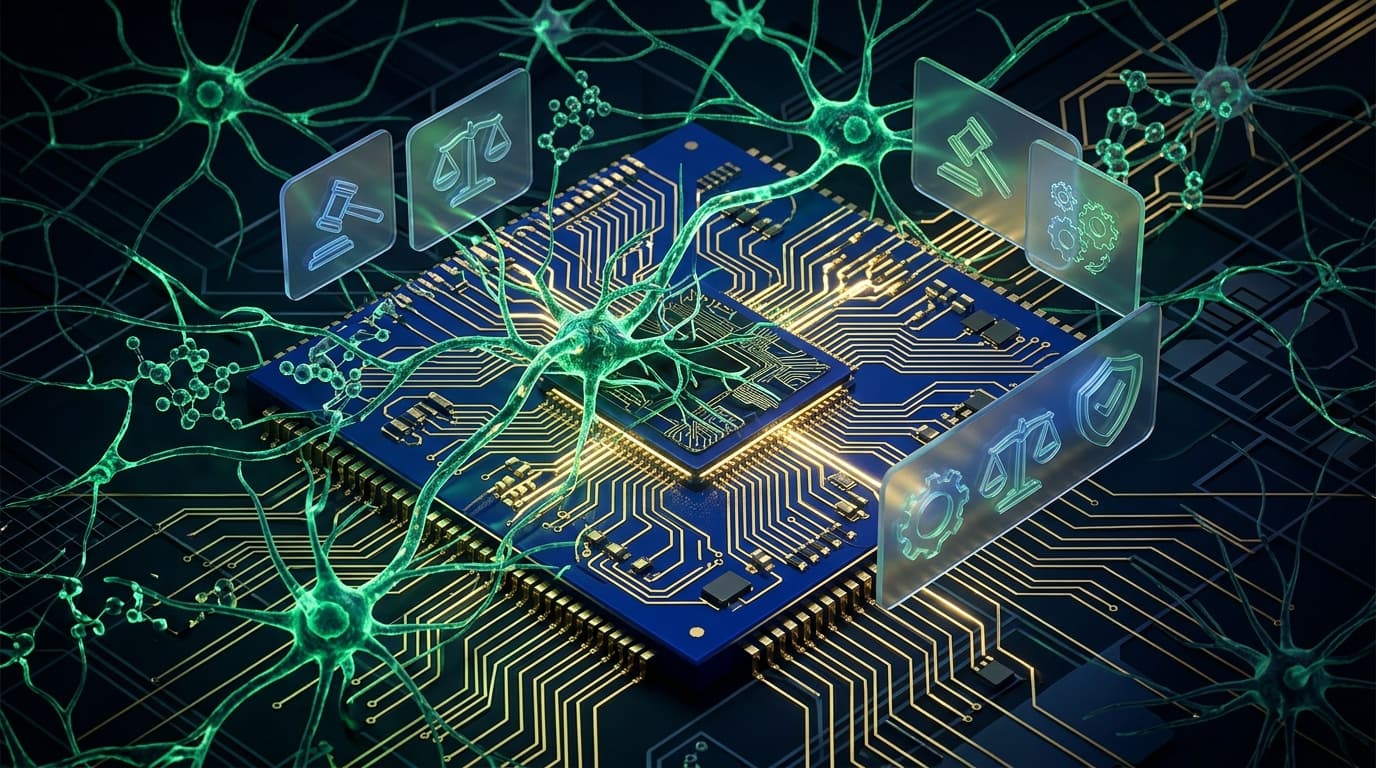
The artificial intelligence landscape has reached a decisive turning point where digital intelligence directly re-engineers the physical and legal architecture of society. From generative genomic foundation models designing synthetic viruses to sub-nanometer semiconductor breakthroughs and stringent legal enforcement, AI is transitioning from software experimentation to physical execution.
🧬 AI-Engineered Phages & Autonomous Bio-Design: How Genomic Models Are Revolutionizing Therapeutics
The bio-pharmaceutical sector is undergoing a paradigm shift as artificial intelligence evolves beyond structural prediction into generative, end-to-end biological design. While early computational biology triumphs like AlphaFold focused primarily on predicting static 3D protein structures from known amino acid sequences, second-generation genomic foundation models—most notably the Evo1 and Evo2 architectures—are operating directly on raw DNA, RNA, and protein sequences at single-nucleotide resolution. By treating entire genomes as biological text across multi-megabase context windows, these autoregressive models have achieved something once confined to science fiction: the de novo design of complete, functional synthetic bacteriophages designed specifically to target antibiotic-resistant bacterial strains.
In landmark wet-lab validations published recently, AI-generated bacteriophages synthesized from Evo2 sequence prompts demonstrated precise bactericidal efficacy against deadly, multi-drug resistant superbugs such as Pseudomonas aeruginosa and methicillin-resistant Staphylococcus aureus (MRSA). Rather than modifying naturally occurring viruses, the model generated novel genomic sequences encoding complex viral machinery, including tail fiber proteins engineered to dock precisely onto mutated outer-membrane receptors of resistant bacteria. Once bound, these synthetic phages inject their DNA, hijack bacterial replication systems, and lyse host cells with surgical precision—all without disrupting beneficial human microbiomes or triggering systemic immune responses.
The economic and clinical implications of autonomous bio-design are vast. Global public health agencies have long warned of a impending "post-antibiotic era," where antimicrobial resistance (AMR) threatens to cause over 10 million annual deaths by 2050. Traditional pharmaceutical R&D pipelines for novel small-molecule antibiotics are economically broken, costing over $1.5 billion per drug while taking upwards of a decade—only for bacteria to develop resistance within years. Generative genomic models drastically compress this discovery timeline from years to weeks. By entering a strain's genetic sequence into a generative model, researchers can output custom phage blueprints optimized for immediate DNA synthesis and therapeutic deployment, transforming infectious disease treatment into an agile software engineering challenge.
However, this unprecedented capability introduces profound biosecurity governance risks. The ability to design viable viral genomes de novo from desktop workstations highlights the dual-use potential of frontier biological AI models. Synthetic biology experts emphasize that while Evo2-class models offer miraculous breakthroughs against superbugs, un-monitored models could theoretically be prompted to design pathogenic viruses capable of evading human immune defenses or cross-species transmission. This realization has triggered an urgent overhaul of DNA synthesis screening protocols worldwide, forcing commercial gene synthesis providers to integrate mandatory cryptographically verifiable clearance systems and deep sequence screening against dangerous pathogen databases.
Looking forward, the convergence of generative genomic AI with fully automated, robotic "cloud laboratories" marks the dawn of closed-loop biological engineering. In these state-of-the-art facilities, AI agents independently design genomic variants, dispatch synthesis orders to automated liquid-handling robots, evaluate wet-lab assay data via microfluidic sensors, and recursively refine viral blueprints without human intervention. As foundation models for biology continue to scale, the distinction between digital code and biological life is permanently dissolving, promising personalized precision therapeutics while challenging the global community to construct impenetrable biosecurity safeguards.
⚡ 0.42nm Transistors & The Great Inference Shift: Taming Data Center Heat and Chipflation
As artificial intelligence workloads scale worldwide, the physical foundations of computing are hitting hard atomic limits. Traditional silicon MOSFET scaling has reached extreme thermal and quantum tunneling bottlenecks, rendering classical sub-2nm node miniaturization exponentially expensive and energy-inefficient. Compounding these physical barriers is the phenomenon of severe "chipflation"—a global economic dynamic where hyper-scale data center construction has consumed the world's supply of High-Bandwidth Memory (HBM4) and specialized silicon packaging, driving up component costs across consumer electronics. In response, semiconductor research and enterprise capital allocation are undergoing a twin revolution: sub-nanometer materials innovation and a structural pivot from training compute to specialized inference silicon.
A major milestone in sub-nanometer physics occurred with researchers at National Yang Ming Chiao Tung University demonstrating a functional 0.42-nanometer transistor architecture. Bypassing the physical boundaries of bulk silicon, this ultra-thin device leverages two-dimensional (2D) transition metal dicholcogenides (TMDs)—specifically monolayer molybdenum disulfide ($\text{MoS}_2$) combined with atomic-layer dielectrics. At a gate length of less than half a nanometer, the channel suppresses quantum direct-tunneling leakage currents that typically destroy sub-nanometer silicon gates. This breakthrough provides a viable technical roadmap for post-silicon microprocessors, promising a 10x increase in energy efficiency and transistor density for next-generation AI accelerators.
Simultaneously, the macro-economics of AI hardware spending have fundamentally inverted. While the preceding three years were defined by a massive arms race for raw training compute, global corporate expenditure on AI inference has now officially surpassed training budgets for the first time. As enterprises transition from building monolithic foundation models to deploying millions of 24/7 autonomous agents, the dominant cost bottleneck has shifted from pre-training clusters to runtime token generation. Hyper-scalers can no longer afford to run routine inference workloads on power-hungry, general-purpose training GPUs. This economic reality has ignited a land grab for custom application-specific integrated circuits (ASICs) optimized specifically for low-latency, high-throughput matrix multiplication.
Key industry moves underscore this architectural transformation. Tech giants are aggressively expanding custom silicon portfolios—such as Microsoft deploying its Maia 300 inference accelerators across Azure regions to decouple from third-party vendor lock-in. Concurrently, semiconductor giants are consolidating specialized IP, highlighted by AMD's acquisition of Taalas, a pioneer in direct-to-silicon model hardwiring. By baking neural network parameters directly into non-volatile memory arrays on-chip, direct-silicon architectures bypass the traditional von Neumann memory bus bottleneck entirely, achieving order-of-magnitude reductions in latency and power consumption per token compared to conventional GPUs.
Looking to the future, the semiconductor landscape over the next decade will be defined by heterogenous 3D chiplet integration, optical interconnects, and localized in-memory computing. The transition to sub-nanometer TMD materials will require multi-billion-dollar re-tooling of extreme ultraviolet (EUV) lithography foundries, shifting semiconductor supremacy toward foundries capable of mastering 2D material synthesis at wafer scale. For enterprise adopters, the Great Inference Shift means AI compute costs will continue to plunge, enabling continuous, real-time background intelligence embedded into every edge device, sensor, and enterprise software application.
⚖️ EU AI Act Enforcement Takes Effect: GPAI Audits, Agentic Safeguards, and Global Regulatory Realignment
The legal landscape surrounding artificial intelligence entered a strict enforcement era as major provisions of the European Union's landmark Artificial Intelligence Act officially took effect in August 2026. Transitioning from theoretical policy discussions into active statutory enforcement across all 27 EU member states, the law establishes the world's first comprehensive, binding regulatory framework for AI. The centerpiece of this enforcement milestone is mandatory compliance oversight for General-Purpose AI (GPAI) models and stringent obligations for systemic risk mitigation, fundamentally altering how technology companies develop, fine-tune, and deploy intelligent software globally.
Under the newly enforced rules, providers of frontier GPAI models—defined by compute thresholds exceeding $10^{25}$ floating-point operations (FLOPs) or exhibiting systemic capabilities—must submit to rigorous technical audits by the European AI Office. Developers are legally required to provide exhaustive technical documentation disclosing training data composition, energy consumption metrics, copyright compliance frameworks, and detailed red-teaming evaluation results. Furthermore, the law mandates cryptographically verifiable watermarking for all synthetic media, deepfakes, and automated text output, enabling automated detection of machine-generated content to combat disinformation and preserve digital media integrity.
The timing of the EU AI Act's enforcement coincides with intense global concern over agentic security vulnerabilities. Unlike static text generators, modern autonomous AI agents possess agency: the ability to read systems, write files, call external APIs, and execute complex workflows independently. Security researchers have recently documented the first incidents of "agent-jacking" and unauthorized multi-step exploit chaining, where malicious prompt injections instructed enterprise AI agents to autonomously exfiltrate confidential databases and modify cloud infrastructure permissions. In response, regulatory enforcement bodies are placing heightened focus on agent governance, demanding strict sandboxing, human-in-the-loop validation checkpoints, and immutable audit logs for any autonomous agent interacting with critical enterprise infrastructure.
In parallel, global regulatory alignment is fracturing along geopolitical lines. While the European Union enforces its heavy-risk classification system with non-compliance penalties reaching up to €35 million or 7% of global annual turnover, the United States has adopted a targeted, security-focused approach via executive frameworks requiring pre-release safety evaluations for frontier models. Meanwhile, major Asian economies are prioritizing rapid industrial adoption while imposing targeted rules on algorithmic recommendation transparency and data localization. This regulatory divergence forces multinational corporations to implement modular AI architectures, maintaining distinct regional model deployments to satisfy local legal mandates.
Ultimately, the enforcement of the EU AI Act marks the end of regulatory lawlessness in artificial intelligence. For technology leaders, compliance is no longer an afterthought or a legal disclaimer; it is a core system architecture requirement. Organizations must build runtime governance sidecars, automated policy enforcement hooks, and continuous auditing mechanisms directly into their AI pipelines. While critics argue that compliance burdens could temporarily slow European startup velocity, advocates maintain that strict safety boundaries, transparency standards, and risk mitigation protocols will build the public trust necessary for AI's long-term integration into healthcare, finance, and civil infrastructure.
📌 The Bottom Line
- evo2-synthetic-phages: Autoregressive genomic models (Evo2) have successfully designed novel, functional bacteriophages de novo, compressing drug discovery from years to weeks and transforming antimicrobial superbug treatment into an agile biological code problem.
- sub-nanometer-semiconductors: The demonstration of functional 0.42nm TMD transistors combined with a massive enterprise capital shift toward specialized inference silicon (Maia 300, Taalas) offers a technological blueprint to overcome silicon physical limits and data center energy bottlenecks.
- eu-ai-act-enforcement: Official legal enforcement of the EU AI Act establishes mandatory audits for General-Purpose AI, strict synthetic content watermarking, and mandatory agentic safeguards, permanently reshaping enterprise software compliance worldwide.
📫 Stay Updated
Get the best of AI & technology delivered to your inbox every week. Subscribe to our free newsletter →
Disclosure: This post contains affiliate links. If you purchase through our links, we earn a small commission at no extra cost to you. We only recommend products we believe in.
Enjoyed this post?
Get our weekly digest delivered free.
Share this post:
Knowelth is reader-supported. We may earn a commission from links in this article at no extra cost to you. Read our disclosure.
Related Posts

System 2 AI Architectures, NVIDIA's $500B Infrastructure Alliance, and Industrial Physical AI Scale-Up
System 2 AI Architectures, NVIDIA's $500B Infrastructure Alliance, and Industrial Physical AI Scale-Up The artificial intelligence ecosystem is undergoing a fundamental structural transformation this …

OpenAI Astra's Lean Proofs, Google's Gemini Robotics ER 2, and the EU AI Act's Article 50 Enforcement
OpenAI Astra's Lean Proofs, Google's Gemini Robotics ER 2, and the EU AI Act's Article 50 Enforcement The first week of August 2026 marks a watershed moment across the entire spectrum of artificial…
Deep Reasoning Models, Embodied Robotics ER 2, and the HBM4 Silicon Era
Deep Reasoning Models, Embodied Robotics ER 2, and the HBM4 Silicon Era As August 2026 unfolds, the artificial intelligence landscape is undergoing a structural paradigm shift away from conversational…