System 2 AI Architectures, NVIDIA's $500B Infrastructure Alliance, and Industrial Physical AI Scale-Up
System 2 AI Architectures, NVIDIA's $500B Infrastructure Alliance, and Industrial Physical AI Scale-Up
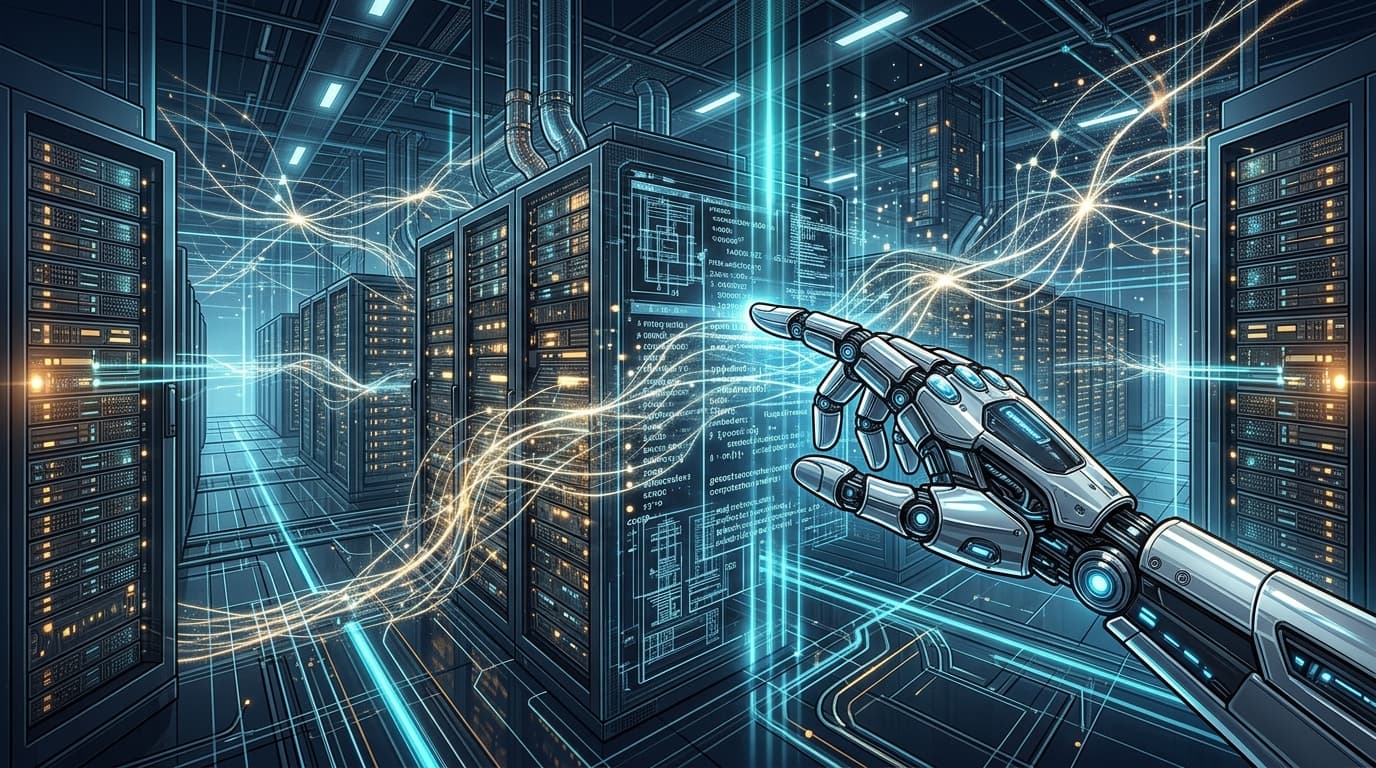
The artificial intelligence ecosystem is undergoing a fundamental structural transformation this month, moving past the era of passive chatbots and raw token streaming. As foundation models integrate native "System 2" deliberate reasoning, global financial syndicates mobilize unprecedented capital for AI compute infrastructure, and physical AI reaches commercial manufacturing scale, technology is entering a mature operational phase defined by autonomous execution and real-world impact.
🤖 System 2 Reasoning: AI Models Shift to Deliberate Internal Thinking
For years, state-of-the-art frontier models operated primarily under a "System 1" cognitive paradigm—generating text rapidly through statistical next-token prediction without internal pause or dynamic evaluation. The rollout of next-generation architectures, exemplified by OpenAI's GPT-5.5 rollout in August 2026, marks a decisive pivot toward integrated System 2 thinking. These native reasoning engines allocate compute dynamic at inference time, utilizing internal scratchpads, step-by-step verification, and recursive self-correction before outputting final answers to the user.
This architectural shift addresses one of the most stubborn limitations of legacy language models: brittle reasoning over long horizons. By allowing models to pause, evaluate intermediate logic, discard dead-end strategies, and test code paths in isolated execution sandboxes, System 2 models achieve step-function improvements in complex domain tasks. Recent benchmarks indicate dramatic accuracy gains in formal mathematical proofs, theoretical computer science conjectures, structural bio-informatics, and enterprise software refactoring—areas where traditional autoregressive models frequently hallucinated subtle logic errors.
From an economic and technical standpoint, System 2 architectures rebalance the cost structure of artificial intelligence. Compute expenditure is no longer concentrated solely in massive pre-training runs requiring tens of thousands of GPUs for months on end. Instead, inference-time compute scaling permits smaller, highly efficient base models to achieve frontier-level problem-solving capabilities simply by spending extra compute cycles deliberating on challenging tasks. Enterprise cloud providers are already optimizing inference pipelines, leveraging techniques such as KV cache compression and hardware-level token caching to make extended reasoning runs economically viable at scale.
For enterprise adoption, the transition to System 2 models signifies the shift from passive AI assistants to dependable agentic co-workers. Autonomous agents equipped with deliberate reasoning can autonomously execute multi-step workflows—such as inspecting complex codebases, diagnosing network outages, or running quantitative financial models—with minimal human intervention. As safety and verification mechanisms become native to the reasoning loop, the margin of operational error narrows, unlocking mission-critical deployments across healthcare, law, and engineering.
Looking ahead, the industry is focused on refining test-time search algorithms and multi-agent coordination frameworks. Rather than competing purely on parameter count, future model releases will be judged on reasoning efficiency, depth of internal reflection, and domain-specific problem-solving accuracy. As System 2 reasoning matures, artificial intelligence is transitioning from a conversational interface into an invisible, highly reliable reasoning layer embedded across global software systems.
⚡ NVIDIA’s $500 Billion Compute Alliance Signals the Sovereign Infrastructure Era
As frontier AI models demand exponential increases in both pre-training and test-time compute, the financial and physical footprint required to support next-generation data centers has outgrown traditional corporate balance sheets. In a landmark announcement on August 11, 2026, NVIDIA revealed a unprecedented $500 billion financing alliance backed by global investment powerhouses including Blackstone, BlackRock, and KKR. This massive capital vehicle is designed to fund the global buildout of gigawatt-scale AI supercomputers, optical network backbones, and dedicated power infrastructure over the next three years.
The scale of this infrastructure megadeal underscores the shift of AI compute from specialized IT hardware into a foundational utility comparable to electrical grids or telecommunications networks. Single data center builds are now crossing multi-gigawatt power requirements, driving direct investments into micro-modular nuclear reactors, grid upgrades, and direct-to-chip liquid cooling systems. By forming an institutional financing syndicate, hardware leaders and cloud providers are de-risking the enormous capital expenditure required to stay at the cutting edge of frontier model development.
Beyond financial scale, the $500 billion infrastructure push aligns directly with the rising global priority of "AI Sovereignty." Nations across North America, Europe, and Asia-Pacific are increasingly treating domestic AI compute capacity as a non-negotiable strategic asset. Government initiatives—such as India's Semicon 2.0 and regional European cloud sovereignty mandates—are accelerating localized data center builds to ensure critical enterprise data, security workloads, and national foundation models remain hosted within domestic borders under local jurisdiction.
From a chip design and architectural perspective, this capital infusion fuels the rapid transition to custom, highly dense silicon architectures. Next-generation clusters are bypassing conventional Ethernet constraints in favor of direct optical interconnects and specialized inference silicon, such as NVIDIA's Nemotron 3.5 Lightning and custom enterprise ASICs. These architectures provide the massive memory bandwidth and sub-millisecond interconnect latencies required to serve complex System 2 reasoning runs and real-time agentic workloads across millions of concurrent users.
The broader macroeconomic implication of this financing alliance is clear: capital scale has become the ultimate moat in frontier technology. As data center investments approach half a trillion dollars, the barrier to entry for training and hosting top-tier foundation models continues to rise. Over the next decade, technology leadership will belong to consortiums capable of mastering the trifecta of specialized silicon design, clean energy access, and institutional capital deployment.
🦾 Physical AI Reaches Factory Floors: Optimus Gen 3, Figure AI, and Hyundai’s E-FOREST Scale-Up
While digital AI agents transform software workflows, "Physical AI"—the fusion of vision-language-action (VLA) foundation models with physical robotic hardware—is crossing a critical commercial inflection point. For decades, industrial automation relied on rigid, single-purpose robots hardcoded for repeatable tasks in controlled environments. In August 2026, the deployment of adaptive, embodied AI platforms across automotive and manufacturing sectors demonstrated that robots can now operate dynamically in complex, human-centric workspaces.
A series of commercial milestones highlighted this rapid scale-up. Tesla commenced scaled production of its Optimus Gen 3 humanoid platform at Giga Texas, while specialized robotics firm Figure AI announced that its humanoid units had surpassed 1,000 active commercial deployments in logistics facilities. Simultaneously, industrial giant Hyundai deployed its proprietary E-FOREST: POLARIS platform—an integrated physical AI ecosystem that allows autonomous agents to manage factory floor logistics, monitor assembly precision, and perform preventative maintenance in real time, reducing facility downtime by an impressive 86%.
The technical breakthroughs enabling this physical AI revolution rest on solving longstanding robotic bottlenecks, particularly the "sim-to-real gap" and real-time sensorimotor coordination. Modern VLA models are trained on massive multimodal datasets incorporating synthetic physics simulations, video demonstrations, and telemetry from real-world robot fleets. Coupled with high-torque harmonic actuators, tactile sensor arrays, and powerful local Neural Processing Units (such as mobile NPUs capable of running 70-billion-parameter vision models directly on edge devices), robots can now adapt instantly to dropped components, shifting bin locations, and human co-workers.
Economically, maturing supply chains for specialized actuators, joint sensors, and edge silicon have driven down humanoid manufacturing costs by over 40% year-over-year. This cost decline changes the return-on-investment calculation for factory automation, making versatile humanoid and quadrupeds cost-competitive with traditional specialized equipment. Furthermore, because these machines learn through zero-shot transfer and natural language instruction, facility managers can reconfigure production lines in hours rather than spending weeks reprogramming industrial software.
Looking forward, physical AI is set to expand beyond automotive assembly into electronics manufacturing, agricultural logistics, healthcare assistance, and hazardous maintenance. As spatial intelligence models continue to improve and hardware reliability scales, embodied AI will redefine physical labor, unlocking unprecedented productivity and safety across global industrial operations.
📌 The Bottom Line
- system-2-reasoning: AI models are shifting from fast token generation to deliberate, self-correcting System 2 reasoning loops, drastically increasing reliability for complex agentic software workflows.
- nvidia-500b-alliance: A historic $500 billion financing alliance between NVIDIA and private equity titans secures the capital required for gigawatt-scale AI data centers and sovereign compute infrastructure.
- industrial-physical-ai: Physical AI reaches commercial scale as VLA foundation models and humanoid platforms like Tesla Optimus Gen 3 and Hyundai E-FOREST reduce factory downtime and transform manufacturing.
📫 Stay Updated
Get the best of AI & technology delivered to your inbox every week. Subscribe to our free newsletter →
Disclosure: This post contains affiliate links. If you purchase through our links, we earn a small commission at no extra cost to you. We only recommend products we believe in.
Enjoyed this post?
Get our weekly digest delivered free.
Share this post:
Knowelth is reader-supported. We may earn a commission from links in this article at no extra cost to you. Read our disclosure.
Related Posts
AI's Frontier Shift: Autonomous Bio-Design, 0.42nm Semiconductors, and the EU AI Act Governance Horizon
AI's Frontier Shift: Autonomous Bio-Design, 0.42nm Semiconductors, and the EU AI Act Governance Horizon The artificial intelligence landscape has reached a decisive turning point where digital intelli…

OpenAI Astra's Lean Proofs, Google's Gemini Robotics ER 2, and the EU AI Act's Article 50 Enforcement
OpenAI Astra's Lean Proofs, Google's Gemini Robotics ER 2, and the EU AI Act's Article 50 Enforcement The first week of August 2026 marks a watershed moment across the entire spectrum of artificial…
Deep Reasoning Models, Embodied Robotics ER 2, and the HBM4 Silicon Era
Deep Reasoning Models, Embodied Robotics ER 2, and the HBM4 Silicon Era As August 2026 unfolds, the artificial intelligence landscape is undergoing a structural paradigm shift away from conversational…