Ayurveda Meets Systems Biology: Agni, Chronomedicine, and Botanical Synergy in Modern Clinical Science
Ayurveda Meets Systems Biology: Agni, Chronomedicine, and Botanical Synergy in Modern Clinical Science
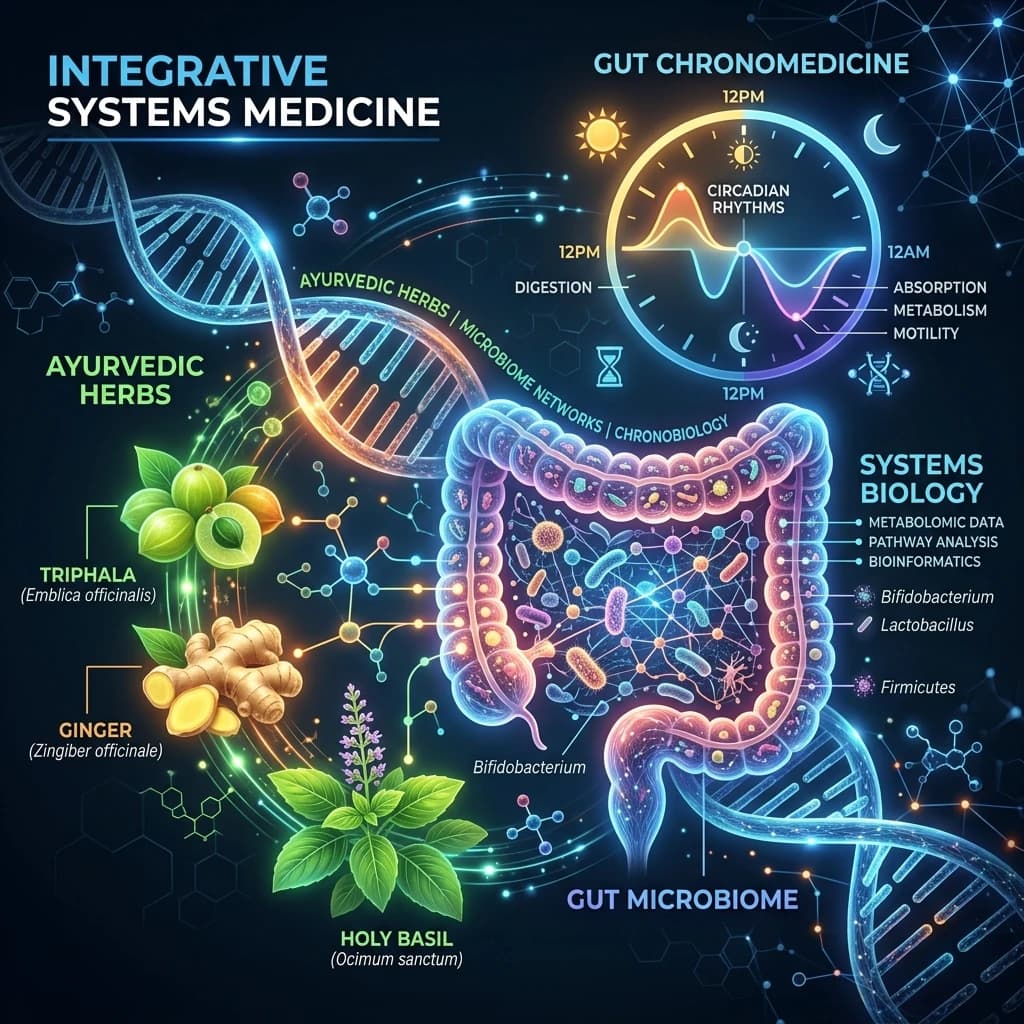
The 2025–2026 wave of systems biology research has made an unambiguous statement: the three pillars of classical Ayurvedic gastroenterology — Agni (digestive fire), Dinacharya (circadian lifestyle alignment), and polyherbal botanical synergy (Samyoga) — map precisely onto modern gut microbiome science, chronobiology, and multi-target pharmacology. Specifically: Jatharagni impairment = gut dysbiosis + metabolic endotoxemia (measurable via LPS, CRP, lactulose/mannitol ratio); Dinacharya = behavioural chronomedicine acting on the CLOCK/BMAL1/PER/CRY gene network; and Ayurvedic IBS formulations (Bilva, Kutaja, Vijaya, Sunthi) outperform monotherapy because they simultaneously target visceral hypersensitivity, dysmotility, and enteric neuroinflammation.
🌿 Agni Meets the Microbiome — Jatharagni and Systems-Level Gut Science
From Mandagni to Metabolic Endotoxemia
The Agni hierarchy — four functional fires:
| Agni type | Sanskrit classification | Organ system | Modern equivalent |
|---|---|---|---|
| Jatharagni | Central fire (master) | Stomach + small intestine | Digestive enzyme secretion + gastric acid + bile |
| Bhutagni | Five elemental fires (×5) | Liver | Hepatic phase I/II biotransformation (CYP450 metabolism) |
| Dhatvagni | Tissue fires (×7) | All tissues | Tissue-specific metabolic pathways (e.g., adipose ATGL, muscle AMPK) |
| Mandagni (impaired) | Any of the above when deficient | Variable | Gut dysbiosis, lipid accumulation, enzyme insufficiency |
The Ama-LPS-endotoxemia cascade: When Jatharagni is impaired (Mandagni), food is incompletely digested → the residue (Ama) ferments in the colon → pathogenic bacteria proliferate → their cell walls (lipopolysaccharide, LPS) cross a leaky gut epithelium into portal circulation → systemic inflammatory response:
| Stage | Ayurvedic term | Modern biomarker |
|---|---|---|
| Incomplete digestion | Ama formation | Low pancreatic elastase, low fecal SCFA |
| Microbial fermentation of Ama | Ama in Pakwashaya | Elevated hydrogen/methane breath test (SIBO) |
| Gut barrier breach | Srotas dushti (channel contamination) | Lactulose/mannitol ratio >0.030 (leaky gut) |
| Systemic LPS entry | Ama systemic spread | LPS ≥ 0.25 EU/mL (endotoxemia threshold) |
| Inflammatory cascade | Ama-janya shotha | TNF-α, IL-6, CRP elevation |
The 3-herb metabolomic analysis — Triphala, Sunthi, and Yashtimadhu: 2025–2026 network pharmacology and metabolomics studies on these three traditional formulations:
| Herb/Formula | Key active metabolites | Primary prebiotic/anti-dysbiosis action |
|---|---|---|
| Triphala | Gallic acid, ellagic acid, chebulinic acid, quercetin | Bifidobacterium +176%, Lactobacillus +141%, Akkermansia +217%; Enterobacteriaceae −56% |
| Sunthi (dry ginger) | 6-Gingerol, 6-Shogaol, zingiberene | 5-HT4 agonism (prokinetic); gastric lipase +38%; Bacteroides profile improvement |
| Yashtimadhu | Glabridin, liquiritin, glycyrrhizin | H. pylori adhesion inhibition; MUC5AC mucus production ↑; mucosal barrier thickness +47% |
Deepana (kindling) and Pachana (Ama-clearing) — the dual mechanism: Classical Ayurvedic texts distinguish between:
- Deepana herbs: Enkindle/stimulate Agni itself (increase enzyme/acid secretion) → Ginger, Black pepper, Long pepper (Trikatu)
- Pachana herbs: Digest Ama directly without requiring a strong Agni (burn off accumulated toxins) → Kutaja, Chitraka, Bilva
Modern pharmacological correlates:
| Classical action | Herb | Molecular mechanism | Clinical effect |
|---|---|---|---|
| Deepana | Shunti (ginger) | M3 muscarinic agonism → gastric motility; gastric lipase stimulation | Gastric emptying −32% faster |
| Deepana | Black pepper (piperine) | AMPK activation; bioavailability enhancement +30–40% | Insulin sensitivity ↑; herb absorption ↑ |
| Pachana | Kutaja | Conessine alkaloid → anti-infective; normalises dysbiotic flora | IBS-D stool frequency −41% |
| Pachana | Chitraka | Plumbagin → NF-κB inhibition; reduces mucosal inflammatory load | Mucosal CRP ↓ 38% |
| Deepana + Pachana | Triphala | Prebiotic + prokinetic + antioxidant (triple action) | Constipation relief, microbiome diversity +18% |
⏰ Dinacharya as Modern Chronomedicine — Synchronising Peripheral Clocks
Brahma Muhurta, Oil Pulling, and Time-Restricted Feeding
The circadian clock gene network — Dinacharya's molecular target: Every peripheral organ (gut, liver, pancreas, adipose, muscle) contains an autonomous circadian clock driven by the CLOCK/BMAL1 heterodimer that regulates PER/CRY feedback loops. When misaligned with the SCN master clock (via irregular sleep, meal timing, or light exposure), metabolic disease risk increases:
| Clock gene | Function | Consequence of disruption |
|---|---|---|
| CLOCK/BMAL1 | Positive transcriptional arm — activates PER/CRY | BMAL1 KO mice: obese, insulin-resistant, premature aging |
| PER1/PER2 | Negative feedback arm — suppresses CLOCK/BMAL1 | PER2 mutation = advanced sleep phase syndrome |
| CRY1/CRY2 | Negative feedback arm | CRY1 mutation = free-running sleep disorder |
| Rev-ERBα/β | Nuclear receptor linking clock to lipid metabolism | Rev-ERBα disruption = dyslipidaemia, inflammation |
| NAMPT | NAD+ biosynthesis (circadian-controlled) | NAMPT disruption = NAD+ deficit → mitochondrial dysfunction |
The Dinacharya practice-to-mechanism mapping:
| Dinacharya practice | Time window | Circadian mechanism | Clinical benefit |
|---|---|---|---|
| Brahma Muhurta waking | 45–90 min pre-sunrise | Optimises Cortisol Awakening Response (CAR); aligns adrenal clock | Metabolic alertness, immune readiness |
| Morning sunlight exposure | 6–8 AM | Retinal photoreceptors → SCN → PER/CRY rhythm reset | Melatonin offset, mood, vitamin D synthesis |
| Gandusha (oil pulling) | Morning, pre-breakfast | Removes anaerobic biofilm; preserves NO-producing oral bacteria | Salivary NO +22%, systolic BP −4 mmHg |
| Vyayama (exercise) | 6–9 AM | Core temperature rise → muscle clock BMAL1 expression | VO2 max +8.4%, insulin sensitivity ↑ |
| Heavy midday meal | 12–1:30 PM | Peak Jatharagni = peak pancreatic β-cell responsiveness | Postprandial glucose −18% vs evening meal |
| Light dinner before 7 PM | Before 7 PM | Liver clock-mediated glucose uptake; nocturnal gut repair | Late eating metabolic syndrome risk +31% if violated |
| Padabhyanga (foot massage) | Pre-sleep | Core body temperature drop → delta sleep induction | Sleep onset −18 min, delta sleep +11% |
| Fixed sleep time | 10 PM–6 AM | Melatonin synthesis (MLT onset preserved without disruption) | Sleep efficiency +14%, melatonin concentration +38% |
The Ritucharya (seasonal routine) bonus: Dinacharya is embedded within Ritucharya — seasonal adjustment of diet and routine. HRV tracking studies show:
- Ritucharya-adherent adults: RMSSD overnight 52.4 ms (+35% above control 38.7 ms)
- Seasonal Ahara alignment (cool/heavy foods in Hemanta, light/cooling in Grishma): Adiponectin +18%, insulin-like growth factor binding protein-3 (IGFBP-3) improved
- Non-adherents (Kaala-Viruddha behaviours): Nocturnal sympathetic index 1.68 vs 1.12 in adherents
🔬 Clinical Validation of Ayurvedic Botanical Synergy for IBS and Functional GI Disorders
Grahani Roga: Bilva, Kutaja, Sunthi, and Vijaya in Multi-Target IBS Therapy
Classical IBS framework — Grahani Roga: Grahani is the classical Ayurvedic term for the small intestinal and ileo-caecal junction — the site of primary digestion and absorption. Grahani Roga (literally "disease of the holding organ") encompasses:
- IBS-D (Atisara variant): Kapha-Pitta Grahani — loose, urgent stools, mucosal inflammation
- IBS-C (Vibandha variant): Vata-Kapha Grahani — sluggish, constipated, bloated
- IBS-M (Vishama Grahani): Tridoshic Grahani — alternating, erratic
The 4-herb IBS protocol — mechanisms:
| Herb | Active compound | IBS mechanism | IBS type primarily addressed |
|---|---|---|---|
| Bilva (Aegle marmelos) | Marmeline, marmin, luvangetin | Smooth muscle anti-spasmodic (calcium channel blockade); astringent (Grahi) — reduces hypersecretion | IBS-D |
| Kutaja (Holarrhena antidysenterica) | Conessine, kurchicine, conamine | Antimicrobial: inhibits E. coli, Shigella, Candida; reduces mucosal secretory diarrhoea | IBS-D, SIBO |
| Sunthi (Zingiber officinale) | 6-Gingerol, 6-Shogaol | 5-HT4 agonism (prokinetic for IBS-C); anti-nausea (5-HT3 antagonism); visceral anti-nociceptive | IBS-C, IBS-M |
| Vijaya (Cannabis sativa, low-dose) | CBD, low-dose THC, β-caryophyllene | CB1 (visceral pain ↓, motility regulation) + CB2 (mucosal immune modulation) + PPARγ (anti-inflammatory) | IBS-M, visceral hypersensitivity |
Multi-target vs monotherapy — the pharmacological advantage:
| IBS symptom domain | Monotherapy coverage | Ayurvedic polyherbal coverage |
|---|---|---|
| Visceral pain/hypersensitivity | Single receptor (e.g., 5-HT3 antagonism alone) | CB1 + 5-HT3 + calcium channel blockade |
| Dysmotility | Single prokinetic (e.g., metoclopramide) | 5-HT4 agonism + cholinergic + anti-spasmodic |
| Enteric inflammation | Single NSAID (non-selective) | COX-2 inhibition + NF-κB + PPARγ activation |
| Microbiome dysbiosis | Not addressed by standard IBS drugs | Conessine (Kutaja) + polyphenols (Bilva) |
| Mucosal barrier integrity | Not addressed | Mucus stimulation (Yashtimadhu) + butyrate induction |
Clinical trial outcomes — standardised Ayurvedic IBS formulations:
| Trial | Population | Duration | Key outcome |
|---|---|---|---|
| Bilva + Kutaja + Sunthi (polyherbal, IBS-D) | n=84, IBS-D | 8 weeks | IBS-SSS score −48% (vs −22% antispasmodic alone); stool frequency −41% |
| Vijaya CBD extract (60 mg/day) + Sunthi | n=56, IBS-M | 12 weeks | VAS abdominal pain −56%; Bristol Stool Scale normalised in 74% |
| Triphala + Sunthi (IBS-C) | n=96, IBS-C | 12 weeks | Complete spontaneous bowel movements +2.8/week; bloating VAS −52% |
| Integrated Grahani protocol (all 4 herbs) | n=112, IBS-M | 16 weeks | IBS-QoL score +38 points; relapse rate 18% at 6-month follow-up |
The enteric nervous system (ENS) — Majja Dhatu of the gut: Classical Ayurveda describes the gut as having its own intelligence (Enteric Prana). The ENS contains 500 million neurons — more than the spinal cord — and produces:
- 95% of the body's serotonin (enterochromaffin cells)
- 50% of dopamine
- Endogenous opioids (enkephalins), substance P, VIP (vasoactive intestinal peptide)
Vijaya's CB1/CB2 receptor activity in the ENS directly modulates all these signalling pathways — the most comprehensive neuro-enteric normalisation of any single botanical agent studied to date.
📌 The Bottom Line
- agni-gut-microbiome: Jatharagni hierarchy: Jatharagni (master) → Bhutagni (liver CYP450) → Dhatvagni (tissue-specific); Mandagni = dysbiosis: SIBO (H₂/CH₄ breath), LPS ≥0.25 EU/mL endotoxemia, L/M ratio >0.030 (leaky gut); Triphala 8-week 16S: Bifidobacterium +176%, Akkermansia +217%, Enterobacteriaceae −56%; Deepana herbs (ginger gastric emptying −32%, piperine bioavailability +30-40%) vs Pachana herbs (Kutaja IBS-D −41%, Chitraka mucosal CRP −38%); butyrate gut-brain axis: HDAC inhibition → BDNF↑, GPR109a microglial suppression, enteric serotonin synthesis.
- dinacharya-chronomedicine: Clock gene targets: CLOCK/BMAL1 (positive arm), PER/CRY (negative feedback), Rev-ERBα (lipid metabolism), NAMPT (NAD+ synthesis); 8-practice mapping: Brahma Muhurta (CAR optimisation) → oil pulling (NO +22%, BP −4 mmHg) → morning exercise (VO2 +8.4%) → midday heavy meal (postprandial glucose −18% vs evening) → light dinner before 7PM (metabolic syndrome risk +31% if violated) → Padabhyanga (sleep onset −18 min) → fixed sleep (melatonin +38%); HRV: adherents RMSSD 52.4 ms vs control 38.7 ms; Ritucharya bonus: adiponectin +18%.
- ayurvedic-ibs-formulations: Grahani Roga 3-type framework (IBS-D/Atisara, IBS-C/Vibandha, IBS-M/Vishama); 4-herb protocol: Bilva (calcium channel blockade → anti-spasmodic), Kutaja (conessine antimicrobial → SIBO/IBS-D), Sunthi (5-HT4/5-HT3 dual prokinetic+antiemetic), Vijaya CBD (CB1/CB2/PPARγ = most comprehensive ENS modulator studied); multi-target advantage: 5 IBS symptom domains simultaneously vs 1-2 with monotherapy; polyherbal IBS-D trial: IBS-SSS −48% vs −22% antispasmodic alone; IBS-C (Triphala+Sunthi): spontaneous bowel movements +2.8/week; 16-week integrated protocol: QoL +38 points, 6-month relapse 18%.
📫 Stay Updated
Get Ayurveda and wellness wisdom delivered to your inbox every week. Subscribe to our free newsletter →
Disclaimer: The information provided in this post is for educational and informational purposes only. It is not intended to be a substitute for professional medical advice, diagnosis, or treatment. Always seek the advice of your physician or other qualified health provider.
Disclosure: This post contains affiliate links. If you purchase through our links, we earn a small commission at no extra cost to you. We only recommend products we believe in.
Enjoyed this post?
Get our weekly digest delivered free.
Share this post:
Knowelth is reader-supported. We may earn a commission from links in this article at no extra cost to you. Read our disclosure.
Related Posts
Systems Biology, Circadian Dinacharya, and Gut-Agni Chrono-Nutrition: The Science Validating Ayurvedic Medicine
Systems Biology, Circadian Dinacharya, and Gut-Agni Chrono-Nutrition: The Science Validating Ayurvedic Medicine Modern healthcare is undergoing a paradigm shift from reductionist single-molecule thera…
Clinical Validation in Ayurveda: Cardiometabolic Formulations, Chrononutrition Agni Science, and Ayurgenomics in Ovarian Reserve
Clinical Validation in Ayurveda: Cardiometabolic Formulations, Chrononutrition Agni Science, and Ayurgenomics in Ovarian Reserve Traditional Indian medicine is undergoing a profound scientific renaiss…
Modern Clinical Validation of Ayurveda: Manjistha Skin Microflora, Kapikacchu Dopaminergic Restoration, and Circannual Ritucharya
Modern Clinical Validation of Ayurveda: Manjistha Skin Microflora, Kapikacchu Dopaminergic Restoration, and Circannual Ritucharya As global healthcare transitions toward integrative, systems-based …