Clinical Validation in Ayurveda: Cardiometabolic Formulations, Chrononutrition Agni Science, and Ayurgenomics in Ovarian Reserve

Clinical Validation in Ayurveda: Cardiometabolic Formulations, Chrononutrition Agni Science, and Ayurgenomics in Ovarian Reserve
Traditional Indian medicine is undergoing a profound scientific renaissance as global medical research increasingly validates its core principles. By combining rigorous randomized controlled trials, systems biology, multi-omics analytics, and chronobiology, modern science is illuminating the molecular mechanisms behind classical Ayurvedic interventions. From polyherbal formulations targeting cardiometabolic disease to metabolic meal timing and individualized reproductive therapies, traditional Ayurvedic wisdom offers precise, personalized solutions for modern global health challenges.
🌿 Multicentric Trials Validate Varadi Kwatha and Pushkar Guggulu in Cardiometabolic Health
Cardiometabolic disorders—encompassing Type-2 Diabetes Mellitus, atherogenic dyslipidemia, and coronary artery disease—represent the leading cause of global morbidity. In classical Ayurvedic pathology, these chronic conditions are categorized under Prameha (metabolic obstinacy), Sthoulya (obesity), and Hridroga (cardiac dysfunction), primarily driven by Kaphaja accumulation, Medovaha Srotas (lipid channel) obstruction, and Dhatvagnimandya (impaired tissue-level metabolic fire). Traditional classical literature prescribes specific polyherbal formulations engineered to clear channel micro-obstructions (Srotoshodhana) and restore metabolic homeostasis. Among these, Varadi Kwatha Ghana Vati and Pushkar Guggulu have long stood as foundational therapeutic pillars.
Recent multicentric randomized double-blind placebo-controlled trials published in peer-reviewed journals such as BMC Complementary Medicine and Therapies and registered on the Clinical Trials Registry-India (CTRI) have provided robust evidence supporting these historical applications. In clinical evaluations of Varadi Kwatha Ghana Vati—a compound featuring Triphala (Amalaki, Haritaki, Bibhitaki), Chitraka (Plumbago zeylanica), Nimba (Azadirachta indica), and Loha Bhasma—investigators observed statistically significant reductions in HbA1c, fasting blood glucose, and postprandial hyperinsulinemia in patients with inadequately controlled Type-2 Diabetes. Simultaneously, multicentric clinical evaluations of Pushkar Guggulu combined with Haritaki in stable coronary artery disease demonstrated marked reductions in total cholesterol, low-density lipoprotein (LDL-C), and serum triglycerides, accompanying improvements in myocardial perfusion and exercise tolerance.
At the molecular level, network pharmacology and phytochemistry reveal a sophisticated multi-target pharmacodynamic profile. The guggulsterones present in Commiphora mukul (Guggulu) act as natural antagonists to the Farnesoid X Receptor (FXR) and nuclear receptor PXR, upregulating hepatic LDL receptors and accelerating bile acid excretion. Concurrently, plumbagin from Chitraka and gallic acid derivatives from Triphala activate AMP-activated protein kinase (AMPK), downregulating key lipogenic enzymes such as HMG-CoA reductase and acetyl-CoA carboxylase. These phytoconstituents suppress nuclear factor kappa B (NF-κB) inflammatory signaling within vascular endothelial cells, attenuating lipid peroxidation and reducing arterial plaque vulnerability. This multi-targeted synergy illustrates the unique strength of Ayurvedic Samyoga (polyherbal formulation science), where multiple compounds act on complementary biological pathways to achieve clinical efficacy without the monotherapeutic side effects often associated with single-molecule drugs.
From an integrative cardiology perspective, these validated clinical trials offer compelling rationale for incorporating standardized Ayush formulations as adjuvant therapies alongside conventional lifestyle interventions and pharmacotherapy. However, clinical implementation requires strict attention to extract standardization, heavy metal testing, and monitoring for potential cytochrome P450 enzyme interactions. As multi-center clinical trials adopt updated CONSORT reporting guidelines, these traditional formulations are transitioning from empirical remedies into evidence-based therapeutics suitable for global integrative cardiology protocols.
Looking forward, the integration of polyherbal cardiometabolic agents into mainstream clinical practice represents a major shift toward preventative and disease-modifying care. By simultaneously addressing systemic inflammation, metabolic clearance, and vascular endothelial protection, formulations like Varadi Kwatha and Pushkar Guggulu bridge the gap between ancient metabolic philosophy and modern biochemical pharmacology.
⏰ Ayurvedic Chrononutrition: Synchronizing Agni, Dinacharya, and Circadian Biology
The ancient concept of Agni (metabolic and digestive fire) forms the cornerstone of Ayurvedic physiology. Ayurveda posits that health depends upon the optimal functioning of Jatharagni (gastrointestinal digestive capacity), Bhutagni (elemental liver metabolism), and Dhatvagni (cellular and tissue metabolism). Classical texts such as the Charaka Samhita explicitly state that Agni is not static; it follows a precise diurnal rhythm dictated by the solar cycle and Tridosha fluctuations. Jatharagni reaches its peak capacity during the Pitta period of the day (midday, roughly 10:00 AM to 2:00 PM), while declining substantially during the Kapha and Vata periods of late evening and early morning. Consequently, Ayurvedic dietary guidelines (Ahara Vidhi) mandate aligning food volume and macronutrient density with these natural biological rhythms.
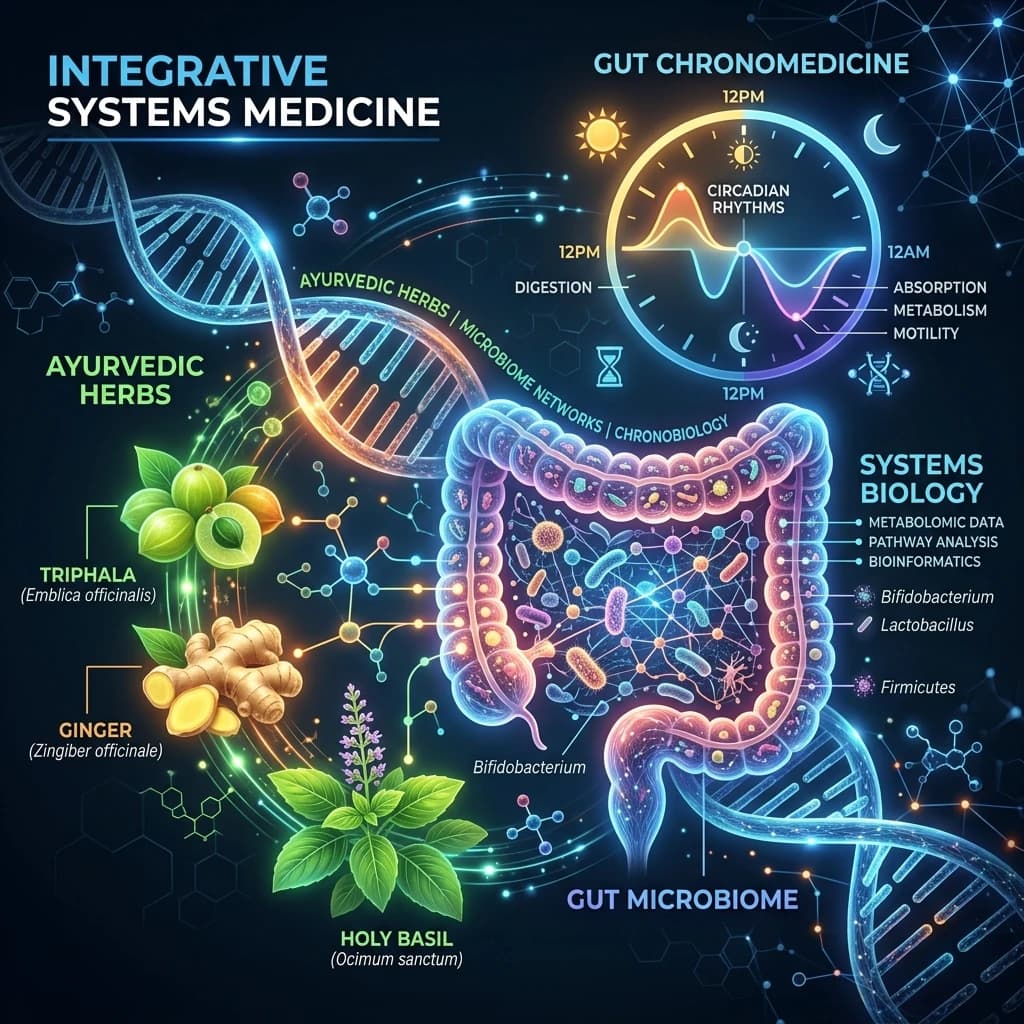
Modern chronobiology and metabolic science have recently rediscovered these exact physiological principles under the banner of chrononutrition. Molecular research has identified peripheral circadian clocks in the liver, gut lining, pancreas, and adipose tissue, controlled by master clock genes including CLOCK, BMAL1, PER1-3, and CRY1-2. These peripheral clocks dictate insulin sensitivity, gastric motility, digestive enzyme synthesis, and bile acid secretion across a 24-hour cycle. When meal intake (Ahara Kala) coincides with peak peripheral clock expression at midday, nutrient oxidation is optimized, and glucose clearance occurs rapidly. Conversely, late-night caloric consumption induces circadian misalignment, characterized by impaired beta-cell responsiveness, prolonged postprandial lipemia, and systemic metabolic stress.
In Ayurvedic pathology, eating out of alignment with Agni results in the formation of Ama—a toxic, undigested metabolic byproduct that accumulates in channels and triggers systemic illness. Modern biochemistry increasingly recognizes Ama as the clinical equivalent of metabolic endotoxemia and circulating lipopolysaccharides (LPS). When food is consumed during periods of low Agni (such as late at night), incomplete digestion alters gut permeability, allowing bacterial endotoxins to cross the intestinal mucosal barrier into the bloodstream. This activates Toll-like Receptor 4 (TLR4) pathways, instigating chronic low-grade inflammation, insulin resistance, and visceral adiposity. The Ayurvedic practice of Dinacharya (daily structured regimen)—which prescribes early rising (Brahma Muhurta), morning movement, substantial midday dining, and light early dinners—acts as a comprehensive behavioral zeitgeber that synchronizes master and peripheral biological clocks.
Furthermore, integrative studies are now connecting Ritucharya (Ayurvedic seasonal regimens) with seasonal shifts in the human gut microbiome. Research demonstrates that the diversity and metabolic output of gut microbiota fluctuate across seasonal transitions. The Ayurvedic seasonal dietary recommendations—adjusting taste profiles (Rasas) and qualities (Gunas) between Adana Kala (dry, energy-depleting seasons) and Visarga Kala (moist, nourishing seasons)—naturally nourish beneficial gut microbial populations, preserving metabolic homeostasis and barrier integrity year-round.
Implementing Ayurvedic chrononutrition in modern life provides a powerful, non-pharmacological strategy against lifestyle diseases. Simple adjustments—such as consuming the primary meal between 11:30 AM and 1:30 PM, maintaining a 12-to-14-hour overnight fast, avoiding heavy meals after sunset, and aligning daily routines with natural daylight—restore Agni and circadian rhythmicity. As chronomedicine continues to evolve, the ancient guidelines of Dinacharya and Ahara Kala stand out as sophisticated, time-tested frameworks for metabolic optimization.
🧬 Ayurgenomics and Multi-Omics Validation of Ayurvedic Protocols in Ovarian Reserve
In female reproductive medicine, diminished ovarian reserve (DOR) poses a challenging hurdle for fertility treatments and in vitro fertilization (IVF). In classical Ayurveda, reproductive vitality is governed by the health of Shukra and Artava Dhatus, which represent the terminal refined products of systemic tissue nutrition (Dhatu Poshana). Conditions involving premature ovarian aging or poor follicular responsiveness are attributed to Vata-Pitta imbalances, Rasa Dhatvagnimandya (impaired nutrient assimilation), and micro-circulatory depletion in the reproductive tissue tract. Traditional therapeutic management relies on Rasayana (rejuvenative) botanicals—such as Shatavari (Asparagus racemosus), Guduchi (Tinospora cordifolia), and Kalyanaka Ghrita—combined with Panchakarma cleansing protocols, particularly Basti (medicated enema therapy), to restore systemic bio-energetics and tissue perfusion.
Groundbreaking multi-omics clinical trials conducted between 2025 and 2026 have brought unprecedented scientific clarity to these traditional fertility interventions. Investigating women with diminished ovarian reserve receiving customized Ayurvedic pre-treatment prior to IVF cycles, researchers analyzed follicular fluid using transcriptomic, metabolomic, and proteomic profiling. The findings revealed that multi-week Ayurvedic Rasayana protocols significantly upregulated mitochondrial electron transport chain gene expression within granulosa cells, reduced reactive oxygen species (ROS) markers, and elevated intra-follicular anti-Müllerian hormone (AMH) signaling pathways. Patients undergoing integrative Ayurvedic pre-treatment demonstrated improved oocyte yield, enhanced blastocyst quality, and higher clinical pregnancy rates compared to control groups receiving standard IVF protocols alone.
These insights are anchored in the discipline of Ayurgenomics—an integrative field combining classical Ayurvedic Prakriti phenotyping (individual constitutional classification: Vata, Pitta, Kapha) with genomic sequencing, epigenomics, and metabolomics. Ayurgenomic profiling demonstrates that individuals with distinct Prakriti phenotypes express unique baseline genomic variations (SNPs in metabolic and endocrine pathways) and distinct epigenetic methylation signatures. For instance, Prakriti-tailored herbal formulations modulate specific microRNA networks regulating follicle-stimulating hormone (FSH) receptor expression and anti-apoptotic pathways in human granulosa cells.
The clinical translation of Ayurgenomics into reproductive endocrinology marks a paradigm shift toward personalized integrative medicine. Medicinal enemas (Basti), historically viewed purely through a traditional lens, are now recognized as powerful modulators of the gut-brain-ovarian axis. By altering gut microbial short-chain fatty acid (SCFA) production and dampening pelvic neuro-inflammation, Basti treatments directly influence hypothalamic-pituitary-ovarian (HPO) axis signaling and pelvic micro-circulation.
As global reproductive healthcare moves toward individualization, combining Ayurgenomic stratification with modern assisted reproductive technology offers a novel, holistic model for reproductive medicine. By nourishing cellular bioenergetics, reducing oxidative stress, and personalizing care to individual genomic profiles, classical Ayurvedic reproductive protocols provide a clinically validated bridge between ancient wisdom and future medicine.
📌 The Bottom Line
- cardiometabolic-ayurveda: Multicentric clinical trials confirm that Varadi Kwatha and Pushkar Guggulu enhance glycemic control, lipid clearance, and endothelial protection through AMPK activation and FXR receptor modulation.
- ayurvedic-chrononutrition: Molecular chronobiology validates Ayurvedic Agni and Dinacharya, proving that aligning meal timing with diurnal metabolic rhythms prevents metabolic endotoxemia and optimizes clock gene expression.
- ayurgenomics-ovarian-reserve: Multi-omics research demonstrates that personalized Ayurvedic Rasayana protocols enhance mitochondrial bioenergetics and oocyte quality in women with diminished ovarian reserve.
📫 Stay Updated
Get Ayurveda and wellness wisdom delivered to your inbox every week. Subscribe to our free newsletter →
Disclaimer: The information provided in this post is for educational and informational purposes only. It is not intended to be a substitute for professional medical advice, diagnosis, or treatment. Always seek the advice of your physician or other qualified health provider.
Disclosure: This post contains affiliate links. If you purchase through our links, we earn a small commission at no extra cost to you. We only recommend products we believe in.
Enjoyed this post?
Get our weekly digest delivered free.
Share this post:
Knowelth is reader-supported. We may earn a commission from links in this article at no extra cost to you. Read our disclosure.
Related Posts

Systems Biology, Circadian Dinacharya, and Gut-Agni Chrono-Nutrition: The Science Validating Ayurvedic Medicine
Systems Biology, Circadian Dinacharya, and Gut-Agni Chrono-Nutrition: The Science Validating Ayurvedic Medicine Modern healthcare is undergoing a paradigm shift from reductionist single-molecule thera…
Ayurveda Meets Systems Biology: Agni, Chronomedicine, and Botanical Synergy in Modern Clinical Science
Ayurveda Meets Systems Biology: Agni, Chronomedicine, and Botanical Synergy in Modern Clinical Science The 2025–2026 wave of systems biology research has made an unambiguous statement: the three pilla…
Modern Clinical Validation of Ayurveda: Manjistha Skin Microflora, Kapikacchu Dopaminergic Restoration, and Circannual Ritucharya
Modern Clinical Validation of Ayurveda: Manjistha Skin Microflora, Kapikacchu Dopaminergic Restoration, and Circannual Ritucharya As global healthcare transitions toward integrative, systems-based …