Sensex Rallies on Easing Crude, RBI's 50% Cash-Guarantee Mandate Shocks Prop Desks, and Parliament Grills RBI on Crypto Risks
Sensex Rallies on Easing Crude, RBI's 50% Cash-Guarantee Mandate Shocks Prop Desks, and Parliament Grills RBI on Crypto Risks
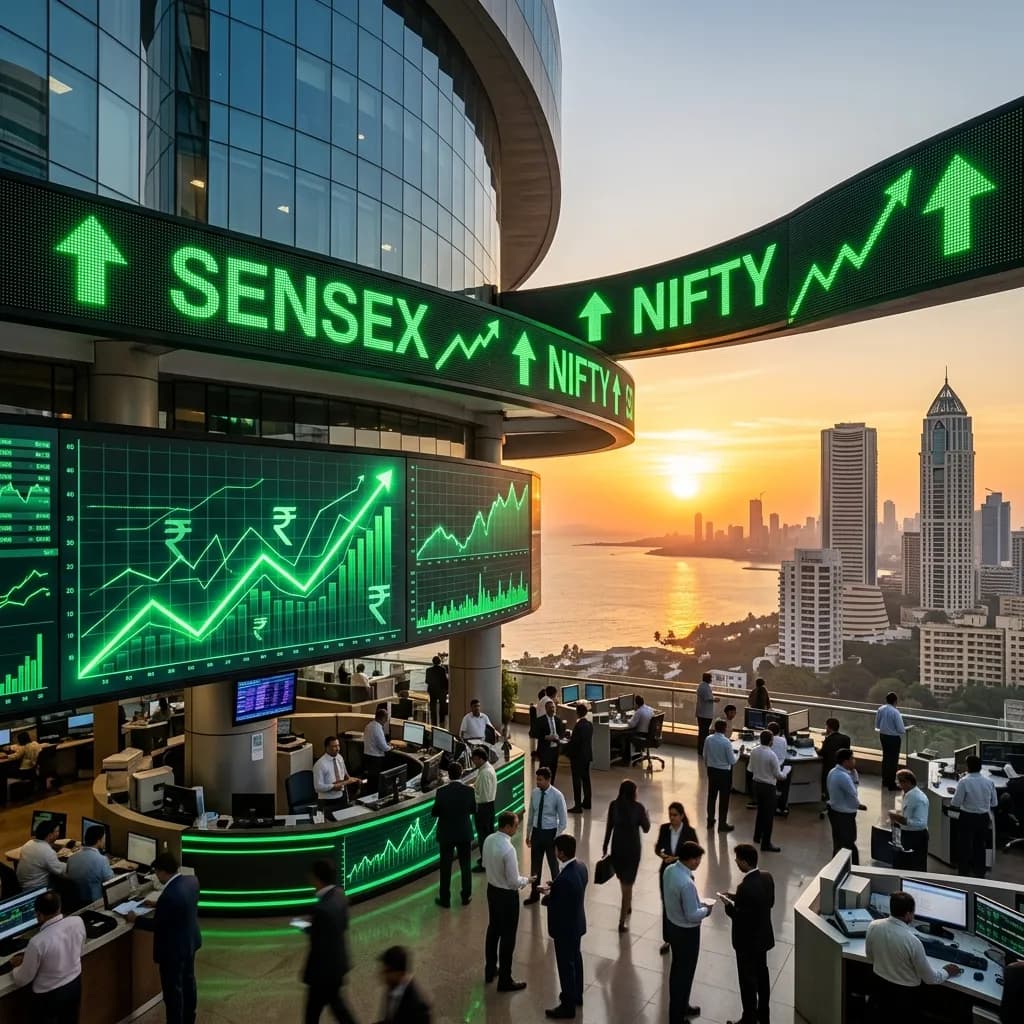
The Indian financial markets experienced a resilient session on July 2, 2026, as benchmark equity indices rallied on the back of falling crude oil prices and diplomatic progress in the Middle East. Underneath the equity optimism, market participants continued to grapple with the operational shocks of the Reserve Bank of India's (RBI) newly active proprietary trading margin guidelines. Meanwhile, regulatory oversight of digital assets intensified in New Delhi, where parliamentary leaders recorded critical RBI testimony regarding systemic stability risks posed by cryptocurrencies.
📊 Sensex and Nifty Advance as Easing Crude and Doha Talks Lift Sentiment
The domestic equity market resumed its upward trajectory on Thursday, July 2, 2026, supported by favorable global cues and structural tailwinds in commodity markets. The 30-share BSE Sensex advanced by 0.52%, or 399.07 points, to close at 77,323.00, recovering strongly from earlier intraday volatility. The benchmark NSE Nifty 50 index traded comfortably in positive territory, securing its position above the critical 24,000 threshold.
The market's bullish undertone was primarily fueled by a sharp correction in international crude oil benchmarks, with Brent crude dropping to approximately $70 per barrel. This decline was catalyzed by diplomatic progress in Doha, where indirect discussions between the US and Iran generated optimism regarding regional stabilization. The decline in oil prices is a significant positive for India's macroeconomic outlook — at $70/bbl vs. the recent $79 peak, India's annualised crude import bill falls by approximately ₹75,000–85,000 crore, directly mitigating imported inflation and easing pressure on the current account deficit.
The technology sector spearheaded the recovery, with the Nifty IT index snapping a multi-session losing streak. IT heavyweights Infosys, TCS, and HCLTech led gainers, driven by value-buying after recent corrections. On the currency front, the Indian Rupee capitalised on the macro tailwinds, appreciating 26 paise in early trade to settle near 94.90 against the US Dollar — its strongest single-day move in over two weeks. Domestic Institutional Investors (DIIs) remained strong net buyers, injecting ₹3,159.20 crore into the cash segment, comfortably offsetting net sales of ₹1,140.50 crore by Foreign Institutional Investors (FIIs).
Market breadth improved materially. The advance-decline ratio on NSE recovered to 1.8:1, with mid-cap and small-cap indices outperforming their large-cap peers by 0.3–0.5 percentage points — a sign of broadening confidence beyond index heavyweights.
🔬 Technical Analysis: Nifty 50 Recovers Above 24,000 — Key Test Ahead
Wednesday's close at 24,125 follows Tuesday's volatile session that had brought the index back toward the critical 24,000 psychological support. The two-session recovery pattern — a V-shaped bounce from the 24,000 floor — is a classic bullish confirmation signal in technical analysis. It tells us that sellers were unable to sustain control below 24,000, and buyers stepped in aggressively.
Technical snapshot on July 2:
- RSI-14: 53.5 — recovered above the 50 midline, bullish momentum confirmed
- MACD: Positive histogram after a brief bearish crossover attempt — bullish structure restored
- India VIX: 13.20 — declining, confirming reduced fear premium
- 20-day EMA: ~23,980 — price is 0.6% above, holding the EMA support
Levels to watch:
- Resistance: 24,270 (July 3 high from previous data) → then 24,500 (upper Bollinger Band)
- Support: 24,000 (20-day EMA and psychological floor — critical to hold)
- Stop-loss for bulls: Close below 23,850 (50-day EMA) would signal near-term trend reversal
🛡️ Prop Desks Feel the Squeeze as RBI's Cash-First Guarantee Rules Take Effect
Capital market intermediaries are experiencing a significant liquidity squeeze following the July 1 implementation of the RBI's updated credit guidelines for proprietary trading. The revised Commercial Banks – Credit Facilities Directions mandate that any bank guarantees (BGs) issued to brokers for proprietary operations must be 100% collateralised. Crucially, at least 50% of this collateral must be held in cash or fixed deposits — a steep increase from the historical average of ~25%.
The leverage math before and after the RBI rule:
| Metric | Pre-July 1 (Old Rules) | Post-July 1 (New Rules) |
|---|---|---|
| Required cash collateral | ~25% of BG value | 50% of BG value |
| Equity haircut | ~20% | 40% |
| Net leverage multiplier | ~1.7x | ~0.85x |
| Bank direct funding to prop desk | Permitted | Prohibited |
The leverage multiplier collapsing from 1.7x to 0.85x means prop desks with the same equity capital can now run only half the position sizes they could before July 1. For a desk that previously managed ₹500 crore in positions on ₹300 crore of capital, the new rule effectively caps positions at ₹250 crore.
The RBI's multi-pronged tightening has sharply restricted the leverage capacity of domestic proprietary trading desks, which are a major source of market liquidity — particularly in the derivatives (F&O) segment. While the RBI's primary objective is to insulate the banking system from sudden capital market shocks (drawing on global lessons from the Archegos Capital collapse in 2021), the immediate consequence is a notable reduction in trading volumes and a rise in intraday volatility across index options and futures.
Who is most affected:
- Large domestic brokerage firms with significant proprietary trading operations
- Market-neutral quantitative hedge funds that rely on bank-guaranteed leverage
- High-frequency trading (HFT) firms operating through Indian trading desks
Who benefits:
- Long-term equity investors (less intraday noise from leveraged prop desk activity)
- Banking system (reduced exposure to capital market contagion)
- India's sovereign credit profile (stronger financial stability credentials)
🪙 Parliament Grills RBI and ICAI on Cryptocurrency Regulatory Roadmap
In a major policy development, the Parliamentary Standing Committee on Finance convened on July 2, 2026, to conduct a comprehensive review of Virtual Digital Assets (VDAs). The session — titled "A Study on Virtual Digital Assets (VDAs) and Way Forward" — focused on drafting a unified national policy for cryptocurrencies, recording testimonies from senior RBI officials and representatives from the Institute of Chartered Accountants of India (ICAI).
RBI's position (summarised from testimony):
The RBI reiterated its long-standing, consistently hawkish view on decentralised cryptocurrencies:
- Monetary sovereignty risk: Widespread crypto adoption could dilute the RBI's control over money supply and inflation management — the central transmission mechanism of monetary policy
- Financial stability risk: The global crypto market's extreme volatility (Bitcoin's historical drawdowns of 70–80%+) creates contagion risks if Indian banks and NBFCs build significant crypto balance sheet exposures
- AML/CFT risk: Decentralised, pseudonymous transactions create significant money laundering and terror financing vulnerabilities that undermine FATF compliance
- The RBI's preferred solution: Central Bank Digital Currencies (CBDCs) — specifically, India's own e-Rupee — that offer digital payment benefits without the risks of decentralised tokens
ICAI's contribution: The accounting body is tasked with establishing:
- Clear accounting treatment for corporate crypto holdings (fair value vs. cost model; classification as intangible assets or financial instruments)
- Individual taxpayer disclosure norms for crypto income and capital gains
- Audit procedures and reporting standards for digital asset transactions
The ICAI's framework work is critical because without standardized accounting treatment, corporate treasuries face audit risk and regulatory uncertainty when holding crypto — which has deterred institutional crypto adoption in India despite significant retail interest.
What a VDA regulatory framework could look like: Based on parliamentary deliberations, the expected framework will likely:
- Register all domestic crypto exchanges with SEBI (similar to the Travel Rule for virtual asset service providers)
- Cap leverage on crypto derivatives traded domestically
- Mandate full KYC/AML compliance with CKYC registry integration
- Classify crypto as a "digital asset" for FEMA purposes, allowing regulated cross-border flows
💡 Investor Takeaway: How Today's Events Connect for Portfolio Construction
The three July 2 stories connect into a coherent portfolio construction theme:
-
Lower crude = macro tailwind for India: The $70/bbl Brent crude level is one of the most powerful macro positives for India's equity markets. Every sustained $10/bbl decline in crude saves India approximately ₹85,000 crore in import costs annually. This directly reduces CPI inflation, improves the CAD, and gives the RBI room to ease policy. The "crude tailwind" benefits FMCG, auto (lower input costs), airlines, and the broader consumption economy.
-
RBI prop desk rules = increased market efficiency (eventually): Short-term volatility from leveraged desk deleveraging is temporary. Long-term, markets driven more by fundamental valuation and less by leveraged speculative positions tend to be more efficient and less prone to flash crashes. This is structurally positive for value-oriented long-term investors.
-
Crypto regulatory clarity = potential opening for institutional allocation: If the Parliamentary committee's work produces a clear, SEBI-registered framework for digital assets, it could legitimise crypto as an institutional asset class in India. Even a 1–2% institutional portfolio allocation to regulated crypto would represent significant new inflows. Watch the Q3 FY27 parliamentary session for VDA framework announcements.
📌 The Bottom Line
- sensex-nifty-rally: The BSE Sensex gained 0.52% to close at 77,323.00 and the Nifty 50 held above 24,000, supported by Brent crude dropping to $70/bbl (saving ₹75,000–85,000 crore annualised vs. recent $79 peak) and a 26 paise INR appreciation to 94.90/USD. DIIs bought ₹3,159 crore vs. FII sales of ₹1,141 crore.
- rbi-prop-rules: RBI's new 50% cash collateral mandate and 40% equity haircut have collapsed prop desk leverage from 1.7x to 0.85x — halving position capacity and reducing F&O volumes near-term, while building systemic safety for the banking sector.
- parliament-crypto-review: The Parliamentary Standing Committee heard RBI's hawkish VDA testimony (monetary sovereignty and AML risks) and ICAI's framework for corporate crypto accounting. An expected SEBI-registered VDA framework could open regulated institutional crypto allocation in India.
📬 Stay Updated
Get India market analysis delivered to your inbox every trading day. Subscribe to our free newsletter →
Disclosure: This post contains affiliate links. If you purchase through our links, we earn a small commission at no extra cost to you. We only recommend products we believe in.
Enjoyed this post?
Get our weekly digest delivered free.
Share this post:
Knowelth is reader-supported. We may earn a commission from links in this article at no extra cost to you. Read our disclosure.
Related Posts
India Markets Daily: Sensex Rebounds to 78,080 as Nifty Drags, RBI Proposes Loan Reset Rules, FIIs Sell ₹1,006 Cr
India Markets Daily: Sensex Rebounds to 78,080 as Nifty Drags, RBI Proposes Loan Reset Rules, FIIs Sell ₹1,006 Cr Indian financial markets navigated a divergent trading session on August 13, 2026, as …
India Markets Update: Nifty Drops Below 24,450 Amid Oil Spike, RBI Holds Repo Rate at 5.25%, and FII Inflows Resume
India Markets Update: Nifty Drops Below 24,450 Amid Oil Spike, RBI Holds Repo Rate at 5.25%, and FII Inflows Resume Indian benchmark indices drifted lower for a second consecutive session as global en…
Nifty Snaps 4-Day Rally as Pre-RBI Policy Jitters & Crude Surge Trigger Profit Booking; Bharti Airtel Q1 Profit Soars 37%
Nifty Snaps 4-Day Rally as Pre-RBI Policy Jitters & Crude Surge Trigger Profit Booking; Bharti Airtel Q1 Profit Soars 37% Indian benchmark equity indices snapped their four-session winning streak on A…