RBI Deleveraging Rules Dampen Broker Funding, SEBI Overhauls Exchange-Based Buybacks, and India Market Access Portal Launches
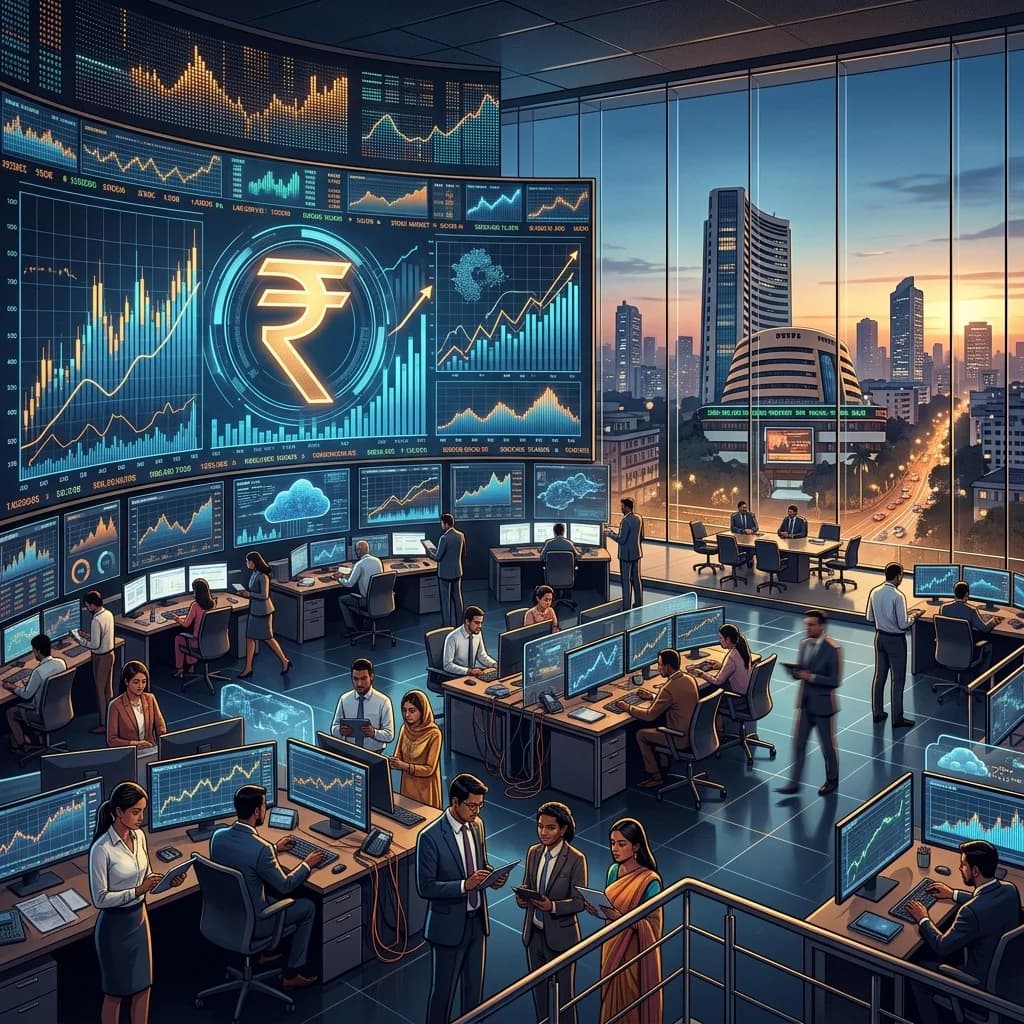
RBI Deleveraging Rules Dampen Broker Funding, SEBI Overhauls Exchange-Based Buybacks, and India Market Access Portal Launches
The Indian financial markets began the new trading week of July 6, 2026, navigating a shifting regulatory landscape that seeks to balance system stability with investor ease. While equity markets prepare for the upcoming Q1 FY27 corporate earnings season, a major deleveraging wave has hit proprietary trading desks following the implementation of the RBI's tighter bank funding rules. Concurrently, SEBI rolled out progressive frameworks including a streamlined open market buyback process and a unified access portal for foreign portfolio investors.
📊 RBI's Tightened Bank Funding Rules Delever Proprietary Trading Desks
A structural shift in Dalal Street's liquidity profile came into effect as the Reserve Bank of India's (RBI) revised capital market exposure framework took hold on July 1, 2026, forcing a major recalibration among proprietary trading desks. The new regulations:
- Prohibit commercial banks from extending credit or loans to stockbrokers for their proprietary trading activities
- Require 100% collateralisation of bank guarantees issued to brokers for clearing and settlement — with at least 50% mandatorily in cash or fixed deposits
- Apply 40% haircuts on equity securities pledged as collateral, meaning brokers must post significantly more security per rupee of credit
The central bank's tightening targets speculative leverage in the capital markets ecosystem — a concern that has grown as proprietary desks evolved into increasingly large, highly-leveraged participants in equity and derivatives markets. The Indian regulatory precedent draws from global lessons: in the US, the 2021 Archegos Capital collapse (which caused $10 billion in bank losses from prime brokerage over-leverage) demonstrated the systemic risks that excessive broker-bank funding relationships can create.
Industry estimates suggest the curbs on bank funding for proprietary trading desks could impact 12–15% of daily trading turnover on BSE and NSE. Proprietary desks — which act as crucial liquidity providers in the mid-cap and derivatives segments — are being forced to deleverage, leading to a temporary widening of bid-ask spreads. However, regulators and long-term market participants broadly view this as a healthy reduction of systemic leverage, even if the near-term friction on derivatives volumes is uncomfortable.
Brokers had lobbied for a phased roll-out or carveout for designated market makers. The RBI remained firm, emphasising that bank funding should support productive economic activity rather than speculative arbitrage. Proprietary trading desks must now increasingly rely on own equity capital or non-bank financing sources such as bonds and NBFC credit lines.
Market impact assessment for Q2 FY27:
- Short-term: Derivatives volumes may contract 10–15% as desks reduce position sizes; this reduces NSE/BSE transaction fee revenues proportionally
- Medium-term (6–12 months): Desks that can secure non-bank financing or raise equity capital will resume operations at reduced but more sustainable leverage
- Long-term: India's capital markets become structurally safer — a positive for sovereign credit ratings and long-term FII confidence
🔬 Technical Market Implications: Lower Liquidity = Higher Volatility in Mid-Caps
The reduction in proprietary trading activity has a specific technical market implication: liquidity in mid-cap and small-cap stocks — where proprietary desks play a disproportionately large role in providing bid-ask market making — is expected to thin out in the near term. Thinner liquidity environments historically correlate with:
- Wider bid-ask spreads (higher transaction costs for retail investors)
- Sharper intraday price swings on institutional orders
- Higher impact costs for large trades
Investors with significant mid-cap or small-cap exposure should factor in moderately higher execution costs over the next 1–2 quarters as the market adjusts.
🔄 SEBI Overhauls Exchange-Based Buybacks with Strict Utilization and Volume Limits
In a significant move to protect minority shareholder interests, SEBI announced a revamped framework for open market share buybacks through stock exchanges, effective August 1, 2026.
Previous vs. New Buyback Framework:
| Parameter | Old Framework | New Framework |
|---|---|---|
| Completion window | 6 months | 66 working days |
| Minimum deployment | None | 40% in first half of window |
| Daily purchase cap | Not specified | 25% of 10-day avg volume |
| Promoter trading | Not restricted | Frozen during buyback |
| Public shareholding floor | 25% | 25% (enforced more strictly) |
The most significant change is the compression of the buyback window from 6 months to 66 working days (~13 calendar weeks). Previously, companies could announce a buyback, make token purchases over the first few weeks to support the stock price, then allow the announcement effect to fade without meaningfully deploying capital. This practice — called "buyback anchoring" — was widely criticised as manipulative.
The 40% minimum deployment requirement in the first half of the window ensures that capital is genuinely returned to shareholders rather than used purely as a price support signal. The 25% daily volume cap prevents companies from dominating order books and artificially moving prices during the buyback period.
The promoter shareholding freeze is particularly investor-friendly: it eliminates the scenario where management announces a buyback while simultaneously selling personal holdings at the inflated prices the buyback creates — a classic insider conflict of interest.
Investment angle: Companies with strong free cash flow generation that have historically returned capital via buybacks — Infosys, TCS, Wipro, Hindustan Zinc, Coal India — should see more disciplined and faster capital return cycles under the new framework. This is modestly bullish for valuations in cash-rich companies that commit to buybacks.
🌐 SEBI Launches 'India Market Access' Portal to Boost Foreign Capital Inflows
SEBI has officially launched the "India Market Access" portal — a unified, single-window platform for current and prospective Foreign Portfolio Investors (FPIs). Developed in collaboration with NSE, BSE, NSDL, and CDSL, the portal serves as a one-stop destination for offshore capital seeking regulated access to Indian securities markets.
Key features of the India Market Access portal:
- End-to-end digitized registration: FPIs can submit and track registration applications entirely online, eliminating the paper-based documentation workflows that previously required physical courier submissions
- Real-time application tracking: Live status updates on registration progress, compliance queries, and approval timelines — reducing the information asymmetry that made India's FPI process opaque
- Regulatory repository: All SEBI circulars, FEMA notifications, GST guidance on FPIs, and DDT treaty information consolidated in a single searchable database
- Designated Depository Participant (DDP) integration: Direct communication channels with NSDL and CDSL-registered DDPs for demat account opening
The portal is specifically designed to attract mid-sized global institutional investors — pension funds managing $1–50 billion, university endowments, and sovereign wealth fund sub-mandates — who have historically found India's multi-step registration process too cumbersome relative to competing markets like Taiwan, South Korea, or Brazil.
Currently, India has approximately 12,000 registered FPIs managing a total AUM of approximately ₹68 lakh crore in Indian securities. The portal is expected to reduce the average FPI registration turnaround from 30–45 days to under 15 days — a significant improvement that could incrementally accelerate the pace of new FPI registrations.
💡 Investor Takeaway: Three Policy Vectors Shaping Q2 FY27 Equity Markets
The July 6 regulatory triple-header — RBI broker leverage caps, SEBI buyback reform, and India Market Access portal — collectively define three vectors that will shape equity market dynamics through Q2 FY27:
-
Deleveraging reduces near-term volatility amplitude: As proprietary desks shrink position sizes, the capacity for sharp intraday swings (in both directions) in the derivatives market is reduced. For retail options traders, this means lower option premiums — which is actually a buying opportunity for option buyers but challenging for theta-decay sellers.
-
Buyback reform = stronger capital returns: Companies that have idle cash balances will now face sharper market pressure to commit to buybacks under the new 66-day rules. This is positive for shareholders in cash-rich large-caps — especially in IT, metals, and energy PSUs.
-
FPI ease-of-access = medium-term structural inflow support: Each reduction in administrative friction for foreign investors translates to a structurally larger pool of capital with access to Indian markets. For index-level returns, sustained FPI inflow growth is one of the most powerful long-term tailwinds.
📌 The Bottom Line
- rbi-prop-desk-rules: The RBI's stricter capital market exposure rules (100% BG collateral, 50% cash mandatory) limit bank funding for proprietary trading — potentially impacting 12–15% of daily exchange turnover near-term but improving systemic safety long-term.
- sebi-buyback-rules: SEBI's open-market buyback overhaul mandates 66-day completion, 40% deployment in the first half of the window, 25% daily volume cap, and a full promoter trading freeze — eliminating "buyback anchoring" and protecting minority shareholders.
- fpi-market-access: SEBI's new "India Market Access" portal digitises FPI registration (target: <15 days vs. current 30–45 days), consolidates regulatory guidance, and targets mid-sized global institutional investors currently deterred by administrative friction.
📬 Stay Updated
Get India market analysis delivered to your inbox every trading day. Subscribe to our free newsletter →
Disclosure: This post contains affiliate links. If you purchase through our links, we earn a small commission at no extra cost to you. We only recommend products we believe in.
Enjoyed this post?
Get our weekly digest delivered free.
Share this post:
Knowelth is reader-supported. We may earn a commission from links in this article at no extra cost to you. Read our disclosure.
Related Posts
India Markets Daily: Sensex Rebounds to 78,080 as Nifty Drags, RBI Proposes Loan Reset Rules, FIIs Sell ₹1,006 Cr
India Markets Daily: Sensex Rebounds to 78,080 as Nifty Drags, RBI Proposes Loan Reset Rules, FIIs Sell ₹1,006 Cr Indian financial markets navigated a divergent trading session on August 13, 2026, as …
India Markets Update: Nifty Drops Below 24,450 Amid Oil Spike, RBI Holds Repo Rate at 5.25%, and FII Inflows Resume
India Markets Update: Nifty Drops Below 24,450 Amid Oil Spike, RBI Holds Repo Rate at 5.25%, and FII Inflows Resume Indian benchmark indices drifted lower for a second consecutive session as global en…
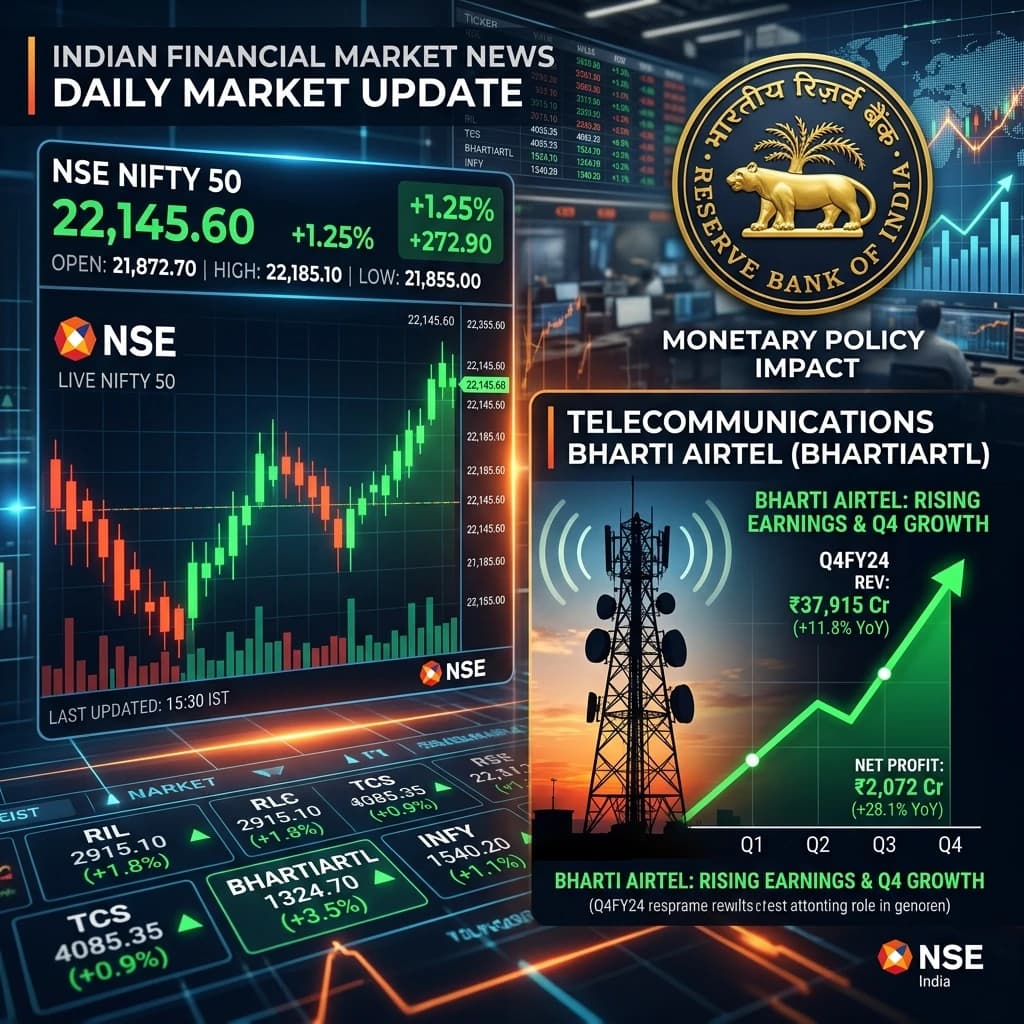
Nifty Snaps 4-Day Rally as Pre-RBI Policy Jitters & Crude Surge Trigger Profit Booking; Bharti Airtel Q1 Profit Soars 37%
Nifty Snaps 4-Day Rally as Pre-RBI Policy Jitters & Crude Surge Trigger Profit Booking; Bharti Airtel Q1 Profit Soars 37% Indian benchmark equity indices snapped their four-session winning streak on A…