Stone Symphonies: Decoding the Architectural Genius of Mahabalipuram, Konark, and Halebidu
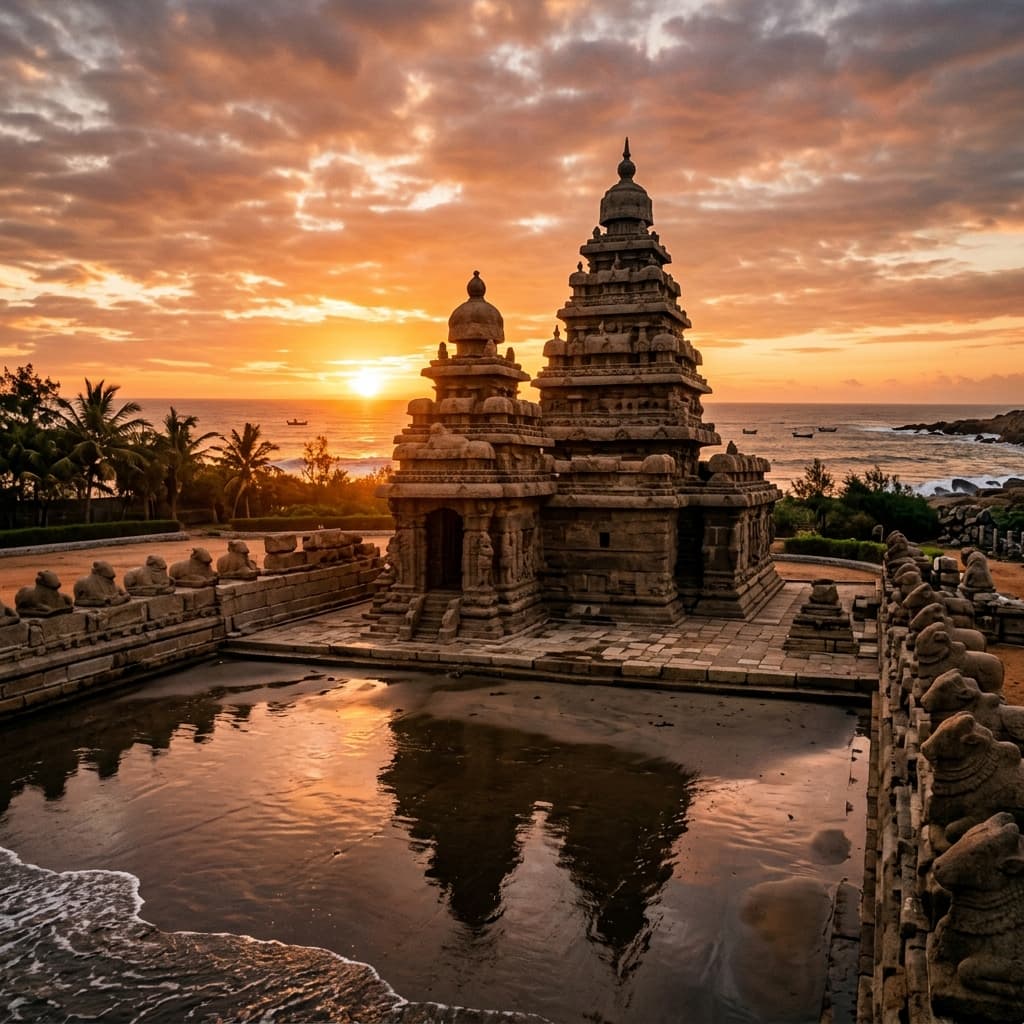
Stone Symphonies: Decoding the Architectural Genius of Mahabalipuram, Konark, and Halebidu
Three temple complexes — the Shore Temple of Mahabalipuram (Pallava dynasty, c. 700–728 CE), the Sun Temple of Konark (Eastern Ganga dynasty, c. 1250 CE), and the Hoysaleswara Temple of Halebidu (Hoysala Empire, c. 1121 CE) — represent three different solutions to the fundamental challenge of Indian temple architecture: how to encode divinity, astronomy, and political power in stone that will outlast dynasties. Pallava architects pioneered structural granite construction transitioning from rock-cut cave temples; Eastern Ganga engineers at Konark embedded a functioning sundial into a 24-wheel celestial chariot accurate to the minute; and Hoysala master sculptors exploited freshly quarried soapstone's temporary malleability to achieve lace-like carved detail impossible in harder stone — then let atmospheric chemistry harden it permanently.
🏛️ Shore Temple, Mahabalipuram — Pallava Revolution in Structural Granite
The Transition from Rock-Cut to Structural Architecture
The Pallava architectural sequence (7th–8th century CE):
| Phase | Type | Example | Technology |
|---|---|---|---|
| Phase 1 (c. 630–668 CE) | Rock-cut mandapas | Mahishasuramardini Cave | Carved directly into hillside granite |
| Phase 2 (c. 668–690 CE) | Monolithic rathas | Pancha Rathas (Five Chariots) | Single granite outcrop carved top-down |
| Phase 3 (c. 700–728 CE) | Structural temple | Shore Temple | Quarried granite blocks assembled |
The Shore Temple marks the moment when Pallava architects shifted from carving stone they already had (in-situ rock) to constructing structures from quarried and dressed blocks — the basis of all subsequent Indian temple architecture.
Shore Temple specifications:
| Element | Detail |
|---|---|
| Builder | Narasimhavarman II (Rajasimha), Pallava king |
| Date | c. 700–728 CE |
| Location | Bay of Bengal shoreline, Mahabalipuram, Tamil Nadu |
| Material | Dressed granite blocks (quarried from local formations) |
| Architectural style | Early Dravida (Pallava sub-style) |
| UNESCO designation | Part of Group of Monuments at Mahabalipuram (1984) |
The Three-Shrine Layout
The Shore Temple's spatial arrangement is unique in South Indian temple architecture:
| Shrine | Orientation | Deity | Architectural Type | Dating |
|---|---|---|---|---|
| Eastern (primary) | Faces east (sunrise) | Shiva (lingam) | Pyramidal vimana with octagonal shikhara | c. 700–715 CE |
| Western (primary) | Faces west (sunset) | Shiva (lingam) | Smaller pyramidal vimana | c. 715–728 CE |
| Central (secondary) | Between east + west | Vishnu (Anantashayana — reclining) | Flat roof (oldest element in complex) | Pre-700 CE (nucleus) |
The reclining Vishnu shrine at the centre is epigraphically identified as the oldest element — the Shore Temple was built around an existing Vishnu shrine, suggesting the site had prior sacred significance. This Shaiva-Vaishnava cohabitation under a single royal patron reflects the Pallava policy of pan-sectarian patronage.
The "Seven Pagodas" and Submarine Temples
European navigators (Portuguese, Dutch, British) called Mahabalipuram "Seven Pagodas" — referring to what they believed was a series of temples extending into the sea. Local tradition and Tamil literary sources support this. The 2004 Indian Ocean tsunami provided dramatic evidence: the retreating water before the wave exposed submerged granite walls, pavements, and carved stone blocks 500–800m offshore. Indian Navy underwater surveys (2004–2006) confirmed:
- Structural foundations of at least 2 temples at 5–8m depth
- Dressed granite blocks in coursed patterns (not natural formations)
- A large wall extending ~300m parallel to shore at 5m depth
The Shore Temple is the single above-water survivor of what was a larger coastal temple complex, gradually consumed by sea-level rise and storm erosion over 1,300 years.
The Nandi (bull) perimeter wall: The Shore Temple is surrounded by a unique protective wall studded with monolithic Nandi sculptures — Shiva's sacred bull — facing outward in all four directions. This creates both a ritual boundary (defining sacred space) and a physical wave-break. The Nandis appear to have been added by later Pallava kings, perhaps as the sea's encroachment became apparent.
🗿 Sun Temple of Konark — The Astronomical Sundial Chariot
Historical Context — A Victory Monument and Astronomical Statement
Eastern Ganga dynasty and Narasimhadeva I:
| Aspect | Detail |
|---|---|
| Builder | King Narasimhadeva I, Eastern Ganga dynasty |
| Date | c. 1250 CE (construction ~12 years) |
| Location | Puri district, Odisha coast (9km from Bay of Bengal) |
| Primary deity | Surya (Sun God) |
| Political context | Victory monument against Delhi Sultanate incursions |
| Architectural style | Kalinga (Odisha sub-tradition of Nagara) |
| UNESCO designation | Sun Temple, Konark (1984) |
| British nautical name | "Black Pagoda" (interfered with magnetic compasses) |
The Chariot — Engineering Specifications
The cosmic chariot design:
| Element | Number | Dimension | Astronomical Meaning |
|---|---|---|---|
| Stone wheels | 24 | ~3m diameter (10 feet) | 24 hours in a day |
| Horse teams | 7 | Full-size stone (12 horses total, some collapsed) | 7 days of the week |
| Wheel spokes | 8 per wheel | — | 8 praharas (3-hour divisions of the Hindu day) |
| Wheel hub projections | 16 per wheel | — | 16 muhurtas (48-minute divisions) |
The wheels as precision sundials: Each of the 24 wheels is carved with a central hub, spokes, and an outer rim. Modern astronomical analysis confirms:
- The hub's shadow falls on specific spoke positions at specific times of day
- Each spoke division = approximately 45 minutes
- With the hub's shadow bisecting a spoke, time can be read to ±3 minutes accuracy
- At the latitude of Konark (~19.9°N), the wheel's axle orientation and diameter are calibrated for local solar angle
Why 24 wheels: One wheel per hour of the day → together, the 24 wheels represent the complete solar cycle of a single day. The chariot moves through time itself.
The original three-structure axis (east-west):
| Structure | Original Height | Current Status | Function |
|---|---|---|---|
| Nata Mandapa (dance hall) | ~30m | Collapsed (19th c.) | Ritual dance performances before Surya |
| Jagamohana (assembly hall) | ~39m | Surviving | Congregation space for devotees |
| Deul (main sanctum) | ~67m (200+ feet) | Collapsed (19th c.) | Housed the primary Surya image |
The Deul (main tower) was one of the tallest temple structures ever built in India — ~67 metres. Its collapse is attributed to: (a) the iron girder spanning the sanctum door corroding and failing; (b) salt-laden coastal winds weathering the chlorite stone over centuries; (c) possible structural damage from the 1568 CE Kalapahad raid (Afghan general who deliberately damaged Odisha temples).
🔱 Hoysaleswara Temple, Halebidu — Soapstone Lace-Work in Stone
The Hoysala Empire and Chloritic Schist
Why soapstone (chloritic schist) transformed Hoysala architecture:
| Property | Fresh-Quarried Soapstone | After Atmospheric Exposure (years 5–20) |
|---|---|---|
| Hardness (Mohs) | 1–2 (softer than fingernail) | 6–7 (harder than window glass) |
| Carvability | Excellent — chisel cuts like wood | Impossible to carve further |
| Surface finish achievable | Microscopically fine (filigree patterns, 0.5mm detail) | Permanently preserved |
| Durability | Fragile when fresh | Harder than granite at surface |
| Colour | Grey-green when fresh | Darkens to deep grey-green; some honey-gold oxidation |
This two-phase material property is the secret to Hoysala temples' extraordinary detail. Sculptors carved during the "soft" window (months to a few years after quarrying) and then the stone hardened permanently around their work.
Hoysaleswara Temple specifications:
| Element | Detail |
|---|---|
| Commissioned by | King Vishnuvardhana, Hoysala Empire |
| Dedicated to | Hoysaleswara (king's Shiva) + Santaleswara (queen Shantala's Shiva) |
| Began | c. 1121 CE |
| Functional | c. 1160 CE |
| Completed | Never — truncated by Delhi Sultanate invasions (1311, 1326 CE) |
| Plan type | Dvikuta (twin-shrine) with shared mandapa |
| Platform type | Stellate (star-shaped) — creates 32-pointed zig-zag plan |
| UNESCO | Proposed (on India's Tentative List since 2014) |
The Star-Shaped Platform — Maximising Sculpture Surface
Why a stellate (star-shaped) plan? A square or rectangular temple has 4 flat walls. A stellate plan — where the walls project outward in a series of pointed bays (32 in the Hoysaleswara's case) — dramatically increases the total wall surface area for the same enclosed floor area. More wall surface = more sculpture.
The Hoysaleswara's outer wall perimeter is ~230m for a structure with a ~40m × 60m footprint — a flat-wall rectangle of equivalent footprint would have only ~200m perimeter. The stellate plan adds ~15% more carving surface with zero increase in structural cost.
The sculptural friezes — bottom to top:
| Band Position | Subject | Symbolic Meaning | Number of Figures |
|---|---|---|---|
| Base (lowest) | Elephants (processional) | Foundation — strength, stability | ~2,000 |
| Second | Lions (prancing) | Courage, royal authority | ~1,000 |
| Third | Horses (galloping) | Speed, dynamism | ~800 |
| Fourth | Scrolling floral vines | Life, fertility, abundance | Continuous |
| Fifth | Makaras (mythical sea creatures) | Water, boundaries | ~400 |
| Sixth | Geese (hamsas) | Purity, wisdom | ~300 |
| Seventh | Epic narrative scenes | Ramayana + Mahabharata + Bhagavata | ~4,000 panels |
| Eighth (topmost) | Celestial maidens (madanikas) | Highest spiritual beauty | 240 individual figures |
The 240 madanika (bracket figure) sculptures at Hoysaleswara are considered the pinnacle of Indian female sculpture — each figure stands ~1.2m tall in a unique posture (applying kajal, playing music, dancing, with a pet), carved with individuated facial expressions, jewellery detail, and fabric texture that reads as textile in stone.
📌 The Bottom Line
- mahabalipuram-shore-temple-pallava: Pallava architectural evolution: rock-cut mandapas (Phase 1) → monolithic rathas (Phase 2) → structural granite (Phase 3, Shore Temple); 3-shrine layout: east Shiva + west Shiva + central Vishnu Anantashayana (oldest element, pre-700 CE); "Seven Pagodas": 2004 tsunami exposed submarine walls 500-800m offshore at 5-8m depth — Indian Navy confirmed at least 2 submerged temples; monolithic Nandi perimeter = ritual boundary + physical wave-break.
- konark-sun-temple-eastern-ganga: Narasimhadeva I Eastern Ganga, c. 1250 CE; 24 wheels (24 hours) × 7 horses (7 days) × 8 spokes (8 praharas) × 16 hub projections (16 muhurtas); wheels = precision sundials accurate to ±3 minutes at Konark's 19.9°N latitude; original axis: Nata Mandapa + Jagamohana (surviving, 39m) + Deul (~67m = tallest Nagara shikhara ever — now collapsed); collapse causes: corroded iron girder + coastal salt weathering + 1568 Kalapahad raid.
- halebidu-hoysaleswara-soapstone: Chloritic schist: fresh Mohs 1-2 (carve like wood) → atmospheric hardening Mohs 6-7 (harder than glass) over 5-20 years; Vishnuvardhana c. 1121 CE; dvikuta (twin-shrine: Hoysaleswara + Santaleswara); stellate 32-pointed plan: +15% wall surface vs equivalent rectangle; 8-band frieze: elephants (2,000) → lions → horses → flora → makaras → hamsas → epic narratives (4,000 panels) → madanikas (240 figures, 1.2m each, individuated expressions + textile detail); never completed — Delhi Sultanate raids 1311+1326 CE.
📬 Stay Updated
Explore India's extraordinary architectural heritage with weekly deep dives. Subscribe to our free newsletter →
Disclosure: This post contains affiliate links. If you purchase through our links, we earn a small commission at no extra cost to you. We only recommend products we believe in.
Enjoyed this post?
Get our weekly digest delivered free.
Share this post:
Knowelth is reader-supported. We may earn a commission from links in this article at no extra cost to you. Read our disclosure.
Related Posts
Stone Chronicles of Sovereignty and Democracy: The Epigraphic Legacy of Aihole's Meguti Temple, Uttiramerur's Assembly Inscriptions, and the Royal Reliefs of Hampi's Hazara Rama
Stone Chronicles of Sovereignty and Democracy: The Epigraphic Legacy of Aihole's Meguti Temple, Uttiramerur's Assembly Inscriptions, and the Royal Reliefs of Hampi's Hazara Rama Across the diverse lan…
Monolithic Cliffs, Alpine Spires, and Chariots of Stone: The Architectural Feats of Dhamnar, Baijnath, and Melkadambur
Monolithic Cliffs, Alpine Spires, and Chariots of Stone: The Architectural Feats of Dhamnar, Baijnath, and Melkadambur Across the vast geographical expanse of the Indian subcontinent, ancient and medi…
Sacred Corridors, Interlocking Stone Chains, and Thousand-Pillar Sanctuaries: The Architectural Marvels of Rameswaram, Kanchipuram, and Moodabidri
Sacred Corridors, Interlocking Stone Chains, and Thousand-Pillar Sanctuaries: The Architectural Marvels of Rameswaram, Kanchipuram, and Moodabidri Across the Indian subcontinent, sacred architecture r…