Octagonal Sanctuaries and Monolithic Spires: Unveiling Mundeshwari, Krimchi, and Avani's Stone Legacies
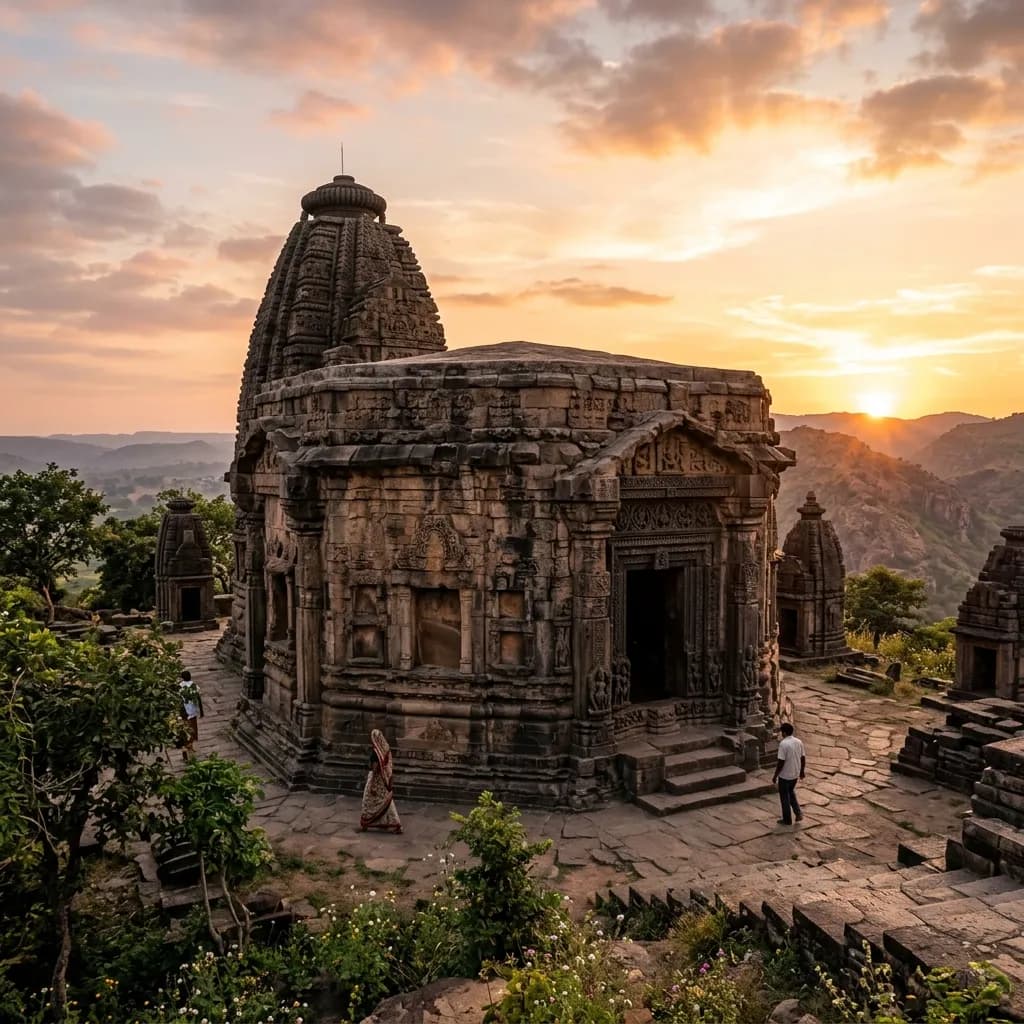
Octagonal Sanctuaries and Monolithic Spires: Unveiling Mundeshwari, Krimchi, and Avani's Stone Legacies
Three temples on the margins of standard architectural survey — Mundeshwari Devi on Mundeshwari Hill, Bihar (late 6th–early 7th century CE, confirmed by a 635 CE inscription); the Krimchi temple complex near Udhampur, Jammu (8th–9th century CE, Bhutial dynasty attribution); and the Ramalingeshwara complex at Avani, Karnataka (Nolamba dynasty, early 10th century CE) — preserve architectural forms found nowhere else in India. Mundeshwari's octagonal (astakona) stone sanctum with four-directional doorways and diagonal-facing devakostha niches is the only confirmed octagonal post-Gupta Hindu temple in India — a geometric experiment that was never replicated at scale. Krimchi's linear arrangement of seven temples along a stream valley combines Nagara shikhara profiles with Kashmiri-Hellenistic column geometry and iron-dowel dry ashlar — the trace of the Silk Road's architectural vocabulary surviving in the western Himalayan foothills. And Avani's Ramalingeshwara complex is one of Karnataka's earliest prakara-enclosed multi-shrine complexes: four shrines for the four sons of King Dasharatha (Rama, Lakshmana, Bharata, Shatrughna) plus auxiliary shrines for Sita, Vali, and Sugriva — all within a single courtyard wall, making it a literal Ramayana in granite.
🏛️ Mundeshwari Devi Temple — India's Only Octagonal Post-Gupta Sanctum
The Octagonal Plan — Why It Never Replicated
Temple plan geometry in early Indian architecture:
| Plan type | Frequency | Structural rationale | Examples |
|---|---|---|---|
| Square (chaturasra) | Most common | Simplest load-bearing geometry; natural basis for shikhara | Nearly all Hindu temples |
| Rectangular (ayata) | Common | Elongated for larger assembly halls | Jagamohanas; mandapas |
| Circular (vritta) | Rare | Used for Yogini temples only; hypaethral | Chausath Yogini (Bhedaghat, Hirapur) |
| Apsidal (D-shaped) | Rare | Buddhist chaitya influence | Some early Buddhist-Hindu transitional temples |
| Octagonal (astakona) | Extremely rare | Complex angular load distribution; no precedent for shikhara | Mundeshwari (only confirmed Hindu example) |
Why the octagonal plan was not replicated: Building an octagonal garbhagriha creates structural challenges that don't exist in square plans:
- Shikhara geometry: The classical Nagara shikhara presupposes a square footprint. An octagonal base requires the shikhara to transition from 8 sides to the circular amalaka finial — no established architectural grammar existed for this in 7th-century India
- Wall-corner loads: At each of the 8 corners, two walls meet at 135° (not the square's 90°) — requiring more complex corner interlocking stones
- Roof spanning: Spanning the octagonal interior with stone lintels required lintels of different lengths for the two alternating span types
The Mundeshwari builders solved all three problems — but apparently the complexity outweighed the aesthetic benefit, and the experiment was not widely adopted.
Mundeshwari Temple Specifications
Physical data:
| Element | Detail |
|---|---|
| Location | Mundeshwari Hill, Kaimur district, Bihar (~600m elevation) |
| Dynasty | Post-Gupta (possibly Maukhari or early Kalachuri patronage) |
| Dating | 635 CE confirmed by on-site inscription; likely built c. 580–620 CE |
| Plan shape | Octagonal (astakona) — unique in post-Gupta Hindu temples |
| Material | Dressed local sandstone |
| Doorways | 4 cardinal doorways (North/South/East/West) |
| Diagonal niches | 4 devakostha niches on diagonal sides |
| Shikhara | Lost — only the octagonal base and lower walls survive |
| Sanctum images | Chaturmukh Shiva Linga (4-faced) + Mundeshwari Devi (Shakti) |
| Status | ASI protected; active worship |
The Chaturmukh Shiva Linga: A four-faced Shiva Linga (Chaturmukh) represents the four aspects of Shiva manifesting simultaneously:
| Face direction | Shiva aspect | Cosmic function |
|---|---|---|
| East | Sadyojata | Creation; new beginning |
| South | Aghora | Dissolution; destruction |
| North | Vamadeva | Preservation; sustenance |
| West | Tatpurusha | Obscuration; concealment (the hidden face) |
| Top (upward) | Ishana | Grace; revelation (5th aspect of Panchamukha variants) |
The 4-faced variant (Chaturmukh) plus the octagonal sanctum creates a unified cosmological programme: 4 cardinal door openings = 4 cosmic directions; 4 diagonal niches = 4 sub-directions; 4 Shiva faces = 4 cosmic aspects. The entire temple is a three-dimensional mandala of the cosmos in 8 directions.
The 635 CE inscription — evidence and significance: The Mundeshwari inscription, carved in Brahmi script, records a visit by a royal patron (likely a Maukhari or early Kalachuri vassal) and confirms the temple was already functional and well-maintained by 635 CE — making this among the oldest dated inscriptions confirming Hindu temple activity in eastern India.
🗿 Krimchi Temples — Nagara-Kashmiri-Hellenistic Convergence
The Bhutial Dynasty and the Western Himalayan Trade Route
Krimchi's strategic location: Krimchi sits in the Udhampur valley on the ancient Punjab-to-Kashmir trade route — the road connecting Lahore and the Punjab plains to the Kashmir valley before the modern Jammu-Srinagar highway was built. This route carried:
- Silk Road goods from Central Asia via Kashmir south to Punjab markets
- Pilgrims traveling from the plains to Vaishno Devi and Kashmir Shaiva centres
- Military expeditions from Kashmiri and Rajput rulers
The Bhutial dynasty (regional rulers, 7th–9th century CE) built the Krimchi complex as a sacred waystation on this route.
The architectural synthesis at Krimchi:
| Element | Source tradition | Detail |
|---|---|---|
| Shikhara profile | Nagara (North Indian) | Curvilinear towers with vertical projections (rathas) |
| Column design | Kashmiri-Hellenistic | Abstract geometric capitals; fluted shafts reminiscent of Doric columns |
| Raised platform | North Indian Nagara | High stone adhisthana (raised plinth) |
| Masonry technique | Dry ashlar + iron dowels | Gravity-interlocked stone + iron anchor pins at joints |
| Linear site plan | Kashmiri tradition | Temples arranged along a water body (stream) linearly |
| Deity dedication | Pan-sectarian | Shiva + Vishnu + Ganesha (multiple sects served) |
The Hellenistic column influence — Silk Road trace: The column capitals at Krimchi display abstract geometric patterns — straight-edged, faceted, symmetric — that are strikingly similar to the Doric and Ionic capitals of Hellenistic Greek architecture that spread through the Gandhara (Pakistan/Afghanistan) region following Alexander's campaigns (326 BCE) and the subsequent Greek kingdoms. By the 8th century CE, these Gandhara-Hellenistic design elements had been absorbed into Kashmiri temple vocabulary and were transmitted southward along the Punjab-Kashmir trade route.
Complex layout — seven temples along a stream:
| Temple | Approximate height | Deity | Preservation |
|---|---|---|---|
| Temple 1 (largest) | ~15m (50+ feet) | Shiva | Good — shikhara partially standing |
| Temple 2 | ~10m | Vishnu | Good |
| Temple 3 | ~8m | Ganesha | Good |
| Temples 4–7 (smaller) | 3–6m | Various | Variable (some ruined) |
The linear arrangement along the stream means each temple has flowing water nearby — important for daily ritual purification and abhisheka (ritual anointing). The stream functions as both the site organiser and the sacred axis.
🔱 Avani Ramalingeshwara — Ramayana in Granite
The Nolamba Dynasty — Karnataka's Border Kingdom
The Nolambas (Nolamba-Pallavas): The Nolamba dynasty (c. 750–1110 CE) controlled the borderlands between the Gangas (eastern Karnataka), the Rashtrakutas (north), and the Cholas (south). As vassals-turned-independent kings, the Nolambas developed a distinctive regional style that synthesised early Dravidian Pallava elements with local Karnataka granite-working traditions.
Avani's sacred geography:
| Claim | Source | Significance |
|---|---|---|
| "Gaya of the South" | Local tradition + pilgrimage texts | Equivalent sacred status for ancestor rites (shraddha) |
| Valmiki's hermitage | Ramayana tradition (Uttara Kanda) | Sita took shelter at Valmiki's ashrama near Avani |
| Birth of Lava and Kusha | Ramayana tradition | Lava and Kusha born here; later reunited with Rama |
| Western Ganga inscription | 399 CE stone inscription | Oldest datable evidence of sacred site activity at Avani |
The prakara (enclosure wall) — Avani's architectural innovation: The Ramalingeshwara complex at Avani is one of the earliest examples of a unified prakara (courtyard enclosure wall) housing multiple distinct shrines in Karnataka:
| Element | Detail |
|---|---|
| Enclosure type | Single prakara (rectangular courtyard wall) |
| Shrine count | 7 shrines within the prakara |
| Primary shrines | 4 — for Rama, Lakshmana, Bharata, Shatrughna (Dasharatha's sons) |
| Auxiliary shrines | Sita + Vali + Sugriva |
| Oldest shrine | Shatrugnalingeshwara (structural evidence = oldest fabric) |
| Most ornate shrine | Lakshmanalingeshwara (finest carving + ceiling panel) |
| Material | Fine-dressed grey granite |
The Lakshmanalingeshwara ceiling panel: The ceiling of the Lakshmanalingeshwara shrine contains the complex's finest sculptural achievement: a relief panel of Uma-Mahesvara (Shiva and Parvati in intimate divine union pose) surrounded by the Ashta Dikpalas (8 directional guardians):
| Figure | Position | Vahana shown |
|---|---|---|
| Shiva (Uma-Mahesvara, central) | Centre | Nandi (implied) |
| Parvati (Uma, beside Shiva) | Centre | — |
| Indra | East | Airavata (elephant) |
| Agni | South-East | Ram |
| Yama | South | Buffalo |
| Nirrti | South-West | Human figure (rakshasa) |
| Varuna | West | Makara (sea creature) |
| Vayu | North-West | Deer/antelope |
| Kubera | North | Seated on a throne (yaksha form) |
| Ishana | North-East | Nandi (second Nandi at NE = Shiva's own direction) |
The outer wall kirtimukha niches: The outer walls of each shrine display niches (koshtas) topped by kirtimukha arches — the "face of glory," a disembodied monster-mask motif with a wide open mouth, no lower jaw, and exaggerated eyes. In Shaiva temple tradition, kirtimukha is said to be a being that devoured itself in obedience to Shiva. As an architectural element, it marks the threshold between sacred and profane space.
📌 The Bottom Line
- mundeshwari-devi-octagonal-post-gupta: Only confirmed octagonal post-Gupta Hindu temple in India; 635 CE inscription = oldest dated Hindu temple evidence in eastern India; octagonal plan engineering challenges: shikhara grammar undefined for octagonal base + 135° wall corners (vs square 90°) + mixed lintel spans; Chaturmukh Shiva Linga: 4 faces = 4 aspects (Sadyojata East/Aghora South/Vamadeva North/Tatpurusha West) + 4 diagonal devakosthas + 4 cardinal doors = 3D mandala of cosmos in 8 directions; temple as Shaiva-Shakta synthesis (Chaturmukh Linga + Mundeshwari Devi coexist).
- krimchi-temples-nagara-kashmiri-hellenistic: Bhutial dynasty (7th-9th c.) on Punjab-Kashmir Silk Road trade route; 7 temples linear along stream (water = ritual purification axis); Nagara shikharas + Kashmiri-Hellenistic Doric-Ionic-influenced column capitals (Gandhara Greek transmitted via 8th c. Kashmir temple vocabulary) + dry ashlar + iron dowels; 3 sects served (Shiva/Vishnu/Ganesha); Temple 1 (largest, 15m) best preserved; iron dowels at joints = Kashmiri structural technique.
- avani-ramalingeshwara-nolamba: Nolamba (c. 750–1110 CE, Karnataka borderland dynasty); 399 CE Western Ganga inscription = oldest Avani sacred activity evidence; one of Karnataka's earliest unified prakara (7 shrines: 4 Dasharatha sons + Sita + Vali + Sugriva) = Ramayana in granite; Shatrugnalingeshwara = oldest shrine; Lakshmanalingeshwara = most ornate: Uma-Mahesvara ceiling + complete Ashta Dikpala ring (Indra/Airavata East → Ishana/Nandi NE = 8 directional programme); kirtimukha niche arches = threshold markers between sacred and profane space.
📬 Stay Updated
Explore India's extraordinary architectural heritage with weekly deep dives. Subscribe to our free newsletter →
Disclosure: This post contains affiliate links. If you purchase through our links, we earn a small commission at no extra cost to you. We only recommend products we believe in.
Enjoyed this post?
Get our weekly digest delivered free.
Share this post:
Knowelth is reader-supported. We may earn a commission from links in this article at no extra cost to you. Read our disclosure.
Related Posts
Stone Chronicles of Sovereignty and Democracy: The Epigraphic Legacy of Aihole's Meguti Temple, Uttiramerur's Assembly Inscriptions, and the Royal Reliefs of Hampi's Hazara Rama
Stone Chronicles of Sovereignty and Democracy: The Epigraphic Legacy of Aihole's Meguti Temple, Uttiramerur's Assembly Inscriptions, and the Royal Reliefs of Hampi's Hazara Rama Across the diverse lan…
Monolithic Cliffs, Alpine Spires, and Chariots of Stone: The Architectural Feats of Dhamnar, Baijnath, and Melkadambur
Monolithic Cliffs, Alpine Spires, and Chariots of Stone: The Architectural Feats of Dhamnar, Baijnath, and Melkadambur Across the vast geographical expanse of the Indian subcontinent, ancient and medi…
Sacred Corridors, Interlocking Stone Chains, and Thousand-Pillar Sanctuaries: The Architectural Marvels of Rameswaram, Kanchipuram, and Moodabidri
Sacred Corridors, Interlocking Stone Chains, and Thousand-Pillar Sanctuaries: The Architectural Marvels of Rameswaram, Kanchipuram, and Moodabidri Across the Indian subcontinent, sacred architecture r…