Sacred Stone Dynasties: Unveiling Sri Mukhalingam, Annigeri Amrtesvara, and Tribhuvanam Kampaheswarar
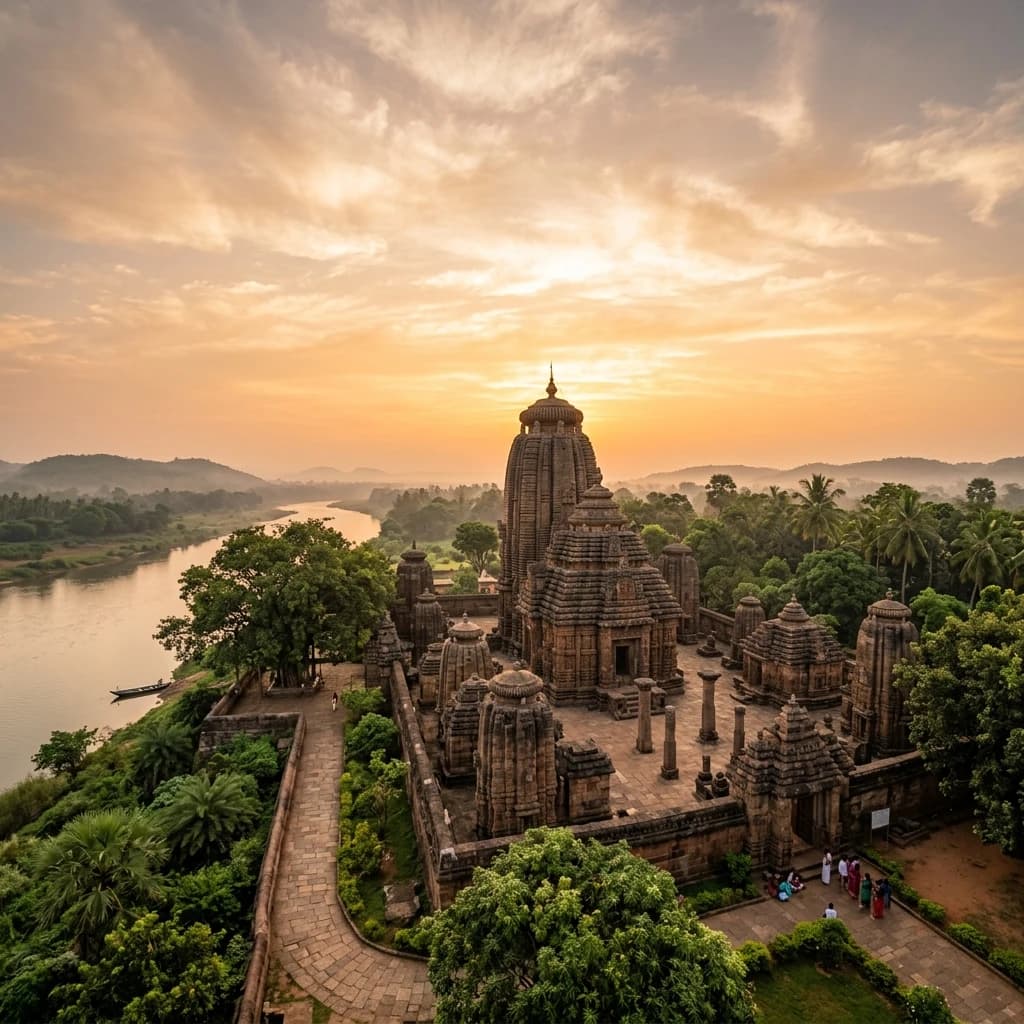
Sacred Stone Dynasties: Unveiling Sri Mukhalingam, Annigeri Amrtesvara, and Tribhuvanam Kampaheswarar
Three temple complexes spanning the breadth of medieval India — Sri Mukhalingam (Andhra Pradesh, 8th century CE), Annigeri Amrtesvara (Karnataka, c. 1050 CE), and Tribhuvanam Kampaheswarar (Tamil Nadu, 1190–1210 CE) — document three centuries of architectural evolution from three distinct traditions. Sri Mukhalingam is the capital complex of the early Eastern Ganga dynasty and the oldest surviving example of early Kalinga Rekha Deula style — its fossilised natural lingam with a carved human face (Mukhalingam) one of the rarest Shaiva sculptural forms in existence. Annigeri Amrtesvara is the prototype that launched the Kalyani Chalukya soapstone revolution — the first temple built entirely of black chloritic schist, whose 76 lathe-turned soapstone pillars and staggered wall geometry directly influenced Halebidu, Belur, and Itagi. And Tribhuvanam Kampaheswarar is the fourth and final monument of the Great Living Chola Temples quartet — the last act of Chola imperial architecture before the Vijayanagara era begins.
🏛️ Sri Mukhalingam — The Eastern Ganga Kalinga Capital
The Eastern Ganga Dynasty — Architects of Odisha's Temples
The Eastern Ganga dynasty in historical context:
| Period | Seat of Power | Key Contribution |
|---|---|---|
| 6th–8th century CE | Sri Mukhalingam (Kalinganagari) | Early Kalinga temple architecture; proto-Rekha Deula style |
| 8th–11th century CE | Transition to Cuttack region | Expansion of Kalinga tradition toward Bhubaneswar |
| 11th–12th century CE | Cuttack / Jajpur | Maturation of Kalinga style; precursor to Konark |
| 13th century CE | Cuttack / Puri | Construction of Konark Sun Temple (greatest Kalinga monument) |
The Eastern Gangas began at Sri Mukhalingam. Every subsequent Kalinga temple — Mukteshvara, Lingaraja, Konark — descends architecturally from the experiments conducted here in the 8th century.
The Three-Temple Yantric Configuration
Sri Mukhalingam is not one temple but a complex of three temples arranged in a triangular configuration with cosmological significance:
| Temple | Deity | Dimensions | Distinctive Feature |
|---|---|---|---|
| Madhukeswara | Shiva (primary; Mukhalingam) | Largest; ~20m tower | Houses the fossilised Mukhalingam (face-lingam) |
| Someswara | Shiva (Soma = Moon association) | Medium; ~15m tower | Lunar iconography; moonstone thresholds |
| Bhimeswara | Shiva (Bhima = powerful form) | Smallest; ~12m tower | Warrior iconography; Bhairava aspects |
The triangular yantric layout: The three temples are not placed randomly — they are arranged at the vertices of an equilateral triangle, reflecting the Trikona Yantra (triangle cosmic diagram) of Shaiva Tantra. The triangle's centroid marks the convergence of all three temples' sacred axes — an invisible point of maximum cosmic power in the complex.
The Mukhalingam — A Rare Sculptural Form
What a Mukhalingam is: Standard Shiva lingams are aniconic — simple cylindrical forms representing the unmanifest cosmic principle. A Mukhalingam (mukha = face) is a lingam on which one or more human faces of Shiva have been carved. This bridges the aniconic (formless) and iconic (with-form) approaches to Shiva worship.
| Type | Face count | Direction | Association |
|---|---|---|---|
| Ekamukhaling | 1 face | South | Sadyojata (creation aspect) |
| Chaturmukhaling | 4 faces (4 directions) | N/E/S/W | Four cosmic aspects of Shiva |
| Panchamukhaling | 5 faces (4 directions + top) | N/E/S/W + upward (Ishana) | All five aspects |
| Sri Mukhalingam | 1 face (south-facing) | South | Rare: natural fossilised lingam with carved face |
The Sri Mukhalingam's central lingam is naturally fossilised stone — not carved from a quarried block but a geological formation identified as a sacred natural phenomenon (svayambhu = self-manifest). The face was carved onto the existing fossilised form — making it exceptionally rare as a hybrid of natural and crafted sacred object.
The perforated stone screen (jali) system: Surrounding the sanctum, perforated stone lattice screens filter sunlight. The shadows these cast on the interior ambulatory floor shift across the day — the patterns change from hour to hour, creating a dynamic light environment that medieval worshippers experienced as living divine presence. The geometric precision of the jali cuttings has been confirmed by modern analysis to produce non-repeating shadow patterns across the full daily solar arc.
🗿 Annigeri Amrtesvara — The Soapstone Prototype
Adikavi Pampa and the Literary-Architectural Confluence
Annigeri's historical significance: Annigeri (Dharwad district, Karnataka) was the birthplace of Adikavi Pampa (c. 902–975 CE) — considered the "father of Kannada literature." Pampa composed the first great Kannada literary epic (Vikramarjuna Vijaya, also called Pampa Bharata). The Amrtesvara Temple was built a century after Pampa's death, but the prestige of his birth city attracted maximum Western Chalukya patronage.
What makes Annigeri the "prototype": The Western Chalukya temple programme evolved across multiple sites. Annigeri (c. 1050 CE) was the first to use black soapstone exclusively. The subsequent evolution:
| Temple | Date | Relation to Annigeri |
|---|---|---|
| Annigeri Amrtesvara | c. 1050 CE | Prototype — first all-soapstone Chalukya temple |
| Lakkundi Brahma Jinalaya | c. 1050–1100 CE | Direct descendant; more refined version |
| Itagi Mahadeva | c. 1112 CE | Called "emperor of temples"; highest Chalukya achievement |
| Halebidu Hoysaleswara | c. 1121 CE | Hoysalas inherit and perfect soapstone technique |
| Belur Chennakesava | c. 1117 CE | Hoysala apex; 103 madanika bracket figures |
The 76-Pillar Rangamandapa
The open assembly hall: Annigeri's rangamandapa (open pillared hall for assembly and ritual viewing) is supported by 76 pillars — all turned on stone lathes, all in black chloritic schist:
| Pillar feature | Detail |
|---|---|
| Material | Black chloritic schist (soapstone) — freshly quarried, later hardened |
| Turning method | Horizontal stone lathe (rotary cutting) |
| Surface finish | Mirror polish — lathe-turned soapstone polishes to near-glass reflectivity |
| Profile | Multiple makaras (sea creatures), poorna kalasha (full pots), and geometric mouldings |
| Count | 76 (not rounded to a symbolic number — this is the actual structural requirement) |
The staggered wall exterior — devakostha niches: The Amrtesvara exterior introduces the staggered wall geometry that defines Chalukya and Hoysala architecture: walls project outward in alternating bays, creating deep niches (devakosthas) in the recesses. Each devakostha holds a large subsidiary deity sculpture in high relief:
| Direction | Primary devakostha deity | Association |
|---|---|---|
| East | Shiva as Lingodbhava (emerging from lingam pillar) | Shiva's cosmic supremacy over Brahma and Vishnu |
| North | Shiva as Chandrashekara (moon-crowned) | Lunar, benevolent Shiva |
| South | Shiva as Bhairava (fierce, skull-bearing) | Destructive, initiatory Shiva |
| West | Shiva as Nataraja (cosmic dancer) | Creative and destructive dynamism |
This four-directional Shiva programme — each aspect in its directionally appropriate niche — is a spatial mandala in stone.
🔱 Tribhuvanam Kampaheswarar — The Chola Final Act
The Great Living Chola Temples — The Quartet
Tribhuvanam is the fourth and final temple in the UNESCO-inscribed Great Living Chola Temples (inscribed 1987, extended 2004):
| Temple | Builder | Date | Vimana Height | Innovation |
|---|---|---|---|---|
| Brihadeeswara, Thanjavur | Rajaraja I | c. 1010 CE | 66m (tallest in India at time) | First all-stone vimana; 80-tonne capstone |
| Brihadeeswara, Gangaikonda Cholapuram | Rajendra I | c. 1035 CE | ~55m | Concave vimana profile (unique) |
| Airavatesvara, Darasuram | Rajaraja II | c. 1146–1172 CE | ~26m | Musical steps (produce notes when struck); chariot form |
| Kampaheswarar, Tribhuvanam | Kulottunga III | c. 1190–1210 CE | ~36.5m | Brick+stucco upper tower; Sarabeswarar shrine |
Tribhuvanam's Architectural Specifics
The hybrid granite-brick vimana: Unlike the earlier three temples (primarily stone), Tribhuvanam's vimana uses a two-material system:
- Lower 4 tiers: Granite (same as Thanjavur and Gangaikonda) — primary structural load-bearing material
- Upper 2 tiers + final dome: Brick-and-stucco — lighter; allows greater height without proportionally increasing foundation load; more refined sculpted detail possible in stucco than in stone
This hybrid approach was necessitated by: (a) the smaller footprint at Tribhuvanam vs Thanjavur, (b) the desire to maintain visual height while reducing structural load, and (c) the stucco's ability to carry more intricate iconographic programmes at the tower's uppermost levels.
The Sarabeswarar shrine — unique theological content: Sarabesvara is a rare manifestation of Shiva as a hybrid lion-bird (Sharabha) — a creature depicted with the body of a lion, the wings and feet of an eagle, and eight legs. In mythology, the Sharabha form was assumed by Shiva to subdue the Narasimha (man-lion) avatar of Vishnu. A dedicated Sarabesvarar shrine at Tribhuvanam is exceptional:
- Very few temples have dedicated Sarabesvarar shrines
- It reflects the late Chola period's distinctive theological emphasis on Shiva's supremacy
- The iconography (lion-body + eagle-wings) required exceptional sculptural skill to render convincingly in stone
The adhisthana inscriptions — administrative record: The temple's base (adhisthana) is covered in Tamil inscriptions — one of the richest epigraphic records of any Chola temple:
| Inscription content | Detail |
|---|---|
| Royal decrees | Kulottunga III's military victories; territorial gifts to the temple |
| Tax exemptions | Surrounding villages exempted from royal taxation in exchange for service |
| Temple endowments | Specific weights of gold donated; specific numbers of lamp-bearers, garland-makers, musicians |
| Dancer endowments | Names of devadasi (temple dancer) families; their annual salary in paddy |
| Scholar endowments | Brahmin scholars' stipends for Vedic recitation; specific texts to be chanted daily |
These inscriptions function as a medieval social document — providing historians with detailed data on Chola-era taxation, temple economy, labour organisation, and gender roles in ritual life.
📌 The Bottom Line
- sri-mukhalingam-eastern-ganga-rekha-deula: Eastern Ganga 6th-12th c. capital; 3-temple triangular Trikona Yantra layout (Madhukeswara + Someswara + Bhimeswara); rare svayambhu (naturally formed) fossilised lingam with carved human face = hybrid of natural + crafted sacred form; jali perforated screen: non-repeating shifting shadow patterns across daily solar arc; dry-ashlar tongue-and-groove Rekha Deula construction (no mortar); proto-type for all subsequent Kalinga temples (Mukteshvara, Lingaraja, Konark).
- annigeri-amrtesvara-western-chalukya-soapstone: c. 1050 CE Someshvara I; first all-soapstone Chalukya temple; prototype lineage: Annigeri → Lakkundi → Itagi (emperor of temples) → Halebidu → Belur; 76 lathe-turned soapstone pillars (horizontal stone lathe; mirror polish finish); staggered wall devakostha niches: 4-directional Shiva spatial mandala (Lingodbhava East / Chandrashekara North / Bhairava South / Nataraja West).
- tribhuvanam-kampaheswarar-kulottunga-chola: Kulottunga III, 1190–1210 CE; 4th Great Living Chola Temple (UNESCO); granite lower 4 tiers + brick-stucco upper 2 tiers + dome (hybrid reduces foundation load while maintaining height); Sarabesvarar shrine (rare Shiva-as-Sharabha: lion-body+eagle-wings, 8 legs — subduing Narasimha avatar); Tamil adhisthana inscriptions = medieval social document: tax exemptions, devadasi salaries in paddy, Vedic scholar stipends, specific gold weights donated.
📬 Stay Updated
Explore India's extraordinary architectural heritage with weekly deep dives. Subscribe to our free newsletter →
Disclosure: This post contains affiliate links. If you purchase through our links, we earn a small commission at no extra cost to you. We only recommend products we believe in.
Enjoyed this post?
Get our weekly digest delivered free.
Share this post:
Knowelth is reader-supported. We may earn a commission from links in this article at no extra cost to you. Read our disclosure.
Related Posts
Stone Chronicles of Sovereignty and Democracy: The Epigraphic Legacy of Aihole's Meguti Temple, Uttiramerur's Assembly Inscriptions, and the Royal Reliefs of Hampi's Hazara Rama
Stone Chronicles of Sovereignty and Democracy: The Epigraphic Legacy of Aihole's Meguti Temple, Uttiramerur's Assembly Inscriptions, and the Royal Reliefs of Hampi's Hazara Rama Across the diverse lan…
Monolithic Cliffs, Alpine Spires, and Chariots of Stone: The Architectural Feats of Dhamnar, Baijnath, and Melkadambur
Monolithic Cliffs, Alpine Spires, and Chariots of Stone: The Architectural Feats of Dhamnar, Baijnath, and Melkadambur Across the vast geographical expanse of the Indian subcontinent, ancient and medi…
Sacred Corridors, Interlocking Stone Chains, and Thousand-Pillar Sanctuaries: The Architectural Marvels of Rameswaram, Kanchipuram, and Moodabidri
Sacred Corridors, Interlocking Stone Chains, and Thousand-Pillar Sanctuaries: The Architectural Marvels of Rameswaram, Kanchipuram, and Moodabidri Across the Indian subcontinent, sacred architecture r…